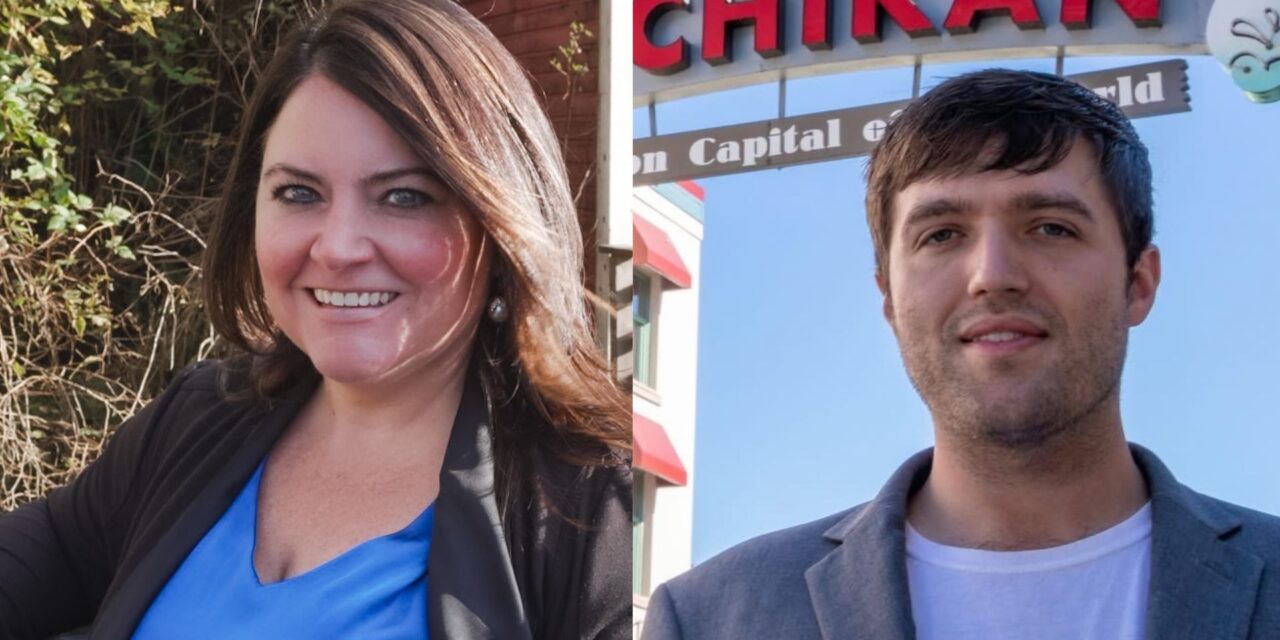
Ketchikan’s city and borough municipal elections are October 7. There are two candidates running for Ketchikan borough mayor.
Although the borough mayor doesn’t technically have voting power, they are responsible for breaking ties, overseeing the borough assembly, and serving as a community and legislative point person.
Current longtime borough assembly members Austin Otos and Jaimie Palmer are running for a 3-year term as mayor. Ahead of the upcoming election, KRBD spoke with both candidates about what their priorities will be if elected.
Who are you and why are you running?
Jaimie Palmer: My name is Jaimie Palmer, and I’m running for borough mayor because I believe that I have the knowledge and skills necessary to advance the needs of the borough at a local, regional, statewide and federal level. I’ve been a leader my whole life and it would be my absolute honor to serve this borough.
Austin Otos: My name is Austin Otos. I am currently on the borough assembly. I’ve been there for six years. What originally got me interested in local government is I saw a lack of younger people that were involved in local government, and most people there were about two or three times my age, so I kind of got involved with that just to spur my interest. A little bit about who I am: I’m born and raised here in Ketchikan. For 31 years I’ve lived here. I work mostly in the hospitality and nonprofit sector. I work at the Inn at Creek Street, and I work for a youth nonprofit called Ketchikan Youth Court. I also dabble in a little bit of tourism. I do some walking tours and whatnot, but mainly just focus on hospitality and tourism. If I do become mayor, and through my candidacy, I’d like to focus on a lot of quality of life issues that I think are important to the community. Without quality of life, I think the well being of the community can struggle. While being on the assembly, I’ve been really focused on recreation, transportation and education.
What differs you from your opponent?
Palmer: There’s quite a bit. I am a mom with two children that attend our local schools. I have a seven year old and a nine year old, and I have a clear and vested interest in their success and the success of their peers. And my mother was a teacher to expand on that, so I really care about the level of education in our community and taking care of the staff and faculty that work within our schools, too. I’m also a commercial property owner and have taken great risks to improve the quality of life of borough residents. But all that to say, Austin is a very nice and smart young man, and I think the community will just have to decide who has the knowledge and skills to advocate and fight for borough interest. And I’ve proven that time and time again.
Otos: I wouldn’t say we have a lot of differences. Me and Jaimie actually have worked really well together on the assembly, we’ve sponsored a lot of action items, and I’m not gonna really disparage her or her views or anything. I think we just have, like, maybe different areas of interest that we want to bring forward if we become mayors. Like I said, a lot of my focus as an assembly member has been recreation, transportation, and education. So those are the kinds of things we may differ on. I think me and her probably, if you break it down, agree with things within those topics, but she might just have a different perspective than I do.
What do you see as the borough mayor’s role in addressing the problems facing our community?
Palmer: We operate with a strong manager form of government, but showing up and being visible is something that’s very, very important, and engaging with the citizenry, understanding the current trends of what’s happening, what’s needed, what obstacles are in the way, and helping to provide direction to the staff and assembly. And I think that’s something I can do really well through my business experience. And yeah, sometimes as an assembly, we make mistakes right now, but we can always course correct and make things better and advance the goals of the borough.
Otos: The mayor is really kind of the community figurehead. Since we have a weak form of mayor, one that can’t vote, unlike some communities, our mayor can only veto things, and he can only break ties. So really, the mayor is kind of the point person in the community for any issues, but also they really run meetings. They collaborate with community partners, and they do a lot of traveling for advocacy work. So a lot of the mayor’s time is taken up by running the meetings. And it’s important that we have a mayor that runs an efficient and good meeting.
If elected, what will be your biggest priority in office?
Palmer: So I’m a talker, and so I’ve noticed that a lot of my campaign, it just always goes back to the word ‘connection.’ And so with that, it can mean a million different things, right? So connection to Prince Rupert. I would love to advocate more and make sure that we can figure it out. Then connection to Gravina. It seems like all the plans that were developed for over there just were put on a bookshelf. And it’s like, okay, it’s time to dust this off. We have flat land over there that’s developable. And so the other piece of the connection would be connection for our citizens, because people are always looking for healthy outlets and ways to just engage and be with people. It’s especially more and more important when we live in the rainforest. A lot of the connection for citizens is showing up in the community and listening and understanding, because I’m always thinking of ways to help grow and foster these relationships and connections and grow our community.
Otos: I think to just continue to advocate for those three things that I had addressed [recreation, transportation and education]. There’s a lot more meat to that, but a lot of the priorities, I think, are quality of life, because I think those are what makes a good community, some infrastructure projects that we have coming down the line, and then lastly, education. With all this redistricting and whatnot last year and the kind of breakdown in communications with district leadership, I think it’s important that the mayor is a point point person and point contact for a lot of the issues that are are surrounding the school district,
Homelessness, housing and cruise tourism were major focuses of the borough in the last year. Could you pick one of those issues and discuss how you would hope to address it during your term?
Palmer: So all of the topics are equally important, but I think because most people associate me with tourism and consider me the token tourism lady, that’s probably the best plot to focus on. So just because I came here in 2009 to work one season in tourism, I ended up staying. You know, I stuck around. I now have taken great risks in this community. But what I see with tourism is that while the borough did the tourism strategy plan, we can still do a better job. Like there was a 2023 Newtown District plan that was done that never came to the borough assembly, so we never adopted it. And so this is a section of town where it should be as robust as Creek Street. It should be lively and thriving, because the history in that little section is just as crazy as Creek Street. And so there’s so much opportunity here. And what I’d like to do is dust off that document, because it’s only from 2023, and begin to utilize it now. Because if we do these things in stride with the DOT work that’s coming in that chunk of town — there’s a huge viaduct project that’s coming, and Newtown businesses are going to be faced with fencing and it just gets messy. And another thing with cruise ship tourism, which is huge: why isn’t our borough transit system also operating water transit? You know, we are island people, and so pretty much any port community around the world that has robust tourism like this has hop on, hop off ferry systems, and it’s just a means of getting around and avoiding congestion on the highway. So that’s a topic that I want to continue to push for. We need to find the balance with cruise ship tourism, and it’s really just through a lot of conversations, a lot of community listening and proper planning.
Otos: I think housing is kind of the main issue in the community. Both of those things that you said, homelessness and tourism, hinge on housing and whether we have it or not. If you don’t have the housing for the workforce in tourism, you’re not going to have tourism. You need workers to stay places. And the inaccessible, the lack of access and unaffordability of housing, you know, puts people on the streets. So those two things hinge on housing. So we have a lot of land that is accessible to us, that’s public borough land, but we want to use this infrastructure money to develop a lot of those plots, you know, water, sewer, roads, basic utilities, electricity and stuff like that. So we definitely have money to do it. It’s just the scope of these projects is a long time. You know, the public process takes a long time, hundreds of acres that you have to develop and log. So the topography and our geography is not conducive to building homes around here. But yeah. So the KGB can sell a lot of its land, but it needs to be targeted. If you just sold off all of our land all at once, that doesn’t really help the housing situation. You have to pick areas that make sense, that are connected to the public transportation system, that are near schools, that are somewhere near the road system, or near utilities. So that’s what I mean by targeted land sales.