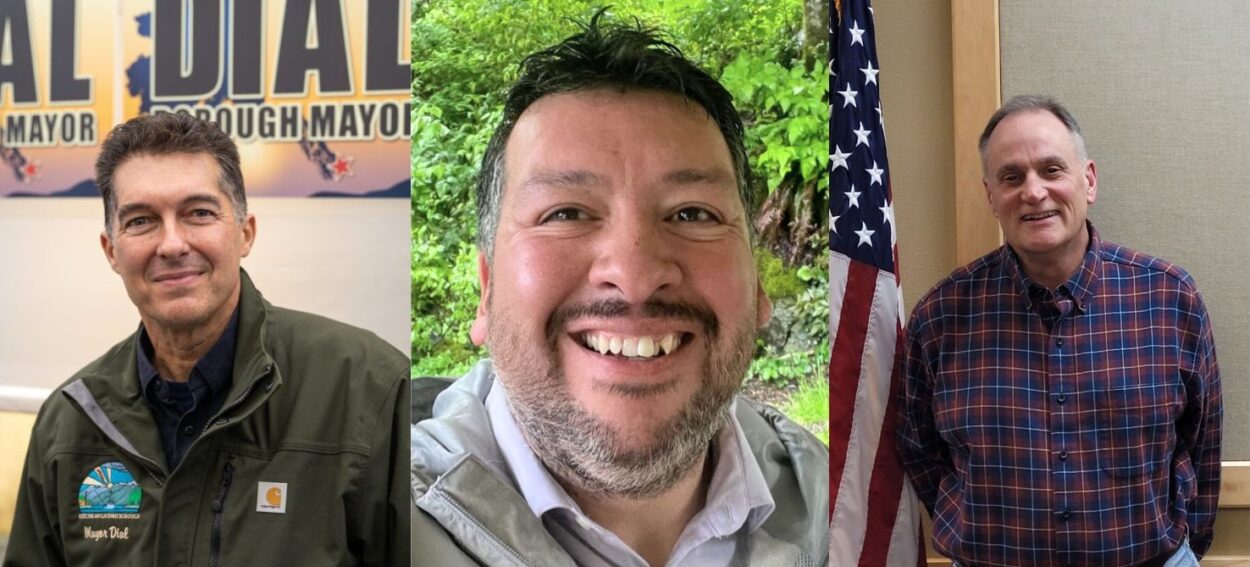
Ketchikan’s city and borough municipal elections are October 7. Three candidates are vying for two, 3-year terms on the Ketchikan Gateway Borough Assembly.
The borough assembly serves as the legislative power of the borough, and is responsible for voting on action items and establishing policy for the borough. The assembly also serves as the borough’s Board of Equalization and Board of Adjustment.
KRBD spoke with candidates Rodney Dial, Grant EchoHawk and Glen Thompson about their experience and priorities if elected to office.
Who are you and why are you running for borough assembly?
Rodney Dial: My name is Rodney Dial. I’m a lifelong Alaskan, lived in Ketchikan the majority of my life, and I’m running for borough assembly to build upon the success that we’ve seen over the last six years. We’re real close on a lot of our major policy issues, and it’d just be a shame to really kind of lose that momentum.
Grant EchoHawk: My name is Grant EchoHawk. I was born in Fairbanks, raised in Metlakatla. Traveled down south for a little while. I moved back in 2018 and this will be my second term if elected. I originally ran for office because I felt that my life experience, and my work experience, my travels, had given me some things that I was hoping to give back to the community. I actually started at the nonprofit space here at KRBD, did a couple of radio shows, was on the board for a little while, worked with other nonprofits, and I thought, “Well, seems like the most efficient way to go. Just get into public office and be able to serve my community that way.” So I gave that a try. I was elected in 2021 to the borough assembly, enjoyed it so much that I decided to run for state house. That was my first run for my first attempt at state house, and now that that’s all settled, and I kind of got all of my work and my other commitments all lined back up again, I’m like, “Okay, well, I still enjoy public service. I still enjoy serving the community.” So if the community saw things I did well the first time, let’s see if I can have another chance at helping out where I can, and contributing to the discourse and moving projects along for the community.
Glen Thompson: I’m the long-serving borough assembly member from way back. Been here in Ketchikan for about 38 years. Former businessman, semi-retired entrepreneur. I used to run the local garbage company. Actually ran regional garbage companies all throughout Southeast Alaska, went to work for the folks redeveloping the pulp mill. Retired from that. I’ve done a whole bunch of different things in the community, and have been on the borough assembly. This will be, if I get elected, term number six. So I’ve been there for a while.
How do you differ from the other candidates?
Rodney Dial: I think the main difference is just experience and the number of federal and state committee assignments I’ve been able to obtain. A lot of those require years of competing against literally thousands of people across the country. So I’m on the National Public Lands [Policy] Steering Committee, the Rural Action Caucus, the Justice and Public Safety [Policy Steering] Committee, got a voting position in the National Organization of Counties and many, many others. Those are very critical, because they allow me to help craft legislation that will actually help us resolve some of our policy issues.
Grant EchoHawk: I think I can go on what feedback I’ve received. I don’t know if it necessarily would differ greatly, but feedback I’ve received consistently is that I listened to people’s points of views and people’s perspective with the intent of understanding and making decisions based on the data that I receive. I’ve also received feedback about my willingness to reconsider my own position if I receive new information. And I think that in the political landscape, that’s just really important. I personally think that there are no saviors in government, that we have servants of the people, and within our communities, we have experts in a lot of different fields. There’s certainly knowledge that I have, but my knowledge is limited to my life experiences. It’s limited to things I’ve personally learned about. I can say pretty confidently that I work really hard to keep my own personal ideology out of my decision making. Similar to anybody else that does a job, when you hire somebody to do a job, whether it’s a contractor or a medical professional, you’re expecting that they’re going to do the best possible job, regardless of where they land on the political spectrum. And that’s the same thing with elected officials. It shouldn’t matter where we land on a political spectrum. It should be, are we making the right decisions for the community?
Glen Thompson: My focus is on business and finance. When I first got on the assembly, the finances were not in good shape. We had the Schoenbar remodel, which basically turned into almost a complete rebuild. And that was about $13 million over budget, and we started from that circumstance. And when I left the borough circa 2015, 2016, we managed to turn things around to where we had reserves upwards of $15-20 million, and we’ve been doing pretty well ever since.
What do you see as your role in addressing the problems facing our community?
Rodney Dial: Well, I think most people would really like us to do more than just talk about our issues, to actually solve them. And fortunately and unfortunately, to really solve a lot of our issues, it just takes that amount of time to really get into those key leadership positions so that you can advance borough issues when you’re competing against cities and counties from all across the country for the same pot of money. And it’s even more critical now, you know, when we see DOGE and we see the efforts on the state level to cut back on grant funding and these things, we just really have to fight for our fair share.
Grant EchoHawk: I think the big role is that making sure that whatever issues that may come up, is that I look at the data, I look at the information. I look at the things that are going to inform my decision, inform my vote, to make sure that I’m not leading myself or the community down a path that may appear to be, on the onset, a good decision, but have unintended consequences down the road. That only comes from legitimate fact finding. And I think a really important role in government is to never stifle discourse, to allow people to voice their opinion. So, making sure that every community member knows that their voice as a member of the ruling authority of the Ketchikan Gateway Borough is the most important voice in the room, and encourage people to use their voice of all walks of life and all segments of our community, since our community is great and everybody contributes to that.
Glen Thompson: I look at the books. I look at what our first priority as a borough is to fund our schools. And so I was one of the people that put together the local education fund back in, I think was 2015, and we continually had issues with the school board over how much funding they were going to get every year. And there was so much, as you probably have seen in the last few years, there’s so much uncertainty with what the state was doing. And then we had the added issue of how much was the borough going to add to that. And so what we determined was that since we were already spending more than property tax on schools every year, we should just dedicate the property taxes directly to a fund and then, the school district would have a pretty clear idea of how much money was going to be available to them in the following year based on what the property taxes were. And so school funding is going to be a real issue going forward for the next couple of years to figure out how we make sure that we have enough money going into the bucket so we have enough money to go out if we need to. You know, as we try to fund the cap on schools, everything else beyond that, and we’re required under the borough to do school funding, planning and zoning and tax collection, those are the three things under statute. Everything else is optional. It’s all elective. And we’ve elected to do a lot. We do recreation, we do transportation, we do animal care, we run the airport. We do a whole bunch of different things, but those things all are secondary. So as we go forward, and we face a huge amount of inflation going forward in our expenses, our revenues, we either have to keep up with that or we have to figure out how to prioritize things. And so that’s where I come in with my background in business and finance.
If elected, what will be your biggest priority in office?
Rodney Dial: My biggest priority is to continue with our advocacy efforts. We’ve been extremely successful. We’ve got 14 housing units in Saxman right now, and the only reason those units are coming online is because we were able to get $4.5 million from the state, and we competed against other communities across the state to get that money. So that’s an example. A $100 million expansion at the airport is another example, and that’s being funded entirely with outside money. We’re not using local tax money for it. So the advocacy just is extremely important, because it has that ability to help us in so many different areas and really address our policy issues.
Grant EchoHawk: I think I’m concerned about the local education fund and general revenue. The last time I was on the borough assembly, I think we had a conversation about adjusting the tax cap. And I think that it’s worthwhile to take another look at it, at least look into a way to possibly generate more revenue with minimal impact on the community and allow us to be able to do more for the community. I dug into it a little bit once I decided to run up for office again. And it still appears that folks visiting our community seem to disproportionately benefit from the tax cap. And I think that any tax or any tax subsidy that is within the community should disproportionately benefit the community at large.
Glen Thompson: Figuring out how to fund our schools. That’s the number one job we have. We right now, in my round numbers estimation, are about $2 million short per year for funding schools, and so we need to find additional revenue sources. Now there’s a couple places we can go. Just recently, we removed an exemption from the transient occupancy tax for people outside the city, and that staff estimates we could raise about $600,000 a year on that tax that’s paid predominantly by folks from out of town. So it’s not going to hit locals. There is a lot of pushback from some of the folks in that business sector, saying, you know, “Why are you taxing us more?” But that was an exemption that was removed, and so that’s a help. We also get payment in lieu of taxes from the federal government and other non taxable government and non government organizations who have exempt property tax, and instead of paying property tax, they pay us a payment in lieu of taxes that currently goes into our general fund. It’s property taxes we may look at putting that into the education fund. The problem with that is, if you take it out of the general fund, we’re not having enough money in there to fund the other things that we do. So it’s like a balloon. You push on one side and the other side adjusts. So there’s that. We may have to look at some revenue sources. Obviously, we could raise the mill rate, which we are loath to do, but that’s one option that we have. We have a recreation sales tax fund that goes to pay off things like our pool and our ball fields and all that. So we only have about one and a half percent of sales tax that goes to funding all of our operations, generally, and again, we try not to raise that. That has to go to the voters if we do. But there’s some things there that we could be taking a look at as well.
Hunter Morrison is a Report for America corps member for KRBD. Your donation to match our RFA grant helps keep him writing stories like this one. Please consider making a tax-deductible contribution.