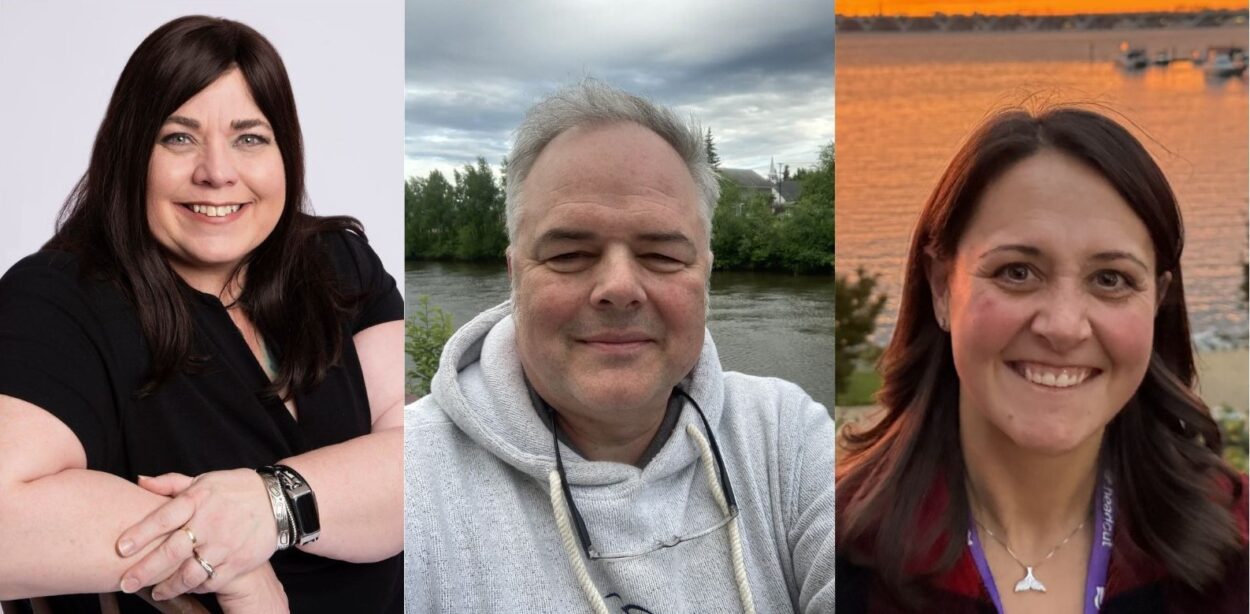
Ketchikan’s city and borough municipal elections are October 7. Three candidates are vying for two, 3-year terms on the Ketchikan City Council.
The city council serves as the city’s legislative power, and is responsible for creating city ordinances and approving budget items. It’s made up of a mayor and seven councilmembers.
KRBD spoke with candidates Janalee Gage, Robb Arnold and Abby Bradberry about their experience and priorities if elected to office.
Who are you and why are you running for city council?
Janalee Gage: I’m a fifth generation Ketchikanite, born and raised here. The first time I ran was in 2015, and I sat on the city council until 2024. I termed out, and now I’m here. I took a year off pretty much, and here I am again.
Robb Arnold: My name is Robb Arnold, and I’ve lived here in Alaska for the last 25 years. I’m involved in local politics. I volunteer at my church. I also have a spot on the planning board. I came here in the 90s to be a logger quite a while ago, but I fell in love with Alaska. So I’ve been a state employee for almost 20 years, working for the Alaska Marine Highway System. My biggest thing is being on the planning board. I see the housing situation, I see infrastructure issues, and I see all these issues that Ketchikan has, and it’s gonna cost quite a bit of money. The reason I wanted to run was so that I could speak up, and I want a sustainable budget that reflects a reasonable way that we can pay for everything that’s coming up. We’re about $11 million, $12 million in bond debt right now, and we’re actually about $100 million in debt, but it’s spread out in other ways. So my whole focus is to be on the council so that I can provide some insight and some leadership on the budget side.
Abby Bradberry: My name is Abby Bradberry. I’ve called Ketchikan home for the past 13 years. I previously served a full three-year term on the city council, and was honored to be appointed again this past March to fill a vacant seat. Over the last six months, I’ve had the privilege of working with the current council, and I’m encouraged by how well we are collaborating to find the best solutions for our community. One of the most important lessons I’ve learned in public service is that the service of an issue rarely tells the whole story. I’ve been working on making it a habit to dig deeper, researching thoroughly, listening to differing perspectives and striving to understand the full picture before making that decision. This year, I’m running for city council because I want to continue contributing to positive, practical solutions that strengthen our community. Ketchikan is facing challenges that require collaboration, creativity and clear commitment to ensuring our essential services remain strong.
How do you differ from the other candidates?
Gage: I would say because I’ve been here. I’m 59 years old. I grew up here. I speak my mind, not to say that none of them don’t. They do too. My clear objective is to make sure that everyone in our community is acknowledged. I stand up for a lot of things when it comes to accessibility, from disabilities to housing. I work in public assistance arenas, so I see what low wages do to our community members. I was the one that brought the anti-discrimination ordinance for the LGBTQ community and got it passed. We are one of three communities in the state of Alaska that have an anti-discrimination ordinance that includes people of the LGBTQ community, but it also shored up one paragraph that was like three lines for all the other minorities. I guess that would also make me differ from other candidates to some degree.
Arnold: Well, the other two candidates have been on the city council, and I think that they’ve done some good things. But also, we need somebody that’s going to be watching out for the budget and our residents with spending, because I know that a lot of families are squeezing their pennies together because they can’t afford groceries. Then they have to pay sales tax, and all these things are adding up. So I’m concerned about working families. I’m concerned about mental health. We need better mental health facilities and counselors. There’s a lot of things that we need, but we really need to look out for each other.
Bradberry: All three of us are extremely different. We have three different backgrounds. I spend my days running a business in tourism, and that gives me a little bit of a different background per se. The other two, they’ve dealt with more state entities or non-profit entities than I have, so I kind of bring that business-like mentality to budgeting and solutions, compromising and collaboration.
What do you see as your role in addressing the problems facing our community?
Gage: My role is to make sure that I speak up when I need to speak up. I know that sometimes we believe that in government, it’s not our place, but really it is. Our place is to make sure that our community members that live here year-round are taken care of and that they’re heard. That they’re not just dusted off for tourism and seasonal. I mean, all the things that go into that, the rising cost of housing rentals, although we can’t control it, we can take a good, hard look at it. I am all for free enterprise, but when it impacts the community to the point where we forget that our economic value is also in our members that live here, then we are cutting our nose off despite our face.
Arnold: My role, I believe, is as a community leader, to speak up and give the real picture of where things are at, so that people aren’t shocked when they get their bills in the mail and they go, “Oh, wow. My utility rates have gone up. Why?” And then, “Oh, wow. My property taxes just went up. Oh, last year they assessed.” Assessments rose by 8%, so you’re paying $250 more. Plus they raised the fees on the boat harbor, so you’re paying an extra $500 if you got a little small boat that you want to go out. And so that hits people really hard. But then we have all these infrastructure issues that have to be dealt with, too. So what are we going to do? So I have some ideas.
Bradberry: The number one rule would be, you have to listen and you have to research. I don’t think anyone sitting on the council knows exactly the right solution or is even fluent in whatever that solution is, but you have to take that energy and effort to go find those people that are [fluent], and see how you can leverage from the city side to help support their mission. So a good example is like the [Mobile Integrated Health] program with the fire department. The wellness coalition kind of headed that up. But they said, “City, we need somebody to run this, or to run this through the channels to get funding or whatnot staffing. And so I took the lead on the council there to bring those ordinances, questions and job positions forward to ensure that they were able to complete that issue. So I feel like city council is kind of more of a support role to citizens and staff to try to make an improvement.
If elected, what will be your biggest priority in office?
Gage: Part of it will be the housing issue, which is the rise in rent. Per income, it’s gotten to the point where it’s about 26% from when it was. So in 2018, rent for a two bedroom was like $1100, $1400 a month. [Now] we’re looking at $2500 a month, and wages haven’t changed. When you look at the borough website for a wage, what a person would need to make to live here, and a single mother with one child needs to make $36 an hour. Which is not reasonable, but that’s the only way you can afford housing, the bare minimum. So housing, utilities and food. No transportation, nothing fancy, no extras, no movies. No activities other than just survival. When we’re looking at that, then we’re also not putting money into our economy.
Arnold: Like I said, the budget is going to be my number one priority. A sustainable budget that works for you and works for us without raising taxes or fees. And my other number one goal is that I think that we have to have fire and police. That’s a safety issue. Right now, I think that we need to retain our firemen and policemen. If you look at the budget overall, 23% of it’s going to the police and the fire department in a normal town our size. Thirty percent should go to the fire and police. So, I think that we need to really put some more money into our police and fire departments to keep good people in these jobs for public safety.
Bradberry: First and foremost, there are so many problems going on in the city, and there’s no way in my three-year term we could tackle all of them or find a solution for all of them. My three main priorities to narrow it down to something obtainable in my three years is collaborative resource management. Working with other agencies: tribals, organizations, nonprofits, state, federal government, to try to bring in funds to help offset the cost for citizens. And that could be for anything. It could be a minor project. It could be a large infrastructure project. But with our budget problems that we have, we have to work together with everybody to be able to make that solution. Not one entity is big enough to do that. My second one is being creative on the budget. Looking to see, can we change how we’ve done something in the past to make it more efficient? To really allow for the funds to either go further in that department, or they could go somewhere else to a critical infrastructure problem that we need to get fixed. And then the third one is making sure our essential services are healthy, stable and reliable. Our electric division, our water, our sewer, the three main things for all of us to be here and to continue and be safe. And then public safety, following behind that, to make sure that we have those services to be able to help the citizens.
Hunter Morrison is a Report for America corps member for KRBD. Your donation to match our RFA grant helps keep him writing stories like this one. Please consider making a tax-deductible contribution.