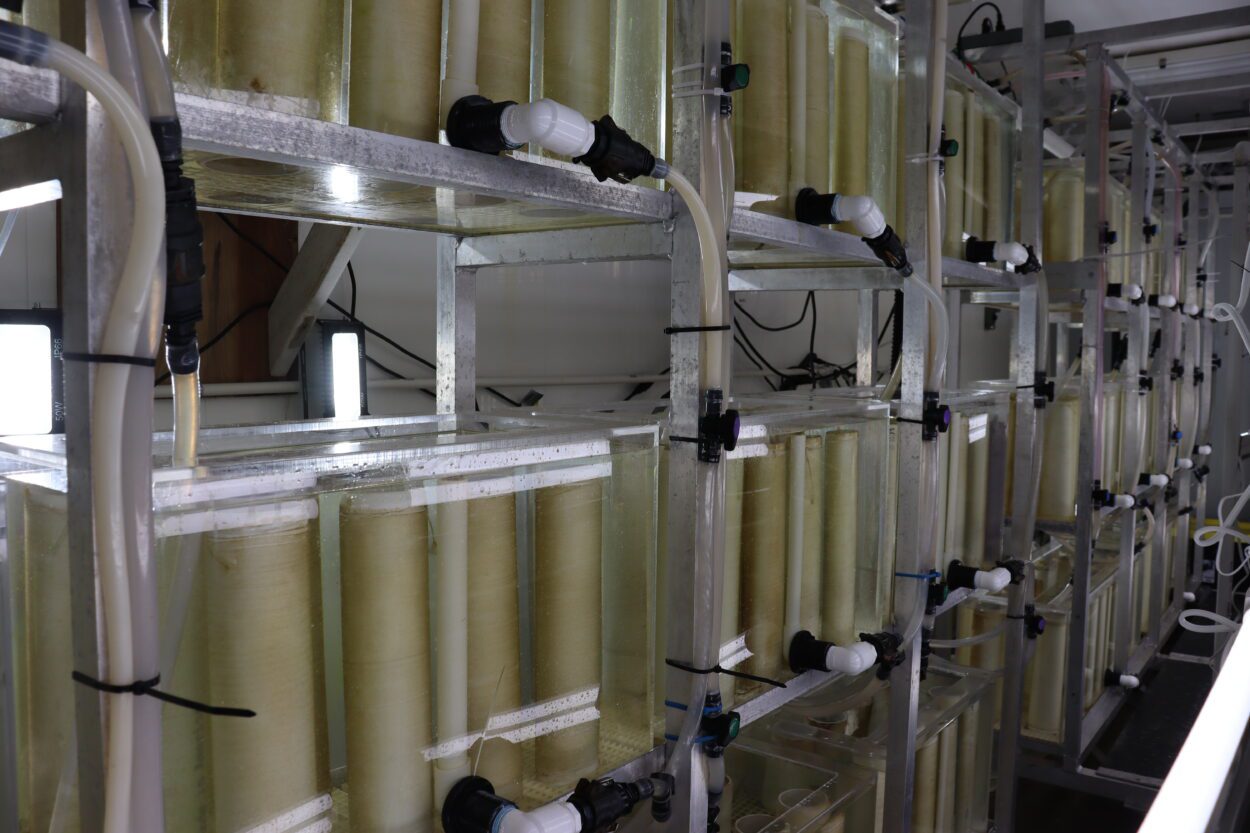
It’s a warm and sunny October day along the shoreline of the Tongass Narrows. Markos Scheer walks down a boardwalk and into a warehouse, where the air feels like the inside of a refrigerator.
He points to a row of PVC pipes submerged in tanks of water. A fabric-like substance is spooled around them.
“That’s all growing sugar kelp,” Scheer explained.
The operation is run by Scheer’s company – Premium Aquatics, LLC. He says they run the only commercial kelp seed hatchery in Southeast Alaska.
“It is essential to any seaweed farming operation,” Scheer said. “Without seed, there is no operation.”
Right now, Premium Aquatics’ seed hatchery produces about 200,000 feet of juvenile kelp for its hundred-acre farm just south of Craig on Prince of Wales Island. But they’re looking to triple that output to service southern Southeast’s burgeoning kelp industry. There’s about 20 pending kelp farm permits in the region.
So, business development group Grow Ketchikan stepped up. The non-profit is applying, on Premium Aquatics’ behalf, for a $692,000 equipment grant through the Alaska Mariculture Cluster to build another kelp seed hatchery at the company’s headquarters. Half of that money would also help the company expand its commercial oyster seed hatchery, which is the only one in southern Southeast Alaska.
“It’s a clean, environmentally friendly thing to do,” said Grow Ketchikan Executive Director Deborah Hayden. She says the grant not only boosts the region’s kelp industry, but invests in its future.
“There’s no reason not to, especially since we have more coastline than any other place in the United States,” Hayden said. “So, it makes sense.”
Last month, she urged the Ketchikan City Council to write a letter of support for the grant application. That was met with unanimous support from council members and the mayor.
Other entities, like the Ketchikan Gateway Borough Assembly and the Metlakatla Indian Community, also drafted letters of support.
“We support mariculture because it brings another avenue for commerce to the community,” said Ketchikan City Mayor Robert Sivertsen. “It provides jobs, uses local shipping and handling and stuff in order to move these things to market. So, I think what we look at is it’s another job in the community of Ketchikan.”
Hatcheries around Alaska have received similar equipment funding from the Alaska Mariculture Cluster in recent years. The Chugach Regional Resources Commission, which runs a shellfish and kelp seed hatchery in Seward, was awarded a slice of a $2.2 million grant last year to expand its seed supply. And the Prince William Sound Science Center, in Cordova, also received money for a seaweed nursery expansion.
But kelp and oysters have more than just economic benefits. They can store carbon, capturing greenhouse gases from the atmosphere. And kelp can work as a natural buffer against storms, and can even be used as a natural alternative to plastic.
Deborah Hayden, with Grow Ketchikan, says she uses a kelp-based face cream regularly.
“Kelp is such an amazing substance, product, plant,” Hayden said. “It has an almost infinite number of uses. It’s nutritional. It’s fertilizer. It’s animal feed. It’s thickener in ice cream. Wherever you see the word carrageenan, that’s kelp.”
“It’s just amazing,” Hayden added.
Hayden says she’ll know if Grow Ketchikan, and Premium Aquatics, will be awarded the mariculture equipment grant by February. Scheer, with Premium Aquatics, says the grant would also help his mariculture company produce oyster seeds on a commercial level. The company currently runs the only oyster seed hatchery in southern Southeast Alaska.
A previous version of this article inaccurately reported that the $692,000 mariculture equipment grant is being offered by the Alaska Mariculture Alliance. It is being offered by the Alaska Mariculture Cluster. This article’s headline was updated to accurately report that Premium Aquatics, LLC would also use the grant money for oyster seed hatchery improvements, if it’s awarded to the company.
Hunter Morrison is a Report for America corps member for KRBD. Your donation to match our RFA grant helps keep him writing stories like this one. Please consider making a tax-deductible contribution.