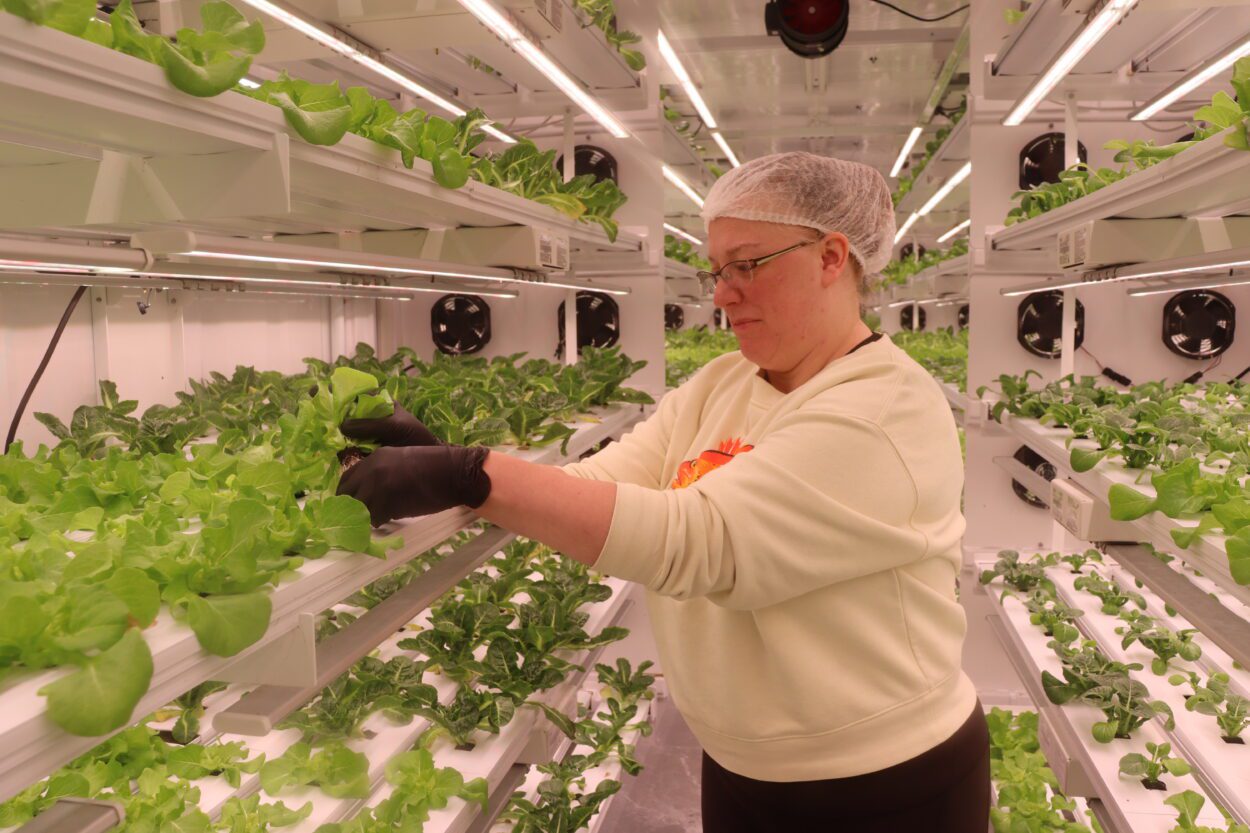
Jennifer Tucker stands between rows of romaine lettuce she grew inside of a climate-controlled shipping container. She grabs a bundle by the head and gives it a pull.
“So these will be harvested on Monday, and they will double in size between Friday and Monday,” Tucker explained.
Tucker is offering free greens to Ketchikan’s SNAP recipients and furloughed federal workers. She posted the offer to the Facebook page for her hydroponic company, Outpost Agriculture, and she’s seen about a half-dozen takers so far.
“We have no control over this. This gives me a little control,” Tucker said. “It just feels like I’m trying to bring a little bit of light during a pretty dark time.”
According to the U.S. Census Bureau, about 1 in 7 of Ketchikan Gateway Borough residents rely on SNAP benefits to meet food needs. That’s more than Juneau, Wrangell and Petersburg. But despite a federal court ordering the Trump administration to fully fund SNAP benefits for November and a disaster declaration to free up state money, the program’s Ketchikan recipients still haven’t had their electronic benefits cards refilled in full.
And it’s not just the borough’s SNAP recipients that are dealing with the consequences of the government shutdown. Numerous Forest Service employees have been furloughed. And the region’s TSA and air traffic control workers have been working without pay.
So around Halloween, Tucker donated five cases of lettuce to those roughly 30 employees.
“As much as I can, I’m going to give to people who normally have their budgets covered, and now, through no fault of their own, their budgets are not covered,” Tucker said.
Other businesses are also helping. Nicole Tubei is the owner of Wolf Point Produce, which sells boxes of seasonal fruits and vegetables.
A few weeks back, Tubei says one of her regular customers, a single mother, couldn’t afford to purchase a produce box. So the company launched its “single mom” campaign, allowing other customers to purchase boxes for single moms who can’t afford them. That eventually evolved to furloughed workers and SNAP beneficiaries.
In the last few weeks, Tubei says about 40 charity produce boxes have been distributed.
“So I hope I’m putting a smile on these people’s faces that are working for free and not getting paid, or they’re trying to figure out how to provide for their family,” Tubei said. “They get something that maybe you would consider a luxury or something special.”
A few Ketchikan faith-based organizations that host food drives say they expect, or have already seen, a slight uptick in clients since the shutdown began last month.
Jackie Yates, president of the Ketchikan Wellness Coalition, says several organizations on the island have been fighting food insecurity for years. And churches, nonprofits and businesses are all working together to meet that need during an emergency.
“I think what I have seen is what Ketchikan is famous for, and it is a bunch of people trying to come together to solve a community problem,” Yates said.
Yates wants people to know that it’s not shameful to ask for help. She’s seeing pushback from people who aren’t homeless or usually food insecure, but the lack of SNAP benefits puts them in a tough spot.
“Normally, they’re able to make it, but with the lack of these SNAP benefits that middle tier group, they’re now in a struggling standpoint,” Yates said.
There are food banks and free meals at staggered times across the community, and Ketchikan Wellness has consolidated the offerings into one list.
Yates urges furloughed workers to ask for help with other expenses during the shutdown, too. She says that’s a benefit with Ketchikan’s locally owned utilities — they might be willing to work with you to set up extensions or payment plans.
Island to Island Vet Clinic recently started a pet food drive to help pet owners who are furloughed because of the shutdown. So far, 6 bags of pet food and a bag of cat litter have been donated.
For some local businesses like Outpost Agriculture, this isn’t the first time they’ve stepped up when members of the community are in need. When the Wolfe Point landslide cut off the borough’s northern residents to grocery stores in town, the hydroponic farm sold greens and herbs at 90% of their normal price.
Tucker, with Outpost Agriculture, knows the struggle of missed paychecks. Her husband is a federal employee. She says her company’s primary goal isn’t to turn a profit.
“We’re a community farm, that’s the purpose of this place, is to feed people as much as we can,” Tucker said.
Tucker says that Outpost Agriculture normally donates about 20% of its harvests to local organizations and nonprofits. If the government shutdown continues, she expects to increase this amount, even if SNAP benefits are fully restored. The company has already increased the amount of produce it grows.
KRBD’s Sydney Dauphinais contributed to this report.
Hunter Morrison is a Report for America corps member for KRBD. Your donation to match our RFA grant helps keep him writing stories like this one. Please consider making a tax-deductible contribution.