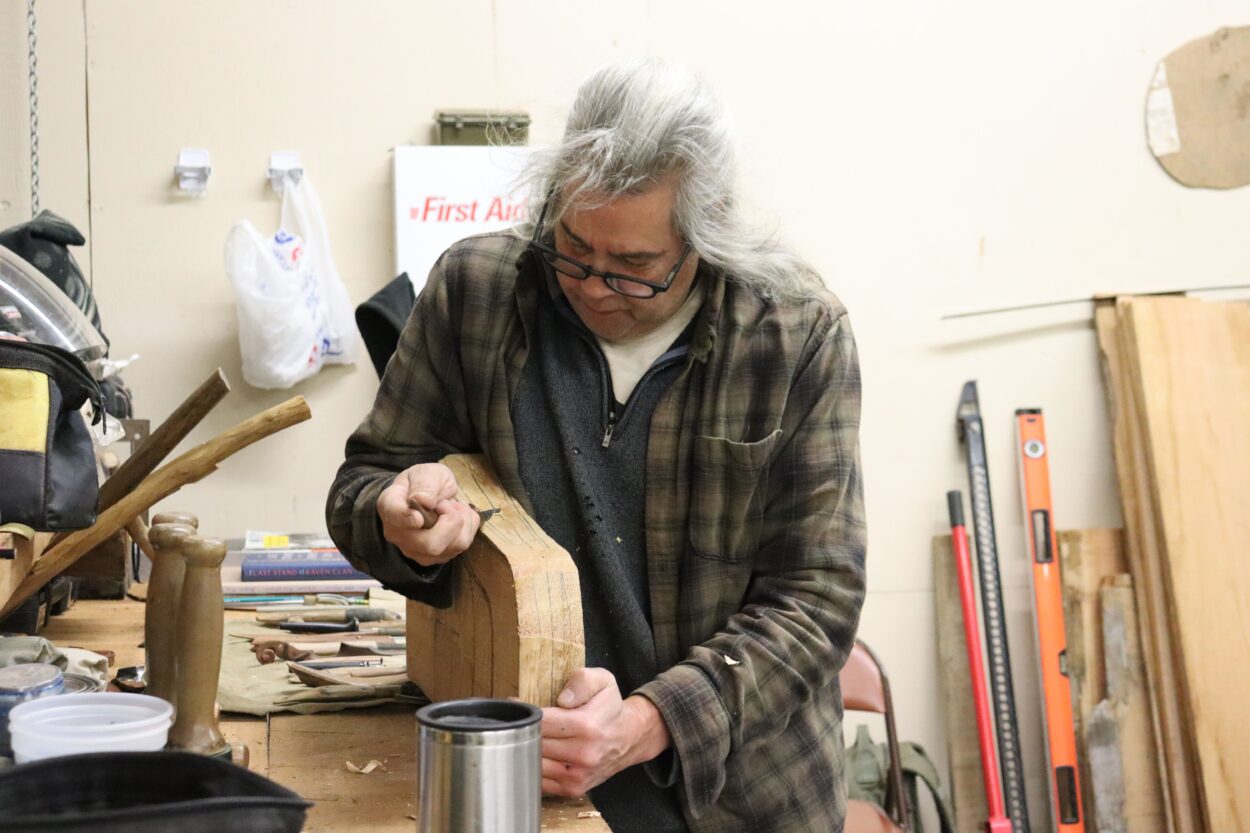
Inside a workshop at Ketchikan’s National Guard Armory last month, Tlingit master carver Tommy Joseph was hard at work. He slowly shaved a block of wood into the shape of a dorsal fin with an oddly shaped knife.
After cracking a joke, he traded the knife for a tool that looked like a sickle but worked like a hammer. Large wood shavings fell to the floor.
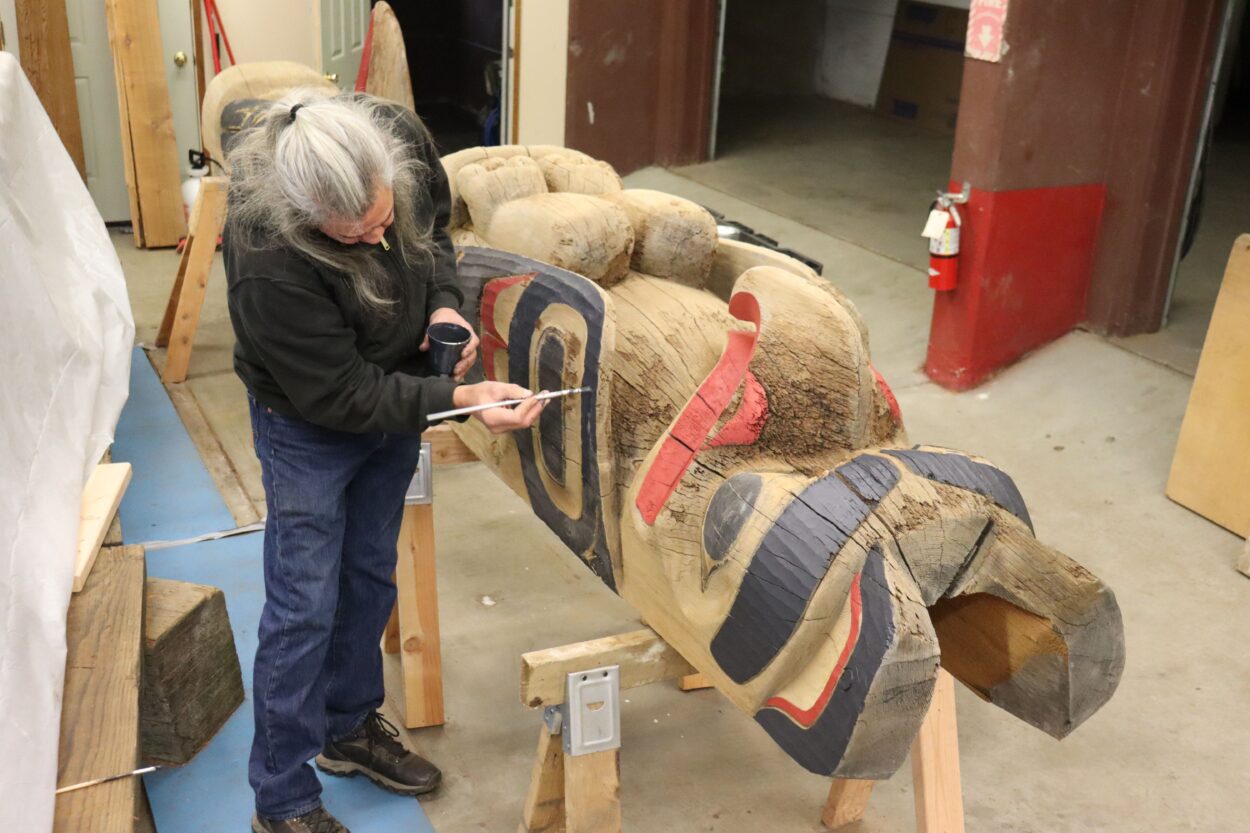
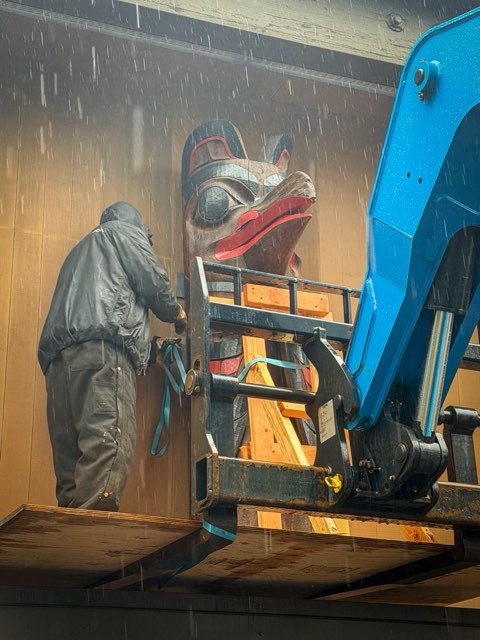
The new dorsal fin was later affixed to the Heritage Center’s Killer Whale house post, which is like a small totem pole. This one has overlooked the museum’s parking lot for about 40 years. It was a small piece of a larger project to restore three of the museum’s house posts.
Historically, house posts were an interior architectural feature that supported the roof of a clan house in southern Southeast Alaska. They’re carved to honor events, clans or tribes. These three are the Eagle, the Raven and the Killer Whale.
Joseph says they were cracked on the outside due to decades of wear. He cut out their cores to prevent further cracking and future rotting. He also painted and resurfaced them.
“It’s time to take care of them, treat them a bit and clean them,” Joseph said. “And hopefully, you can give them lots and lots of life and a future here.”
The three posts were carved in the mid-1980s as part of the Heritage Center’s Native Art Studies Program. Students worked for six months alongside Indigenous master carvers like Dempsey Bob and Freda Diesing to create five posts for the museum’s exterior. Two of those posts, the Wolf and the Bear, have been largely sheltered from the elements under an awning and did not require restoration work.
But like totem poles, house posts traditionally aren’t restored. They’re meant to last the lifespan of a person, about 80 years, then returned to the Earth for decomposition. But these house posts have only been around for about half of that time, and museum staff say they still have life in them.
“They tell the story of the Totem Heritage Center in a way that is not just about the totem poles inside of it,” said Museum Director Samantha Forsko. She says the house posts document the museum’s history and relationships between students and instructors.
“So, that’s why I think it’s so important that we’re restoring right now for the 50th,” Forsko said. “It’s kind of a way to show people that this isn’t just a place where there’s old totem poles.”
Forsko says that’s not all that’s in store for the museum’s 50th anniversary next year. They’re getting a new sign as part of restoration work on the building. And next October, they’ll open a new exhibit that’ll partially highlight those who have taught classes at the Heritage Center.
And that’s kind of full circle for master carver Joseph, as he’s taught numerous classes at the museum. He says he learned from some of the best wood conservators in the country, who have worked on the Liberty Bell and the Martha Washington Log Cabin in Philadelphia.
This is one of a handful of totem restoration projects Joseph has been a part of in Southeast Alaska. He says each one is different from the last.
“I could see that there was vegetation, things growing on these, but not knowing what the inside was,” Joseph said. “Once they’re down, I always describe every one of these jobs like a puzzle. You gotta take it all apart in order to figure out how to put it all back together again.”
The house posts were officially reinstalled at the Totem Heritage Center last Monday.
This story was corrected on Nov. 25 to accurately acknowledge which Indigenous master carvers helped create the Totem Heritage Center’s five house posts.
Hunter Morrison is a Report for America corps member for KRBD. Your donation to match our RFA grant helps keep him writing stories like this one. Please consider making a tax-deductible contribution.