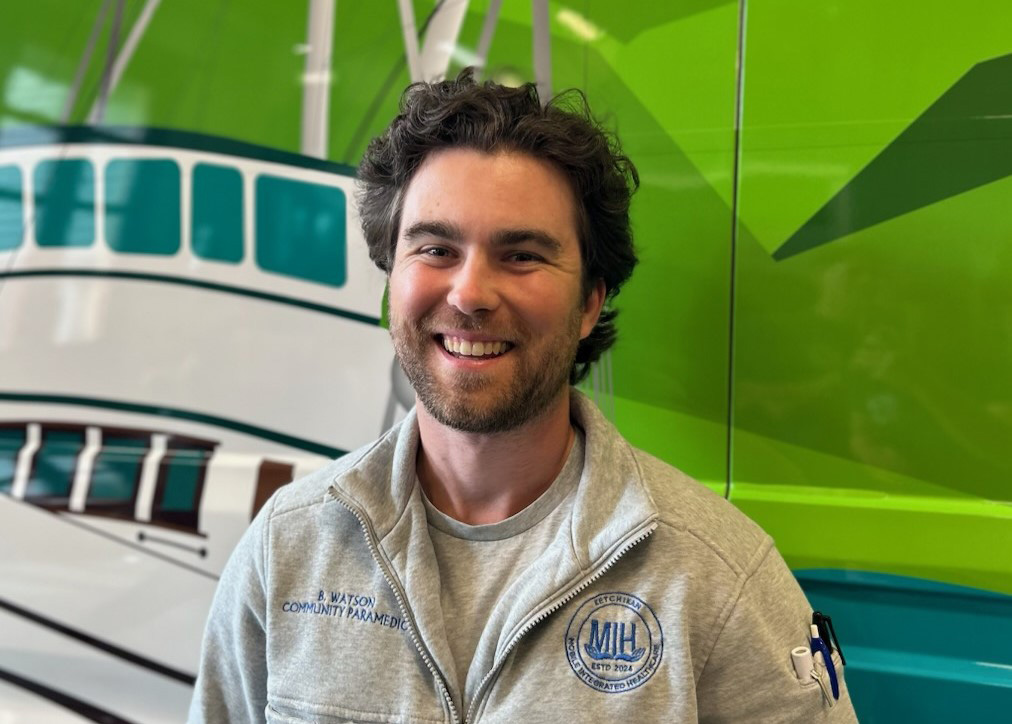
Ketchikan’s mobile integrated healthcare program provides free, on-the-go healthcare. Since it began in June of last year, the program has provided care for over one thousand people.
The National Organization of State Offices of Rural Health awarded one of the paramedics on that team the “Community Star” award — a recognition for individuals providing healthcare in rural places. KRBD spoke with community paramedic Ben Watson about the award and the work it’s taken him to get here.
Note: This interview has been lightly edited for length and clarity.
Sydney Dauphinais: Ben, thanks for coming in. Can you just tell me a little bit about what this award is for?
Ben Watson: Thanks for having me. The [Community Star] award is an annual award that [The National Organization of State Offices of Rural Health] gives out, essentially highlighting individuals and communities across the country. Every state has someone who wins, and it’s highlighting someone whose efforts have been trying to target underserved patient populations in rural environments. Accessing health care in these rural places can sometimes be a challenge. And when you introduce other factors, such as people with cognitive impairments, people who are in underserved patient populations, minorities, even seasonal workers, this adds another layer of complexity to that. So they like to highlight people’s efforts to try to help those individuals.
Dauphinais: So tell me about what you do.
Watson: It’s different every day, which is part of the reason I like it so much. You never really know what you’re going to get yourself into. A lot of what we do I wouldn’t even consider health care. As a paramedic, you think you’re going to be doing a lot of crazy stuff every day. A lot of it is just people skills, talking to people, comforting people, simple things like that. And a lot of what we do ends up being case management. We have a lot of individuals who struggle to navigate the healthcare system. It’s a difficult system to navigate, and there’s complexities to it that people don’t understand. And what we do is we help educate people as to why things are the way they are, how they can better access health care, how they can better talk to their providers to get the answers and the results they want.
We also really, really pride ourselves on effective communication with other community partners and agencies here in town, so we kind of act as a gap fill service. We go to the hospital or KIC or SAIL (Southeast Alaska Independent Living), or any number of organizations that we partner and work with, and we sit down with our patients and really hash out what it is that needs to be accomplished. And then we can go to those organizations and relay that information. That way, it’s just easier for everyone. It’s coming from one place. It’s succinct, it’s highlighting exactly what needs to be done, and it’s just more effective that way.
Dauphinais: That sounds really important. Can you tell me a little bit about the mobile aspect of your work?
Watson: So we work out of the fire department downtown, but we also operate out of a mobile clinic — a van, if you will. It’s a Ford Transit that’s been retrofitted, and it’s got EMT equipment. We’ve got our cardiac monitor. We’ve got medications and all types of things in there that we use to do assessments. We do a lot of wound care, and we can take this van anywhere. It’s really helpful for those people who are unhoused and don’t really have a place to go, people with no insurance, or who can’t get into primary care. We can just get them into our van and kind of do an assessment and see what their needs are.
Dauphinais: If someone wants to access this care from the Mobile Integrated Healthcare Program, what kinds of situations would you say are best for that?
Watson: We try to focus on people with barriers in the way, right? You know, I wouldn’t consider myself someone who I would target for the program. I can talk to my doctor, I can book appointments, I have insurance. I have a good understanding of the healthcare system. There’s not a lot of barriers I have to access healthcare. So when we get referrals to patients like that, typically it’s for things like post-operative procedures, where they may need help understanding how to do proper wound care. Maybe they need help getting and learning about the medications and side effects to look out for that type of thing, but what we really like to focus on are the people who just really struggle to navigate that healthcare system. And so if those people want to get into contact with us, there’s a lot of easy ways. As long as we have the capacity to do it, we’re happy to help.
Dauphinais: So if someone is unhoused, for example, are you doing this care out of your van? Tell me about what this looks like.
Watson: We drive around and if we see people, one of the best things that’s come of this program so far, in my opinion, has been the trust we’ve been able to build with that patient population. They know us. They trust us. They come up to us if they have needs. We’ll drive around, and if we see something we’re a little concerned about, we’ll pull over, stop, ask if they need help with something, and we can address it there.