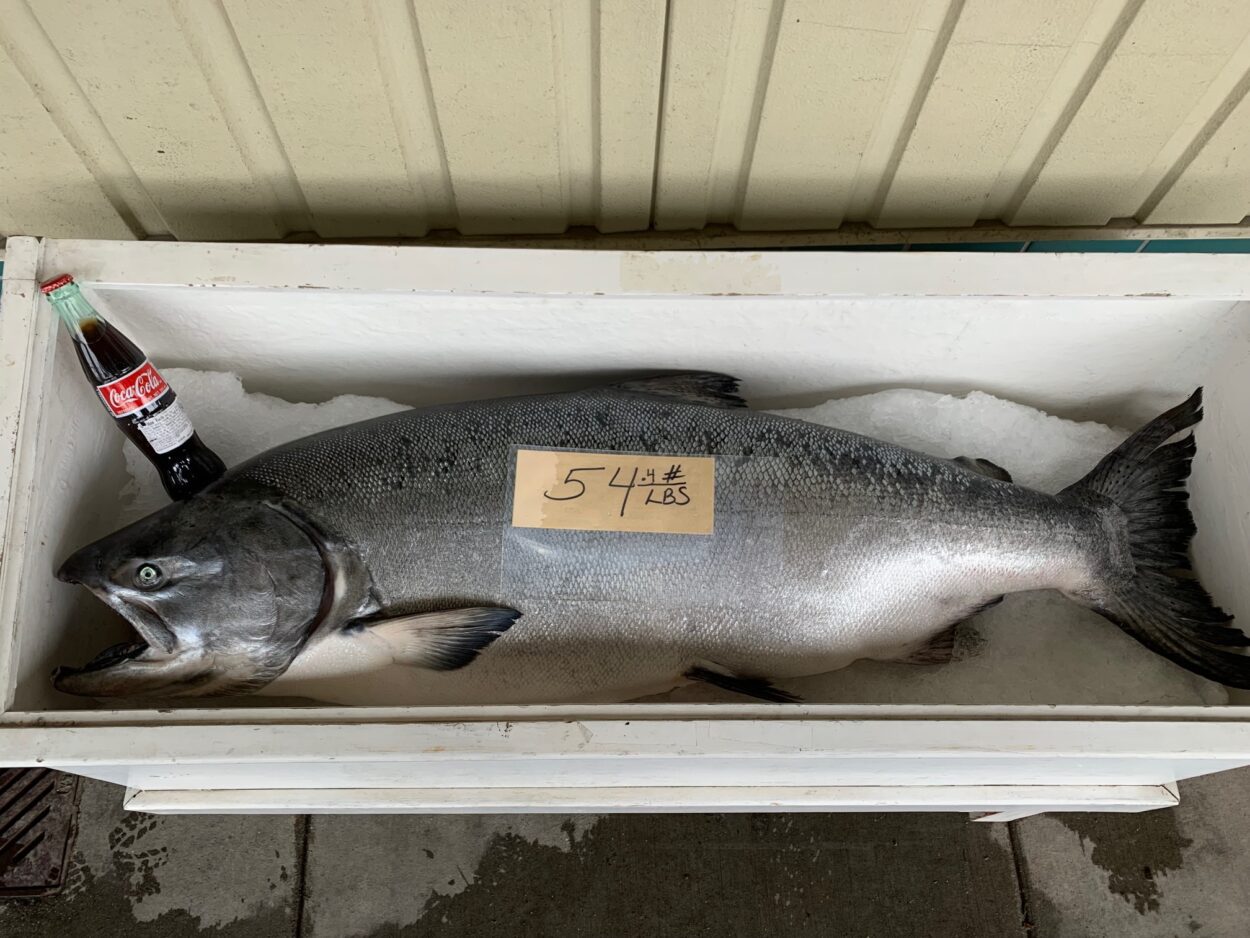
Dwindling king salmon runs have been a concern across Alaska for decades. Researchers and stakeholders have pointed to everything from commercial trawling to climate change as reasons for the species’ decline.
But a recent forecast from the Alaska Department of Fish and Game paints a slightly more optimistic picture. State fishery managers predict Chinook runs this year in Southeast will largely be within their escapement goals – or the number of Chinook that escape the fishery and return to spawn in rivers. Fish and Game’s Southeast Finfish Management Coordinator Troy Thynes said some of this year’s Chinook predictions are higher than last year’s, which is a positive for the fishery.
“We’ve seen some increases in Chinook salmon runs in recent years, which is great,” Thynes said. “Our forecast, at least for northern Southeast, are largely meeting escapement goals for the various systems.”
Forecasts are largely determined by data from past Chinook run sizes and harvest rates. The Southeast forecast looks at five major rivers in the region: the Situk near Yakutat, the Chilkat near Haines, the Taku near Juneau, the Stikine near Wrangell and the Unuk near Ketchikan. Preliminary data suggests that king runs in four of these rivers were higher than predicted in 2025.
But that wasn’t true for the Unuk River, which saw about half the number of forecasted kings last year. State biologists are predicting that Chinook runs in the Unuk will be at the lower bound of the department’s escapement goals this year.
“It’s a million dollar question on what’s going on, but there’s several factors across the salmon life cycle that can contribute to a lower escapement,” said Nathan Frost, a Chinook research biologist with Fish and Game.
Frost said factors like river conditions, food availability and harvest rates can contribute to lower Chinook stocks. But he said changes in Chinook maturity is also a factor.
About a decade ago, the number of six-year-old and five-year-old female Chinook spawners in the Behm Canal region, in southern Southeast, was about 50-50. Now, Frost says five-year-old females make up the majority of spawning Chinook. When those six-year-olds are missing, he said the spawning population relies heavily on the five-year-olds females.
“If that brood year returns poorly, there’s no second age class to buffer the run like we used to have with the six-year-olds,” Frost said. “So this also means that a poor escapement in one year can echo forward and affect a return five years later.”
Just like last year, Frost said Chinook escapements on the Unuk in 2020 were also low.
And it’s not just the Unuk in southern Southeast that didn’t meet its Chinook escapement goals last year. Biologists estimate the Chickamin and Blossom Rivers were in the same boat. And the Keta River’s estimated king escapement last year was the lowest it’s been since 1976.
Thynes said the department is focused on Chinook management for these rivers and those that are forecasted to meet their escapement goals.
“We’re still in a conservation mode for many of these stocks, as far as taking management restrictions, restricting our fisheries and keeping the harvest rates low,” Thynes said.
Thynes said research, like tagging projects and surveys, is ongoing to better understand Chinook survival throughout Southeast. He says more knowledge about the species, and their escapement data can better inform management practices in the region.
Hunter Morrison is a Report for America corps member for KRBD. Your donation to match our RFA grant helps keep him writing stories like this one. Please consider making a tax-deductible contribution.