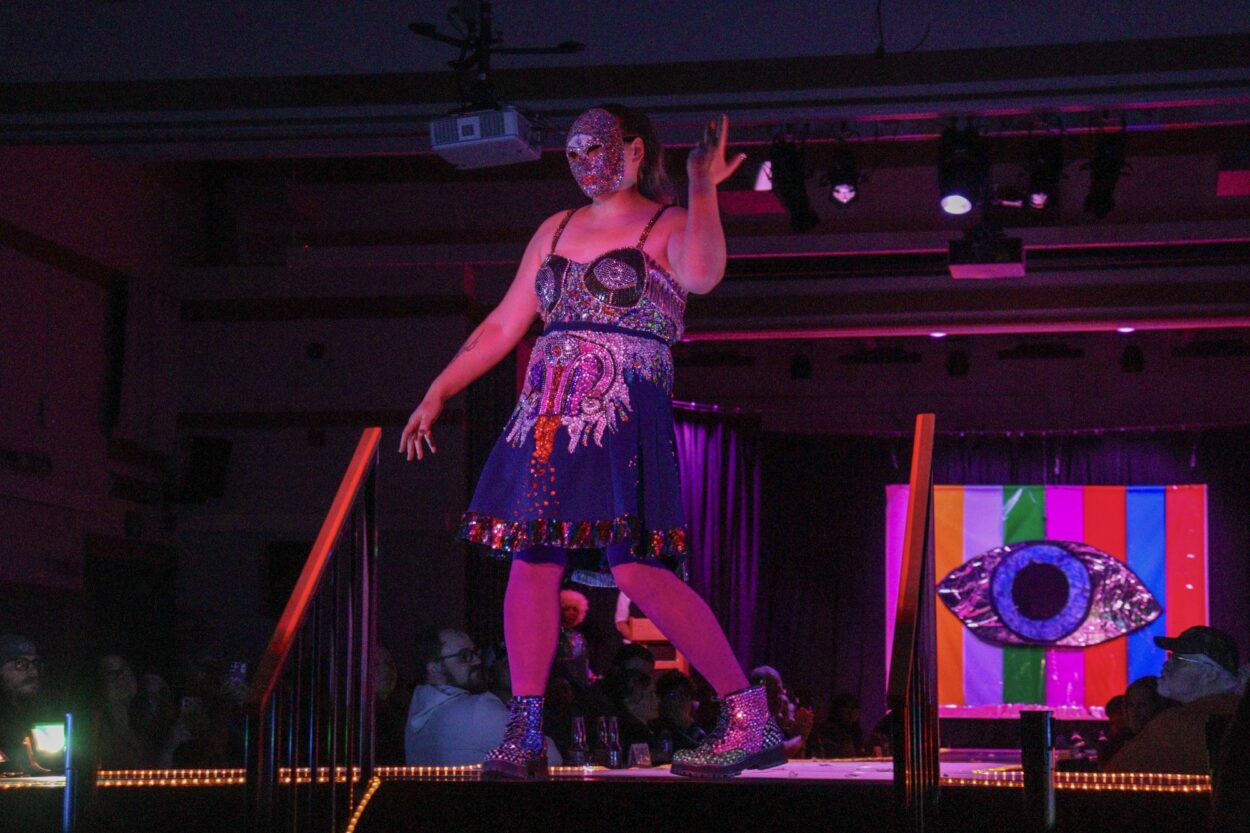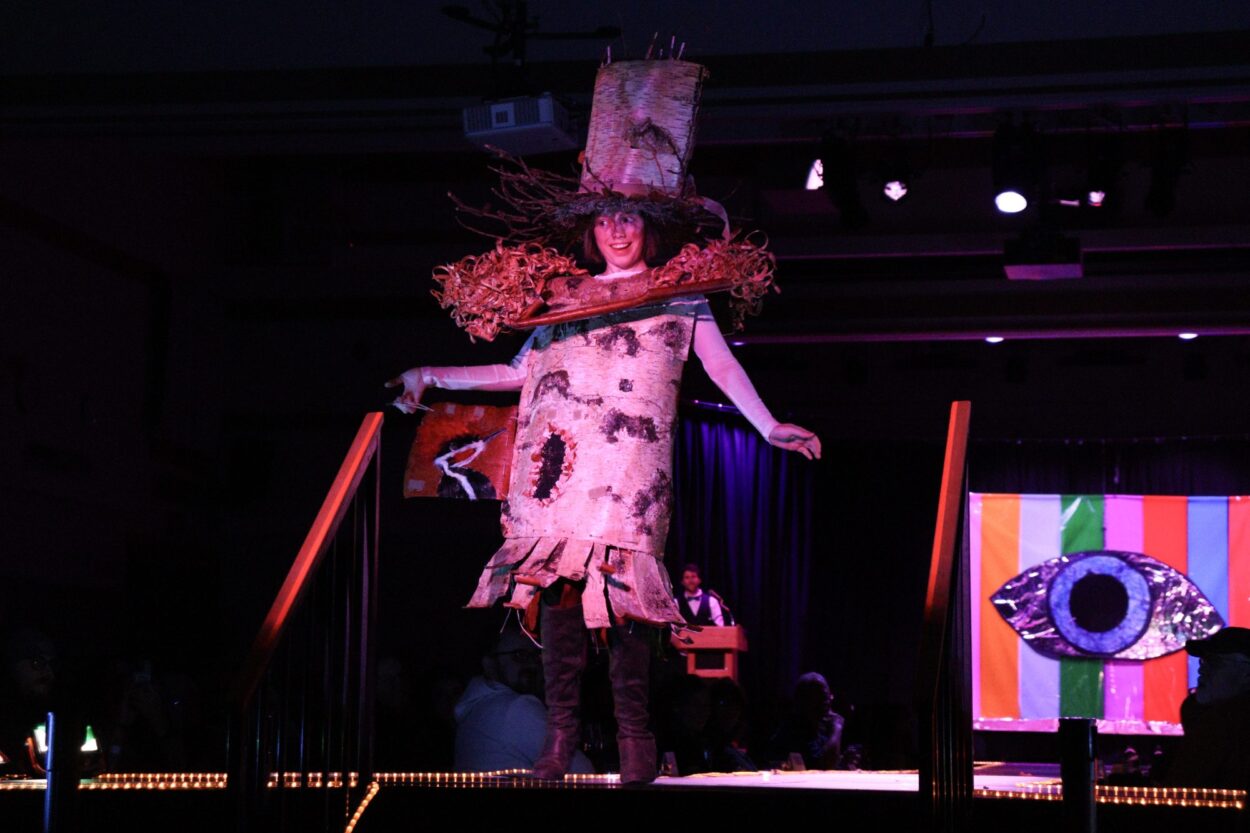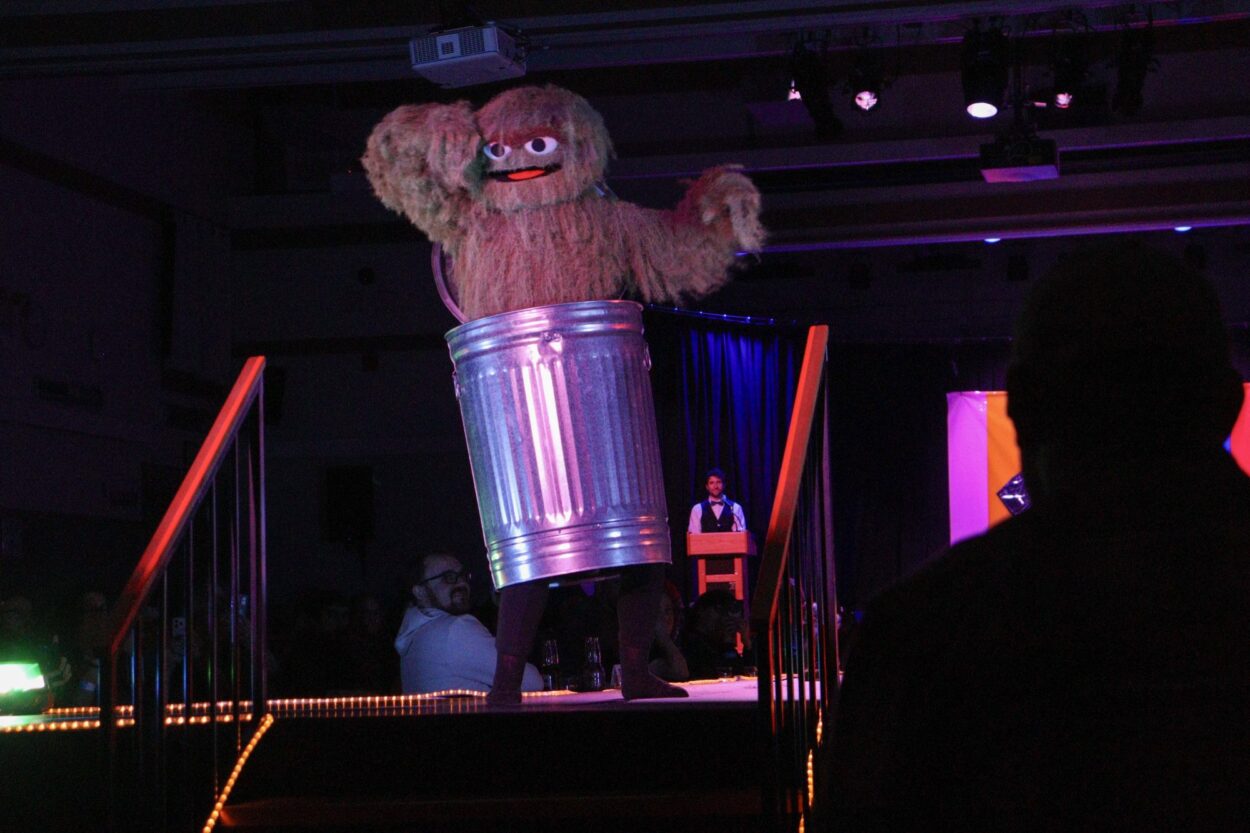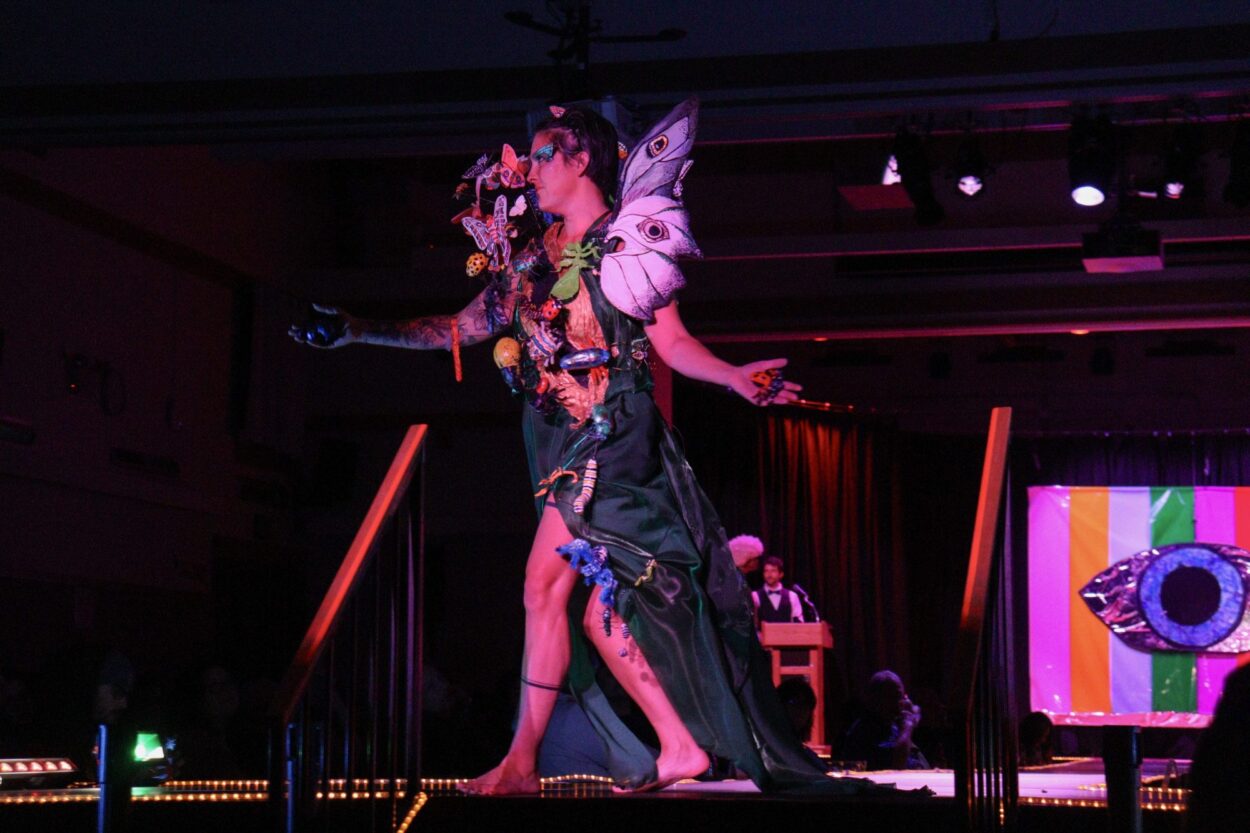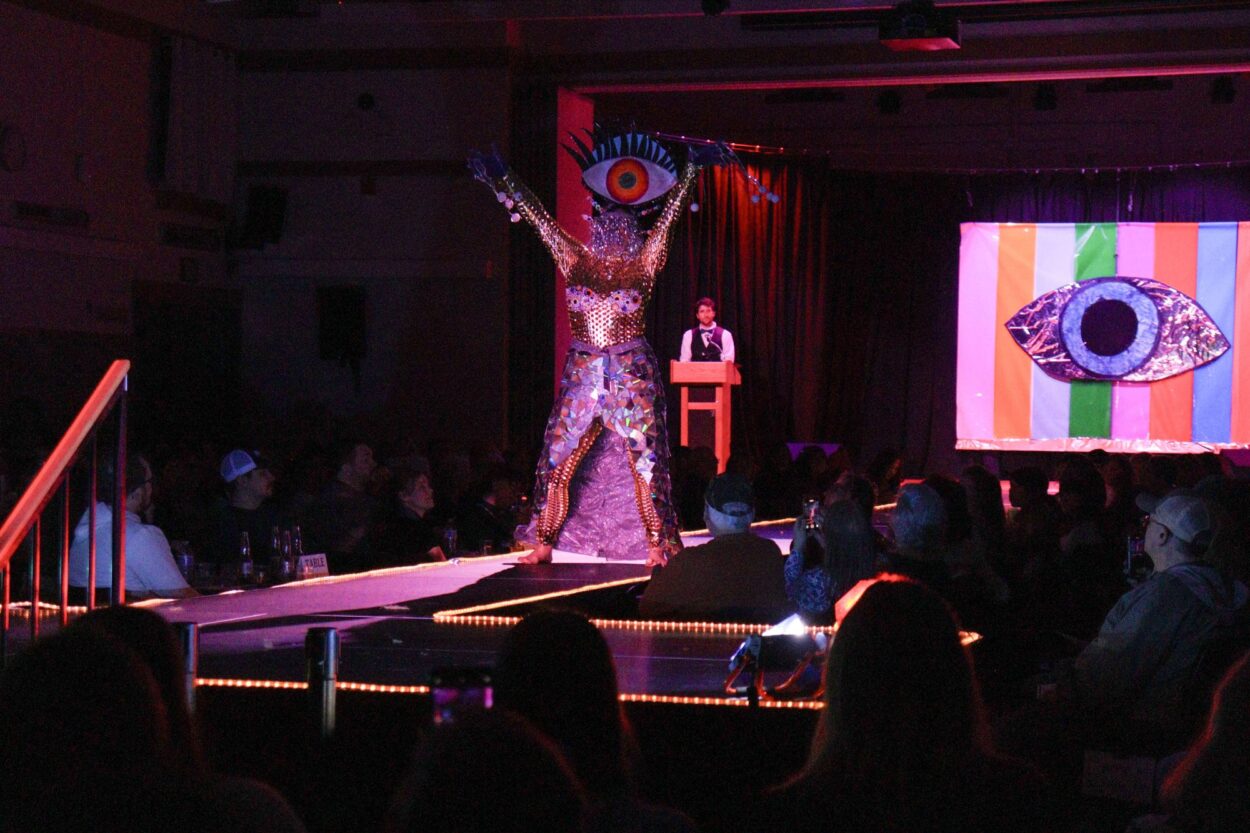
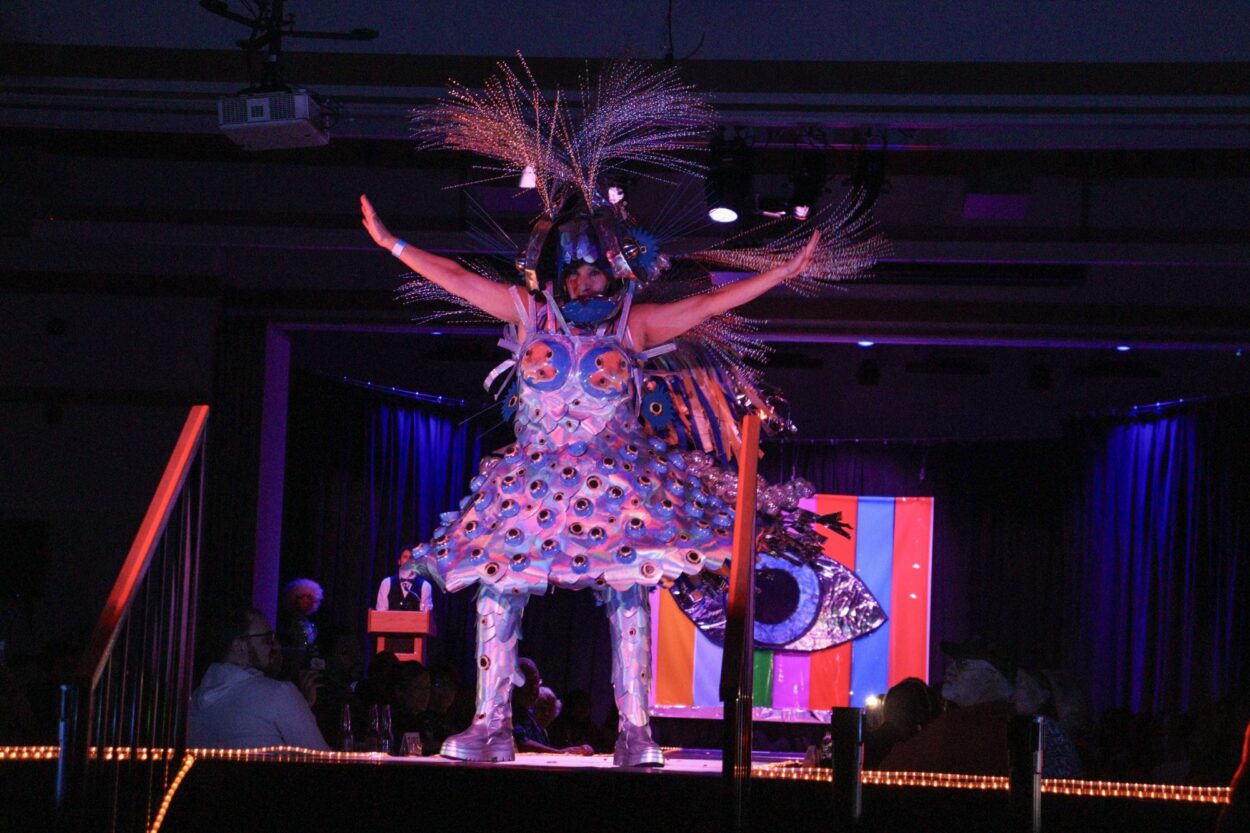
It was a typical dark and rainy evening in Ketchikan, but the mood inside the Ted Ferry Civic Center was anything but typical. A large poster of an eyeball graced the wall behind the stage, where a long runway jutted out.
As the lights are dimmed, two barefooted creatures in sky blue dresses spun around clear umbrellas and daintily tiptoed from the back door of the venue. They carefully walked up a small staircase before two leotard clad humans emerged from behind the stage.
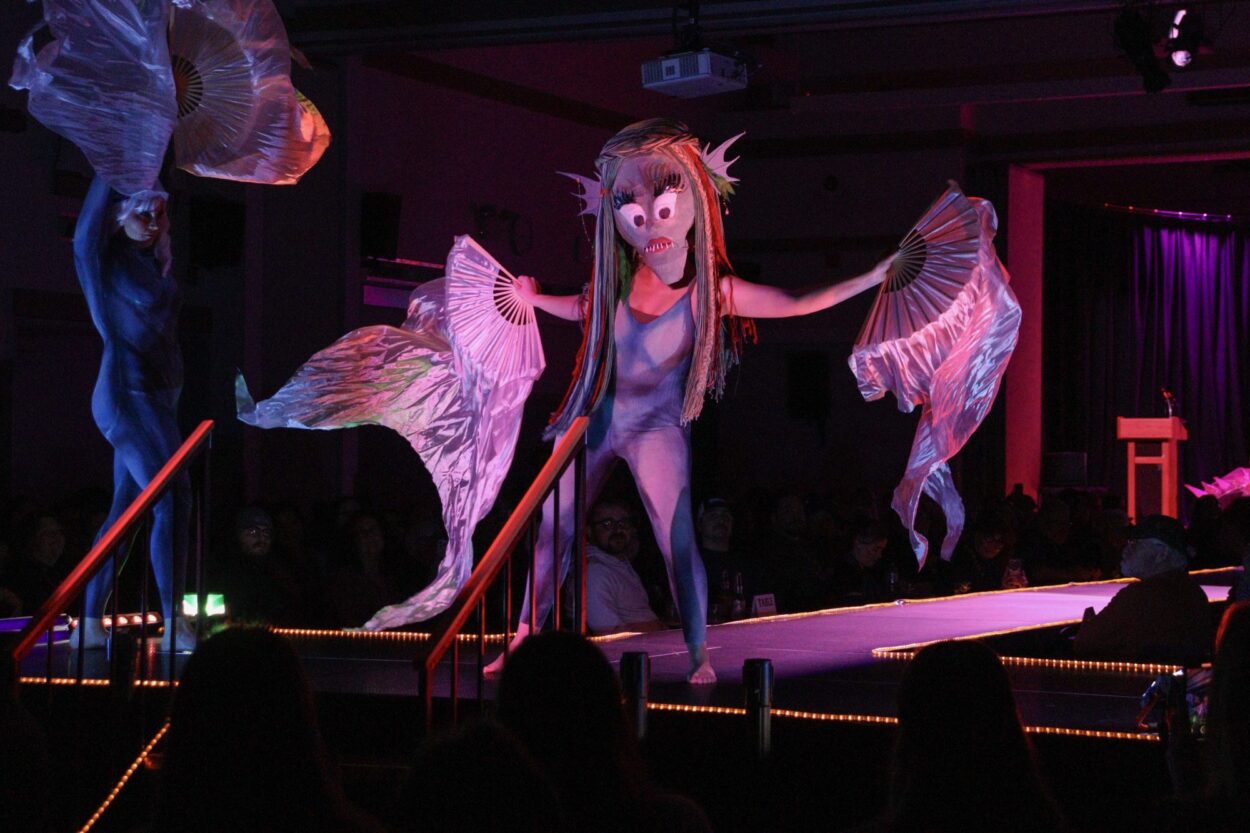
They welcomed their siren – a water creature from the edge of the galaxy. She donned a baby blue mask with an oblong face, crooked teeth, dragon ears and long, multicolored hair. The group gave praise to a paper mache Chinook salmon, the lifeblood of many Alaskans.
That elicited a flurry of cheers from the crowd.
A few minutes later, four sequin studded, dancing crabs took the stage. They struck poses similar to John Travolta in the 1970s classic “Saturday Night Fever.” The audience swooned.
To put the mood of the evening into words: it was weird. But that’s kind of the point because this year’s theme was “Weirdcore.”
“I’ve seen it online a lot, it’s like this ‘Weirdcore’ aesthetic thing, and I thought it was really cool,” said 14-year-old Cora Belle Mitchell, a first-time Wearable artist who came up with this year’s theme.
Her piece, made of faux fur and fleece, perfectly encapsulated this “Weirdcore” aesthetic. It drew inspiration from a bizarre alien species that looked similar to a vibrantly colored wolf.
“It’s kind of off putting-ish, but it also has some familiarity to it,” Mitchell said. “It’s nostalgic and kind of eerie, it’s like a mix of the two.”
That sense of nostalgia went beyond the show’s theme. This year was the 40th anniversary of the Wearable Arts Show.
The Ketchikan Area Arts and Humanities Council held its first Wearable Arts Show in 1986, a year before New Zealand’s World of Wearable Art. That’s the international show that popularized the artistic form and often advertises itself as the original.
Victoria Lord was the executive director of Ketchikan’s arts council in the mid-80s, a time she said the town was chock full of fiber artists. A year before, she said the arts council held a party dress show.
“When I first started, we had a lot of room to grow, and there were a lot of people in the community that were here to make it happen,” Lord said.
She said the council was looking for an event to go with their December Winter Art Walk, and former board member Barbara Babcock suggested wearable arts after hearing about creatives adopting the medium in New York City. The first show was held in a small black box theater downtown at the Main Street Theater. Renowned Ketchikan artist Ray Troll MC’ed with a boombox.
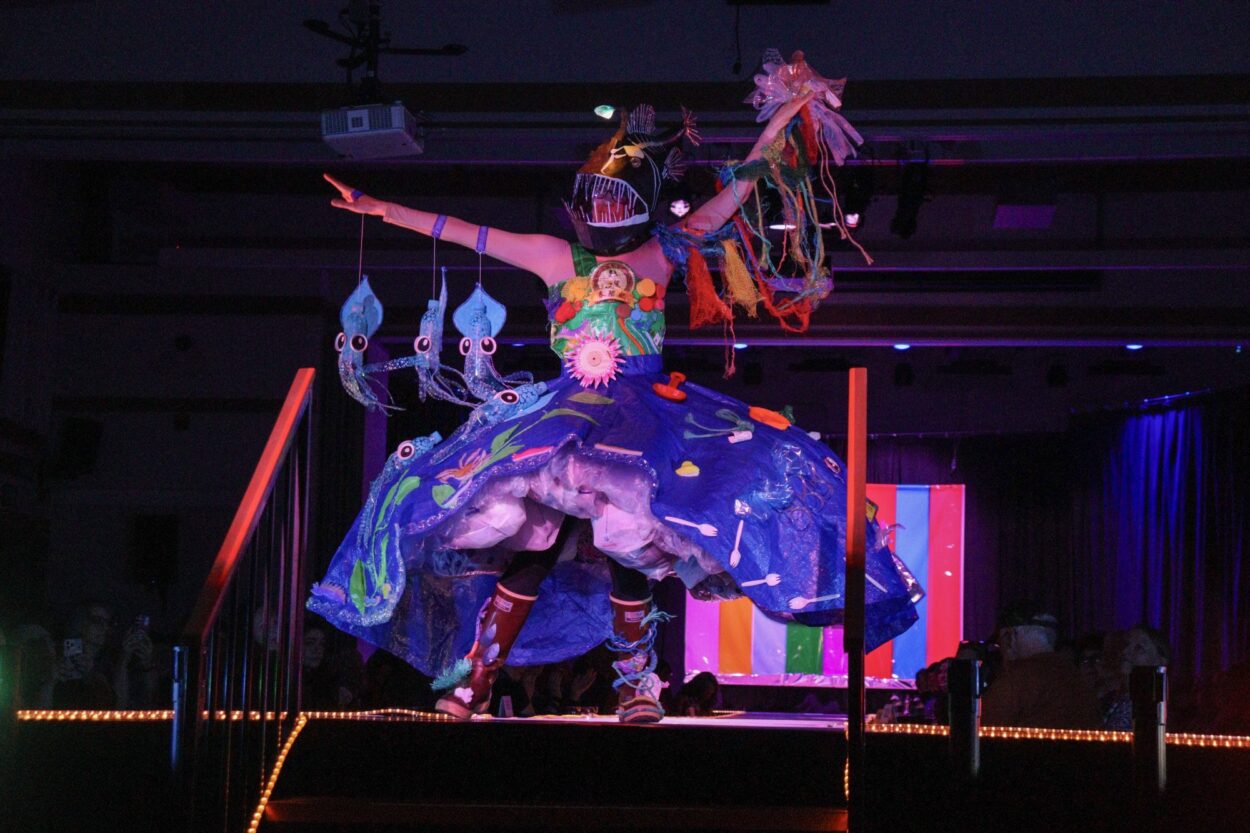
The inaugural theme was fitting for Ketchikan in December – unique rainwear. Think fur-lined Xtratufs, a raincoat with toy animals stitched inside the fibers, and armor made out of used SPAM cans.
Diane Palmer took part in that first show 40 years ago. She was the only participant of that show who’s still creating and showcasing Wearable pieces to this day. Her work this year, titled “Luna” was a hand-made, needle felted feline with wings.
“As I grew into wearable art, I realized things that you wouldn’t really think people could wear or would wear,” Palmer said. “And how you engineer and design those that they can wear and move and have some sort of meaning.”
Somewhere along the way, the show was moved to February, in part to buoy the community’s spirits after months of darkness and rain. The city averages about 150 inches of rain a year, most of it in the winter months. The spectacle was also moved to the civic center.
And although the original Ketchikan-based show has moved around over the years, Lord said its message has stayed the same – to uplift the talent of local artists and dazzle audiences with the unexpected.
“And when you see something that you started blossom into what it is today, it’s really satisfying, and it’s quite lovely,” Lord said.
Fast forward to 2026 and that sentiment was more palpable than ever. Most shows in the multi-day festivities were sold out. And even those that weren’t are still jam-packed with ecstatic audiences.
Kellie Mogg was the artist behind the crooked toothed, dragon eared siren from the opening performance of the 40th Wearable. She said her jarring, off-kilter mask turned out nothing like she had planned.
But that’s okay, she said, because embracing the unexpected is sort of the point of Wearable. She said she wouldn’t have it any other way.
“It was such a good way to get through the winter months and have something to look forward to, something that’s creatively stimulating,” Mogg said. “And to see what’s going on in this town while everyone’s kind of hermitting away, it’s so powerful.”
Mogg said the show’s perseverance is a testament to the creativity of this small, wet, quirky little town in Southeast Alaska.
In its 40-year history, hundreds of artists have participated in Wearable. Many said that the community staple has no plans to simmer down anytime soon.
Hunter Morrison is a Report for America corps member for KRBD. Your donation to match our RFA grant helps keep him writing stories like this one. Please consider making a tax-deductible contribution.