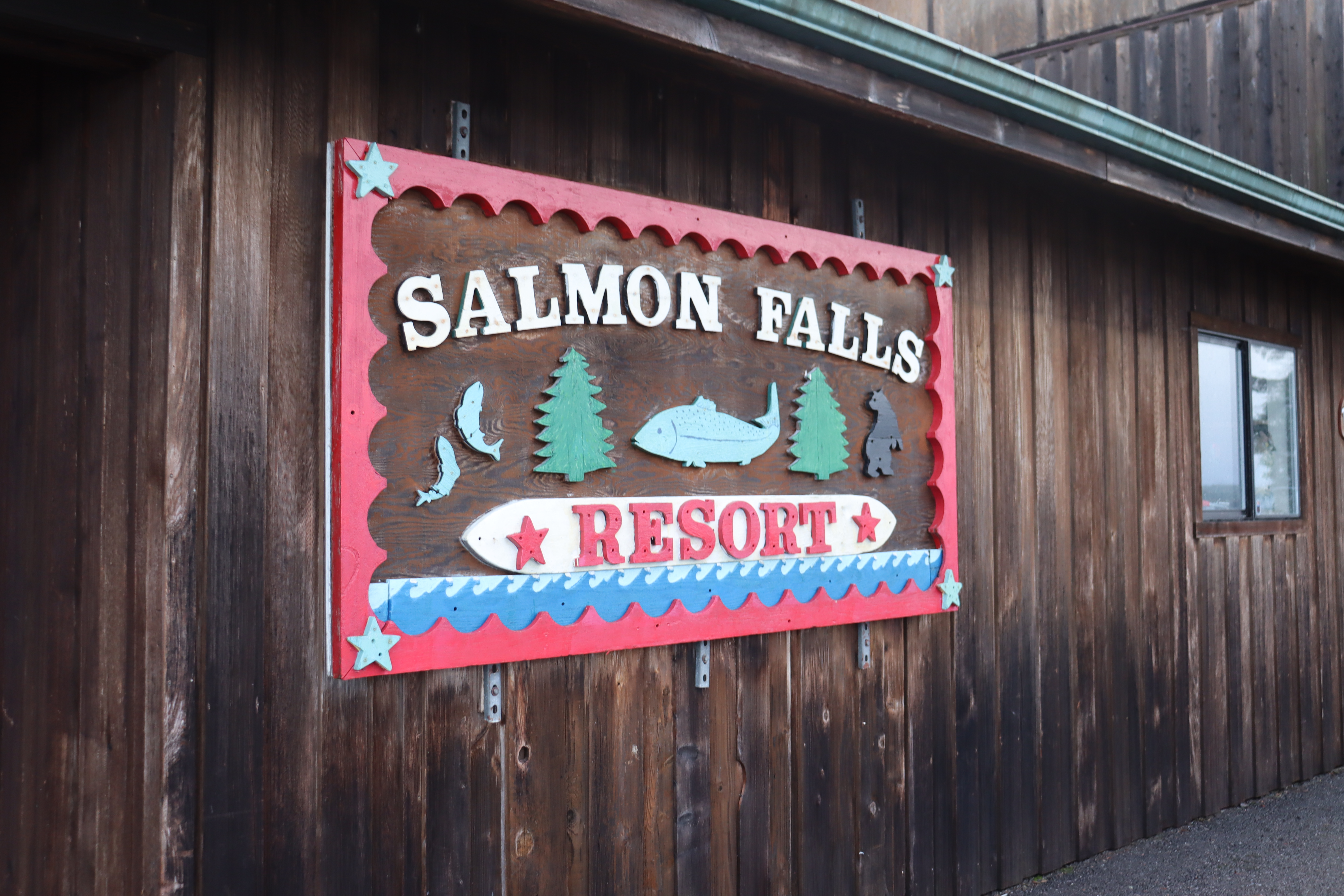
The Ketchikan Gateway Borough Assembly on Tuesday approved a rezoning request to allow for a proposed substance abuse healing center north of town. That’s after the Ketchikan Indian Community purchased the site, which was the former Salmon Falls Resort, last fall.
The rezoning decision came after hours of public testimony and two days of back-to-back meetings. Ketchikan Indian Community members and north end residents took to the assembly chamber’s podium – some in support and some against using the property for a tribally-led healing center at the former resort.
Tribal CEO Emily Edenshaw was the first to speak on Monday. Like some others, she wore a black t-shirt that read “I support KIC and the Healing Center at Salmon Falls.”
Edenshaw said the assembly’s decision goes beyond zoning.
“I ask you all this: what if we do nothing? Because right now the reality is that in our community, our people are struggling. And KIC is doing something about it,” Edenshaw said.
According to the tribe, the proposed healing center would be a 24-hour supervised residential facility with counseling and structured clinical programming. That could include job training. The tribe said the facility would not be a detox center.
KIC’s original request was to rezone five adjoining lots on the property from Future Development and Low Density Residential zones to the General Commercial zone. But the zoning request was later altered to reclassify just three adjoining lots after borough staff recommended denying the rezone of the two other parcels.
A rezone request must be vetted by the borough’s planning commission and approved in two separate meetings by the assembly before taking effect. The borough’s planning commission decided in January that rezoning wasn’t necessary because the tribe’s intended use for the property fit within its current zoning parameters. But borough officials indicated that the property’s commercial history as a bar, restaurant and hotel supports the rezone for the three lots. An information packet from the borough states commercial use on some of the property was once permitted under a previous version of the zoning code.
Many of those who spoke in favor of the rezoning request on Monday were affiliated with KIC.
“I could tell you right now, we are never going to sell that property, said KIC facilities management director Jim Gillian. He said that healing is part of KIC’s plan, and that the Salmon Falls site once belonged to his people.
“It’s ingrained in us. It’s our land, it’s our property, it’s our tideland,” he said.
Gillian called the property and its waterfall a “unicorn.”
“I want to assure others that we’re not letting go of this land,” Gillian said. “It’s our most favorite piece of land. We love this land, and we want to take care of it, and we want to be good neighbors.”
Charles Edwardson, who like many, spoke at the March meeting, urged the assembly to approve the rezoning request. He said that “lives will be saved today, tomorrow and many years to come.” Others spoke to the need for a local substance abuse healing center or shared their own experiences with substance misuse. Tlingit and Haida President Richard Peterson also testified in favor of the zoning request.
But like in prior meetings, not everyone who testified was on board. Many who spoke against the rezone are residents of the nearby Waterfall Creek Subdivision, which was established in the 1980s as a low-density, rural residential neighborhood.
Colby Slanaker, who spoke at all three meetings, believed the rezone request goes against the historic use of the property. He’s concerned about what the property could become under the rezone. A General Commercial rezone could allow for a range of wholesale, retail or service establishments. Dan Lindner had questions about emergency response times, security and physician capability on site.
Kayla Young, who read a letter from Waterfall Creek resident John Rosenfeld, said a rezone is incompatible with the surrounding area’s land use.
“Once the designation is in place, it opens the door to a wide range of large-scale commercial and institutional uses that could permanently alter the character, safety and livability of the neighborhood,” Young said on behalf of Rosenfeld. “We are not asking you to deny the need for services, we are asking you to place them somewhere they belong, in appropriately zoned commercial areas with existing infrastructure and compatibility with surrounding uses.”
Some residents who were opposed to the zoning request said that approving it would go against the borough’s recently passed comprehensive plan, which sets policy for development and growth in the area. Some also felt that an approval could constitute spot zoning, or rezoning of a parcel that is not in line with the surrounding area. Borough attorney Glenn Brown said because of the historic use of the Salmon Falls property, spot zoning is “less of a concern in this one case.”
Some assembly members still had concerns about the rezoning request after over two hours of public testimony. A few of them suggested compromises that would give nearby property owners a seat at the table. The assembly adjourned around 10:30 p.m. on Monday due to time constraints but continued to deliberate on Tuesday.
After several amendments were introduced and failed, the assembly approved in a 5-1 vote KIC’s zoning request with a compromise brought forward by assemblymember Bridget Mattson. It would require planning commission approval of a conditional use permit if the tribe were to bring detoxification facilities or port and vessel services to the property, which were concerns for some nearby residents. KIC members said during the Monday night meeting that they have no plans of bringing a detox center or cruise ship facilities to the property.
At the end of Tuesday’s meeting, assemblymember Rodney Dial said the Salmon Falls request was the hardest rezone he’s dealt with in ten years. KIC’s next steps in bringing the holistic healing center to fruition is interviewing for a director and hashing out a site plan, among other things.
Hunter Morrison is a Report for America corps member for KRBD. Your donation to match our RFA grant helps keep him writing stories like this one. Please consider making a tax-deductible contribution.