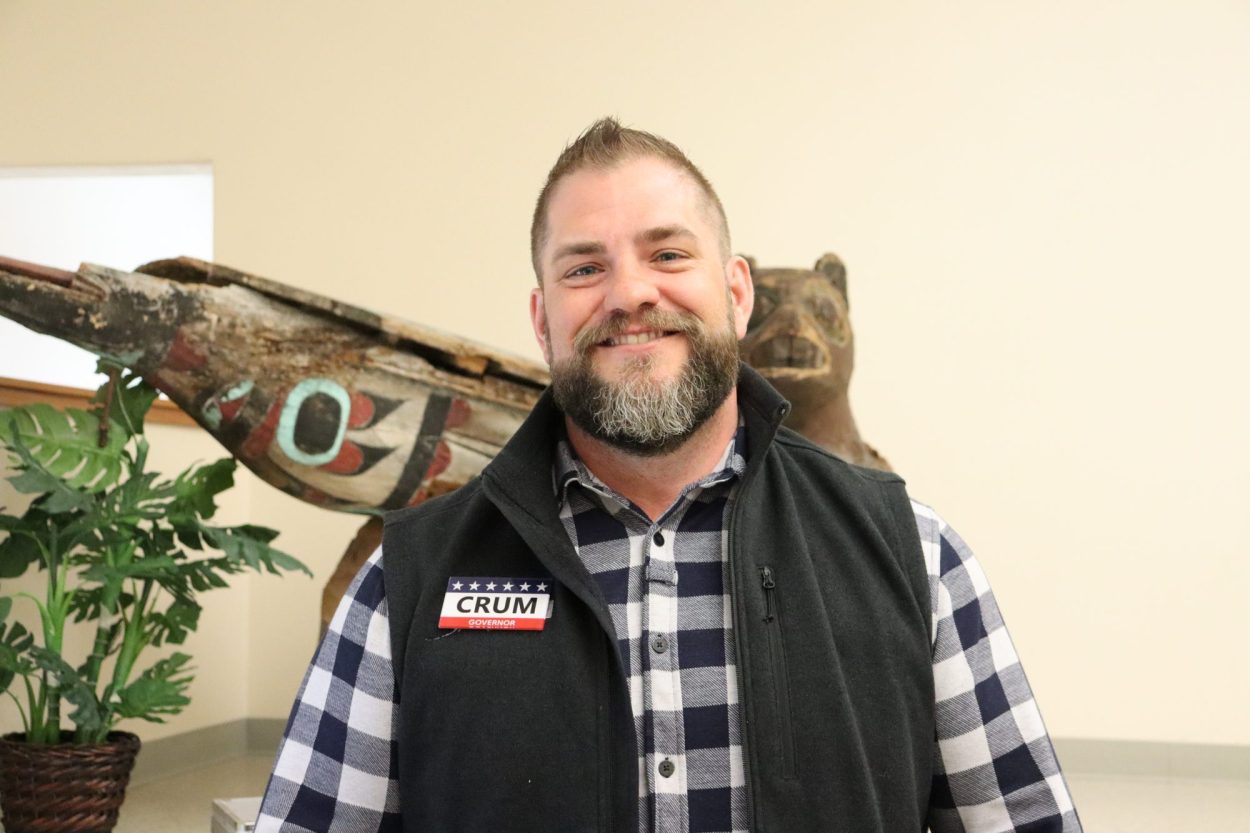
Republican Adam Crum announced in August his intent to run for the 2026 governor’s race. The Former Alaska Revenue Commissioner is one of nearly 20 candidates whose names will likely be on the ballot.
Crum, who lives in Wasilla, recently visited Saxman for the city’s state of the community address. KRBD’s Hunter Morrison spoke with the gubernatorial candidate at the event to learn more about his run for office and goals if elected.
Hunter Morrison: Adam, first things first. Why are you running for governor?
Adam Crum: I’m running for governor because I’m an Alaskan kid. Born in Homer, grew up in Anchor Point, and have a unique career background.
Right now, I’ve got two little girls. If they were to leave the state, I don’t think they’d come back, because I don’t see an opportunity set for them. I think Alaska has had far too much managed decline, and we haven’t actually seized the day. When I talk to people all around the state, particularly people south of 50, we haven’t had major projects in our age group for kids that have grown here. We’ve seen and heard about things that have been promised or talked about but have never pulled the trigger. And I think Alaska needs to finally just realize we need to take control of it ourselves and to build. We have to make sure that we are building the infrastructure that keeps our communities healthy, but it also allows opportunity sets for the private sector to thrive. So I’m running because I want to build what’s next for Alaska.
HM: Tell me about your prior work experience and why you think it would be helpful if elected governor.
AC: I joke on the campaign trail that no rational person would have taken my career path. So when I came back, I worked for my family company. It’s Northern Industrial Training, so it’s grown into the largest post-secondary training provider in the state. It’s known primarily as truck driving and welding. I have a Master’s in science of public health, and that was what got me into service to step up and help run the Health Department. It was the largest department in the state, $3.5 billion operating budget, 3,500 employees. Is there a way you can actually make sure you have good health policy staff around you? But having worked on large, multi-billion dollar capital projects as well as ran organizations, could I look at this and help make it better?
At the end of that, the largest reorganization of state government since 1983 occurred under me. We split the Department of Health and Social Services in half. It was kind of failing in how we provided answers to vulnerable populations on the child welfare side, to our senior side, to the Pioneer Home and the Psychiatric Institute. That occurred, and we created the Department of Health and the Department of Family and Community Services. After that, I told the governor I was done. And he said, “Hey, I have a revenue position opened up.” And so I stepped up, moved over to the Department of Revenue. So it’s that combination of being an entrepreneur, having a business, running the largest organization in the state, and then understanding where all the funds in the state are invested. That’s why I think I have a unique skill set in order to be governor.
HM: If elected, what will be some of your top priorities as governor?
AC: We’re going to build. Alaska has had managed decline. Since 2014, we’ve had a stagnant population. We haven’t had any real major projects. It has been very, very stale. The goal is to actually diversify our economy to make sure that we actually have durable economic development, that we don’t have these booms and busts, that people flood in, the economy super heats, the supply chain comes in and then when the projects die off or prices change – they leave. What I want to do is to make sure that we are covering our gaps in the system. That includes things around infrastructure. These are new roads and bridges. Roads to resources. These are transmission lines that we have to have. We have to modernize our grid. So on the rail belt, which is 70% of the state population, the first thing I would do on day one is actually build a transmission line north from Beluga to Healy. And that would give the state the first loop. We don’t actually do enough when it comes to bonding or doing creative tools to bring revenues into our state. And I want to focus on that. I’m going to focus on the capital budget, and we’re going to build Alaska.
HM: We’re here in Saxman. What brings you down to the area?
AC: Down in Ketchikan, I appreciate this area. There’s so much that is going on, and this was an opportunity to come here in Saxman. And I just joked with the mayor that I got a crash course in Saxman 101, because you got to hear everything they have, from housing issues to workforce issues to their sewer and water, as well all of the other community events. I grew up in a very small town, and I understand that sometimes those unique problems get overlooked by people who live in the cities. And it’s important for me to actually come and hear those, because these are fixable problems. And a lot of this can be helped and provided for just by better coordination. That was one thing that I’ve been able to prove throughout my career in public service, is you can enable teams to coordinate together and get measurable outcomes in a shorter time frame.
HM: Is there anything else you’d like to share about your run for governor? What some of your priorities might be if elected? Or anything along those lines?
AC: I’m a businessman and I’m a public servant. I’ve had this unique background of putting these things together. But first of all, I’m an Alaskan. That means that we actually pull together. Alaska is such a small town, there is no six degrees of separation. We’re two degrees separated from just about everybody in the state. It is a giant small town. Every area of the state and every region matters. I do believe rising tide raises all boats, and I want Alaska as a whole to thrive. And you can work on major projects in one area, but you can also simultaneously keep other ones moving along. It doesn’t have to be an either/or scenario. You can organize your government in such a way that we are all going to thrive and we are all going to benefit from projects. You know what, Alaska? It’s time to move on our own and take control of our own destiny. So it’s one of those. You can either settle for managed decline, or you can build what’s next, and that’s what I’m going to do.
Hunter Morrison is a Report for America corps member for KRBD. Your donation to match our RFA grant helps keep him writing stories like this one. Please consider making a tax-deductible contribution.