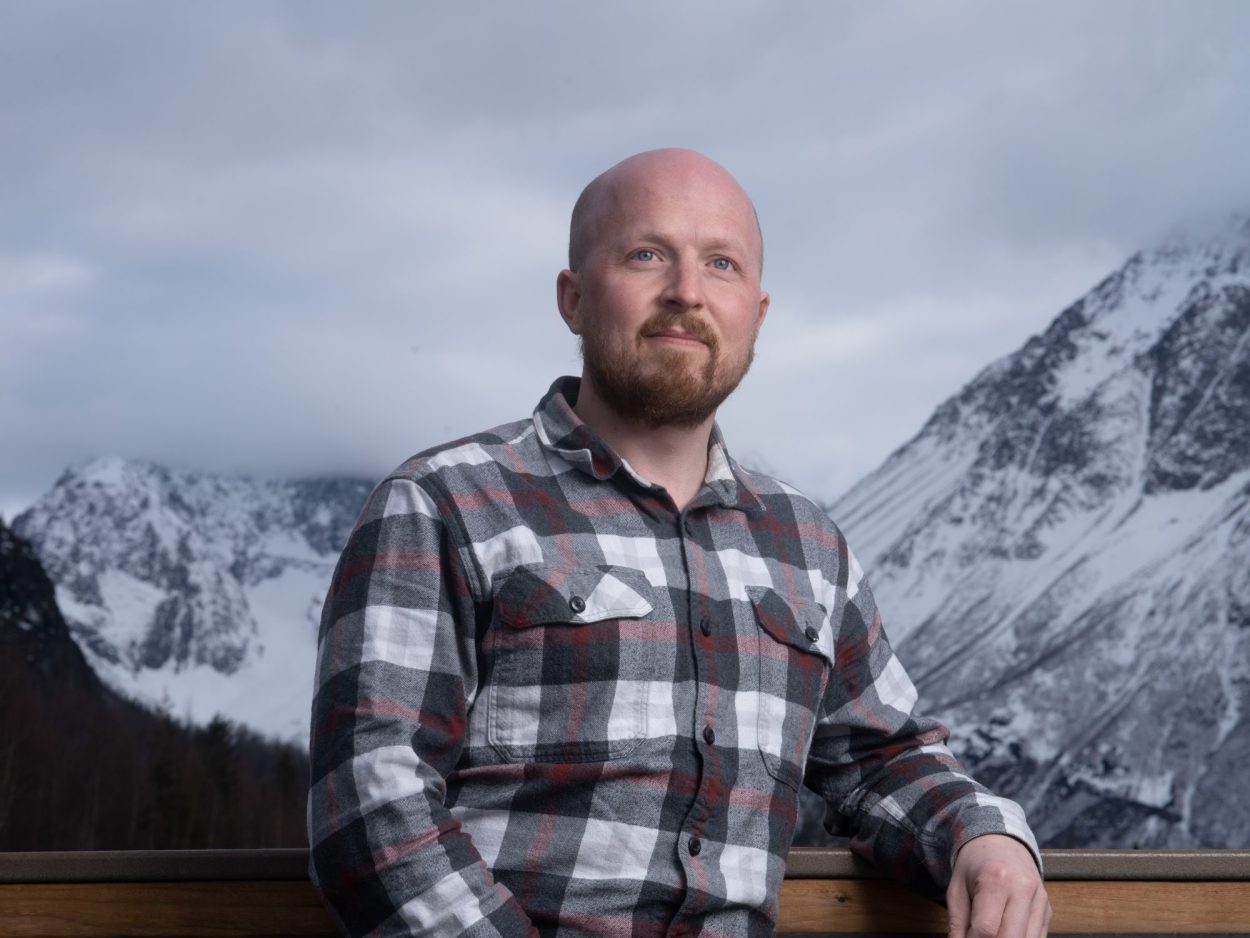
Gubernatorial candidate Jonathan Kreiss-Tomkins was born and raised in Sitka and spent a decade representing parts of Southeast Alaska as a state legislator. Now, the 37-year-old candidate is one of only three Democrats vying to replace Governor Dunleavy in the 2026 election — running against over a dozen other Republican and Independent candidates.
In his most recent trip to Ketchikan, KRBD’s Sydney Dauphinais spoke with Kreiss-Tomkins about education funding, the state ferry system, and what it means to be a pro-fish governor.
Sydney Dauphinais: To start off, why are you running for governor?
Jonathan Kreiss-Tomkins: I’m running for governor because Alaska desperately needs new energy and new leadership in the governor’s office.
Dauphinais: Can you speak to some of your top priorities if elected?
Kreiss-Tomkins: Number one, fix our schools. Public education is on the brink in Alaska, and in so many communities. Here in Ketchikan, that’s front and center. Fawn Mountain is closing, Point Higgins is closing. Obviously, there’s enrollment decline, sort of overlaying issues, but no matter how you cut it, electives are being cut from schools, extracurriculars are being cut, teachers are being let go. Teachers are just straight up leaving the profession, and every part of Alaska has their own story about what the disinvestment in education is looking like.
Dauphinais: That was actually going to be my next question, because, as you pointed out, here in Ketchikan, the district is facing the the impacts of that disinvestment in education. So, how do you plan to address that?
Kreiss-Tomkins: Do the opposite of our current governor. Our current governor, through the veto pen, has tried to reduce funding for education, and kind of at every possible step frustrated our ability to invest in education and create a strong system of public schools in Alaska. It’s like it’s almost personal for him. It sort of defies explanation. So making sure that there’s adequate funding for schools.
Number two, I’m a huge supporter of forward funding. What that would mean is requiring the legislature to pass education funding by February or March instead of late May or June. What that means is the Ketchikan Gateway Borough School District, or any of the other 53 school districts across Alaska, when they make their annual budget, would have certainty and clarity on what level of state education funding is coming in. Right now, every school district across Alaska has made their budget for next year, and that budget is built on a guess. Nobody actually knows the level of education funding, because the legislature has not finalized it. It’s just crazy to ask school districts to try to make budgets for their local schools when you have to guess on what the revenue side of the ledger looks like. We can change that. It’s a process change. I think it makes a tremendous amount of sense, and we should get it done.
Dauphinais: How do you differ from some of the other Democratic candidates?
Kreiss-Tomkins: I’m the only candidate from Southeastern Alaska. I’m the only candidate from coastal Alaska. I’m the only candidate who’s not from Anchorage. So I definitely am running a statewide campaign, including the parts of the state that are not Southcentral Alaska. I think it is sometimes easy for other parts of the state to sort of think the entirety of Alaska revolves around Southcentral, and so all the issues here in Southeast Alaska that we know are so important, from fisheries to the ferry system to issues that are statewide, like schools, I’m deeply familiar with. I grew up here, I was born and raised in Sitka, I know the region through and through, and I understand the issues that are important to Southeast Alaska.
Dauphinais: Since you are so familiar with the issues in Southeast Alaska, can you talk a little more specifically about some region-specific issues you’re focused on that may have gone unaddressed, or in your opinion, incorrectly addressed?
Kreiss-Tomkins: The ferry system is a shell of what it used to be. I grew up taking the ferries to swim meets, to high school sports events, to drama and debate events. That’s kind of a relic of history at this point, because the system is so inefficient and dysfunctional. So I want to make sure that we rebuild the ferry system in Alaska. That means, just as we did in the ‘60s and ‘70s, making generational investment in new vessels that will last another 50, 60, 70 years, the way we did back when the ferry system was first created.
Another priority for me with the ferry system is giving it independent management that isn’t political. Part of the reason I think the system has struggled so much is every time there’s a new governor, they have their own very different vision of what the ferry system should be. They spend a lot of money building new boats, but then the next governor doesn’t like that vision, so they don’t use the boats that we just spent $100 million building. There are many instances of this in the last few decades, and I think we need to reform the governance of the ferry system and make it independent and apolitical, similar to the Alaska Railroad or the University of Alaska. That would be a real priority for me as well. I think it would set the ferry system up for success over the coming years and decades.
Dauphinais: When listing issues you care about in Southeast, you brought up fisheries. How big of a priority is that for you?
Kreiss-Tomkins: Fisheries is one of the areas that I focused on most as a legislator. Sitka is a fishing community, I spent a few summers deck handing on the back deck of trollers, and it’s just core to our sort of way of life and economy in Southeastern Alaska. I want to be a pro-fish and pro-fisheries governor. What I think that means is balance on the Board of Fish, so making sure that all user groups — and not just Southcentral sports fishermen — have a say when the Board of Fish is making really difficult decisions. Right now under this governor, I think we’ve lost balance on the Board of Fish. As a legislator, I worked really hard to protect and advance balance on the Board of Fish with legislative confirmation votes.
I also really want to see reductions in bycatch from the trawl sector in the Gulf of Alaska and the Bering Sea, and I was probably more active on that issue than any other legislator in my 10 years in Juneau. As governor, I would continue to work towards reasonable reductions in bycatch and reductions in habitat impacts that happen through bottom trawling. So, those are two really high priorities.
The last thing I would flag is that the governor makes all of Alaska’s nominations to the North Pacific Fishery Management Council, and I was really active on those nominations as a legislator, and I really want to make sure as governor that our six member delegation to the North Pacific Council is going to represent Alaska’s interests. I would be very committed to making nominations and ensuring that our North Pacific Council delegation represents the best interests of our state.
Dauphinais: Anything else you’d like to add?
Kreiss-Tomkins: One other issue that I feel really strongly about is the state is not getting a fair return on the oil resource that we as Alaskans, literally, the state of Alaska owns Prudhoe and Kuparuk. The oil fields on the North Slope are owned by the state of Alaska. We are the resource owner, and we should expect and demand a reasonable return the way some ranch owner in Texas would expect and demand a reasonable return if there was oil underneath their ranch. I think we are coming up short on that, and the most glaring example is right now one of our two major oil and gas producers, Hilcorp, does not pay corporate income tax to the state of Alaska, and it’s really because of a technicality or a loophole in our tax code. I think it is indefensible that we have not closed it, and it cost the state $150 to $200 million a year, that’s three times the ferry system budget every year, just through that loophole. As governor, I would demand that that loophole be closed and the state get its fair share from the oil resource that we, as the state of Alaska, own.