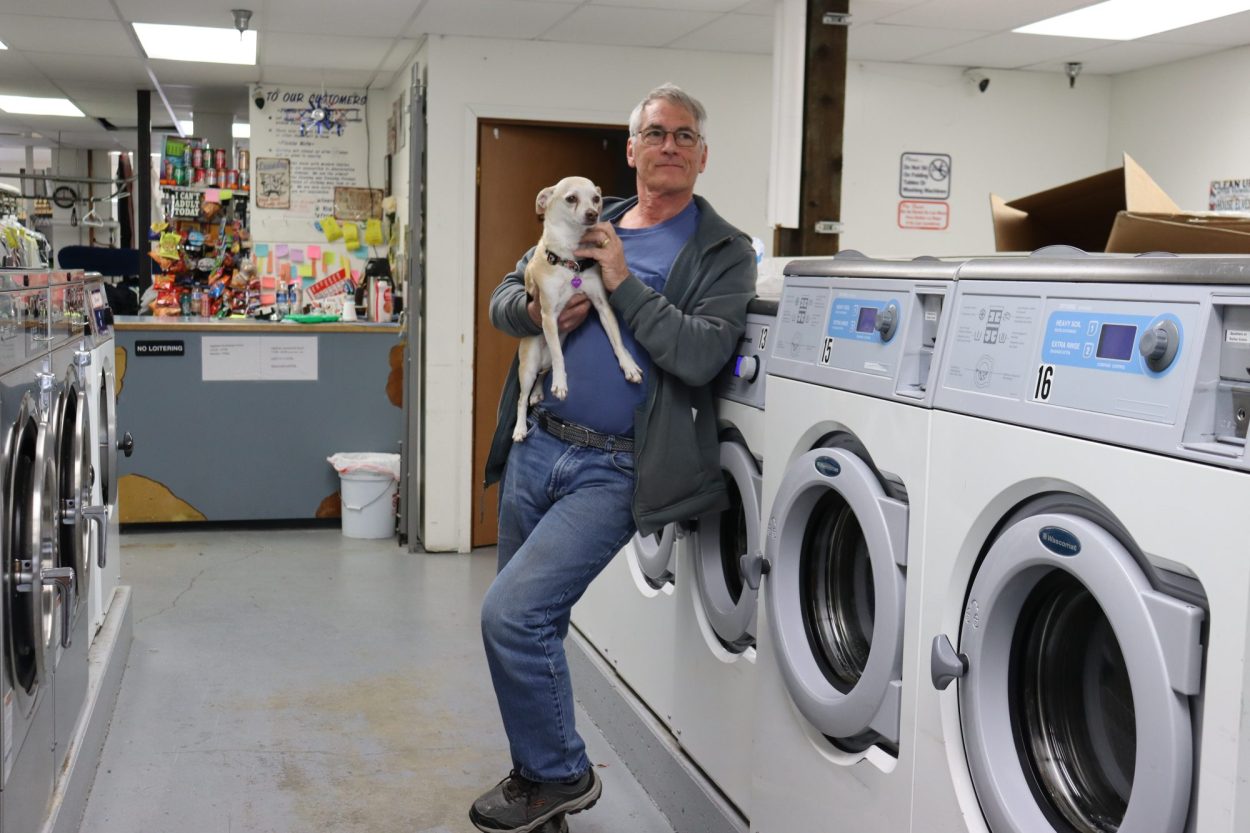
It was a typical weekday afternoon at Highliner Laundromat, near Ketchikan’s main boat harbor. A man with John Lennon style glasses folded his clothes on a table near the front door. An elderly couple was occupied by their cell phones while seated across rows of roaring washing machines.
Longtime building owner Jack Auger was at the front desk looking at his recent utility bill. He pays around $1,000 each month for the facility’s water services. He said when he first bought the building a few decades ago, he was paying about $600 a month for water on not one, but three laundromats he owned.
“Our increase of 10% here, another 5% there, you know, just kept getting more and more, and I couldn’t afford to have all three buildings at one time,” Auger said. “So, I finally ended up coming down here to one building.”
Across town, 89-year-old Amelia McAlpin has lived in her home near Ketchikan Creek for over 50 years. She’s a widow, and was the only person who addressed the city council in January when water and sewer utility rate increases were on the agenda.
“And I thought, ‘Oh my god, they’re going to raise it again,’” McAlpin told KRBD. “Well, I’m going to go and talk for the widows and the widowers that are – we just have fixed income. It’s not like when my husband was here taking care of me.”
The city council approved both utility hikes.
Ketchikan’s water utility rates have increased almost every year for about two decades. Other utility rates stayed the same for about a decade at times.
While that meant utility payers weren’t seeing higher bills, it also meant the city wasn’t saving for future repair and maintenance needs. Ketchikan’s city finance director Michelle Johansen said the city is now playing catch up.
“A reduction in services could be detrimental to our community,” she said. “So, if we want to keep services the same, the only way to pay for that is through rate increases.”
The finance department at a budget meeting last year proposed to the city council an 8% increase in water, sewer and electric rates each year for the next five years. The first set of those increases were approved and went into effect in February and April. The rate hikes must be approved each year by the city council before taking effect.
Solid waste rates also increased by 9.5% this year. That’s on top of an additional proposed 5.5% increase each year for the next five years to fund the department’s disposal contract.
The five-year plan to raise utility rates isn’t unique to Ketchikan. The Juneau assembly adopted last year a similar rate hike structure – increasing water and wastewater rates by 5% each year through 2029.
According to Johansen, Ketchikan contracted a rate structure study where it was recommended the city implement a 12.5% annual increase for electric to help meet its capital improvement plan. She said they’ve had to adjust the plan with the lower, 8% annual increase, but the city’s electric utility manager is looking for grant funding. Despite the rate increases, Ketchikan charges some of the lowest rates for electricity in the state.
That same rate study suggested an additional solid waste rate increase of 3% per year for the next five years.
Johansen said the city’s utility rate hikes are needed to pay employees and keep up with inflation-related costs. She said they’ll also be used to help fund needed infrastructure projects, like the construction of a secondary water main tunnel system that brings water into town from nearby Ketchikan Lakes. The city has only one water main tunnel system, which hasn’t been inspected in nearly 70 years.
“It’s a major project,” said Ketchikan Public Utility Water Division Manager John Kleinegger. He said if no alternative water main is built, the current one can’t be inspected without cutting off all of Ketchikan’s water supply.
“It will take us at least five years before completion, per chance, longer than that, because it’s going to be a very expensive project,” Kleinegger said. “And we’re going to have to seek funding from any number of sources.”
That’s just the tip of the iceberg for Ketchikan’s list of needed infrastructure projects. The city is also looking to replace various water lines, modernize its electric substations, add disinfection components to its wastewater facility and more.
Ketchikan’s utilities are paid for through grants, loans, utility rates and city reserves. But finance director Johansen said the city’s reserve pot isn’t enough to cover water or electric projects. And she said state funding for water and sewer projects disappeared years ago.
“I wish I had better things, happier things to say,” Johansen said. “The 8% is really to try to keep us from being in a really big hole. So we’re trying to keep on top of cost increases as well as try to put a little bit away to make sure we have enough for those capital improvement replacements.”
And while the city council has approved several utility rate increases in recent years, not all council members agree with them. Riley Gass has overwhelmingly voted against utility rate hikes. He did, however, propose in March a compromise 4% electric rate increase that ultimately failed.
Gass believes the cruise ship industry and their passengers should “pay their fair share in our utilities.”
“They’re all going to the bathroom, using water and sewer. They’re all putting garbage in the garbage cans. And they’re, mostly all of them, in some way or another, benefiting from our electricity,” Gass said.
Gass suggested at a recent Cruise Line International Association meeting that he’d like to see more financial contributions from the cruise lines. Council member Jai Mahtani suggested at that meeting an increase in the passenger head tax, a fee that is paid per cruise ship passenger. Mahtani also said he’d like to see cruise ship passengers contribute to the city’s utilities.
According to the finance director, the city collects cruise ship revenue through its port fund, which is limited in how it can be used. The city has also implemented a seasonal restroom rate to collect additional money from cruise ship passengers. There’s also CPV money, which can only be used to fund projects that benefit cruise ship passengers.
Back at the laundromat, Jack Auger led his chihuahua mix, Piper, through rows of washing machines. As he walked back to the front desk, he pointed to a large grey box with a vintage look. It was the first machine he bought when he took over the laundromat.
Auger agrees with some city council member comments that Ketchikan should collect more money from cruise ship passengers. He also disagrees with the city’s flat-rate water system; he believes the city should switch to a metered system that charges based on water usage.
Auger said it doesn’t make sense to him that his laundromat’s electricity bill is roughly half that of his water bill.
“We don’t have to manufacture water, water flies out of the sky for us,” he said. “So why is it $1,000, almost $1,100 a month for my water, versus only $478 a month for my electricity? Can we make electricity cheaper than we can our water in Ketchikan, Alaska, where it rains 150 inches a year?”
The city’s finance director said council members have suggested alternative revenue streams to help fund infrastructure projects, but those options haven’t been researched.
Hunter Morrison is a Report for America corps member for KRBD. Your donation to match our RFA grant helps keep him writing stories like this one. Please consider making a tax-deductible contribution.