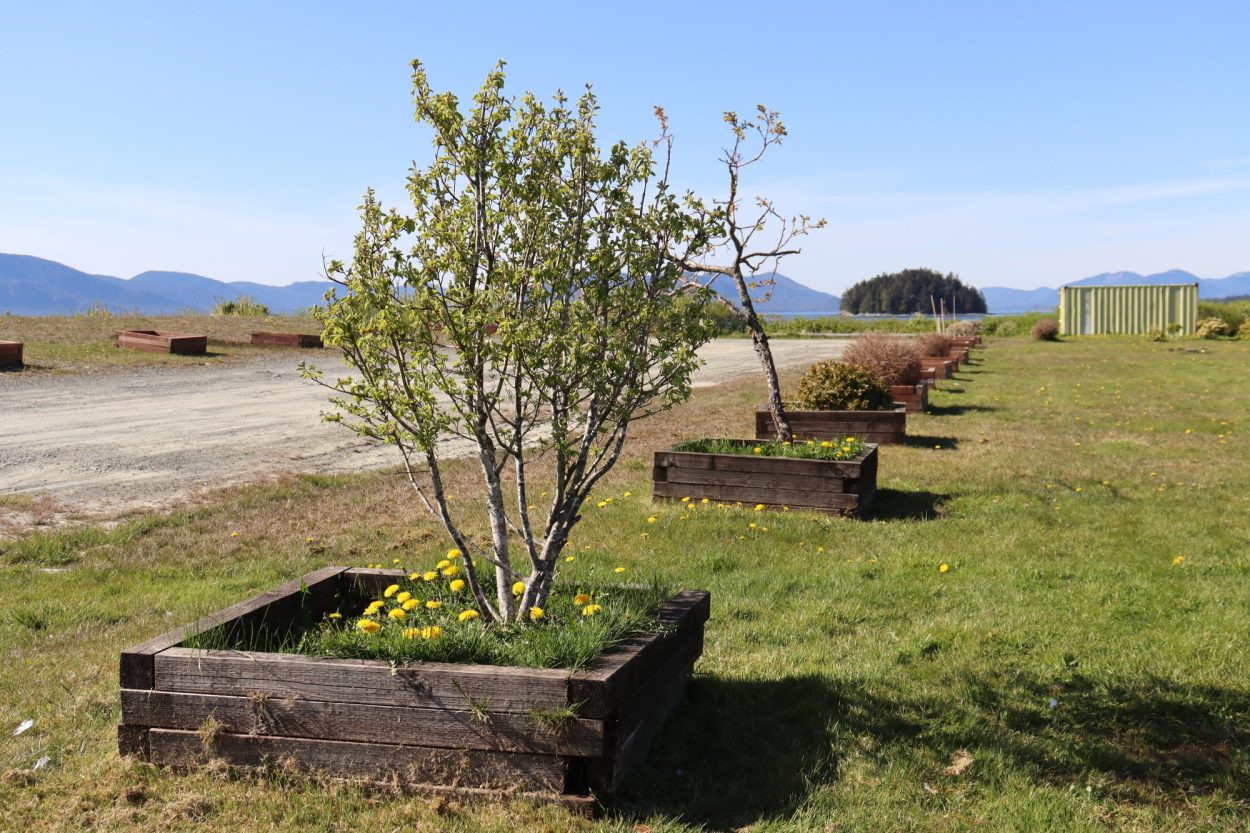
Gatgyeda Haayk, Metlakatla’s Community Garden Champion, recently strolled past a row of shrubs and small trees near the village’s boat harbor. She pointed to two cherry trees rustling in the wind along the shoreline.
The soon-to-be budding trees were brought to Metlakatla as part of its Community Food Forest Project. That’s an initiative that incorporates fruit-bearing trees and bushes into the village’s public landscapes. So far, Haayk said about 50 plants have taken root around town, from the city’s ballpark to the boat harbor.
“In like the next three years, we hope to be able to give fruit back to the community,” Haayk said.
The program comes after Metlakatla’s tribal council passed a resolution a few years back that required all beautification efforts in the community to be edible. Not long after, the village received a three-year grant from the U.S. Forest Service to fund the project. The grant is currently in its final year, but Haayk is looking for other funding.
She said the project has primarily worked with apple trees, but they’ve also planted plum and nectarine trees. The initiative also deals with plants native to the region, like raspberries, gooseberries and saskatoon berries. Haayk has even experimented with plants not usually grown in Southeast, like hazelnut trees, which she said seem to be doing well.
And increasing access to fresh fruit is important because it’s so limited in the village. There’s just one grocery store on Annette Island, and the vast majority of the produce comes from out of state.
“I am hoping that the community utilizes this, and then it also inspires other communities to kind of do the same thing, so that we don’t have to rely on the Lower 48 so heavily on our food,” Haayk said.
While most of the program’s trees and bushes are still young and not yet producing, Haayk said she’s educating the village about the project. Once the plants bloom, she said community members can harvest the fruit, with the exception of those at the village’s community garden, free of charge. All she asks is that it gets eaten.
“It’s astounding how much food gets wasted, and it’s really a shame, because that’s a lot of energy that goes into that little piece of food,” Haayk said. “From being plucked and then takes two weeks of a journey to get up here, it loses so much of its nutritional value.”
To Haayk’s knowledge, there are no similar open harvest projects in Alaska. Bread Line, Inc., in Fairbanks, has a garden and food forest where people can harvest produce like snap peas, lettuce and raspberries, free of charge.
Haayk hopes that Metlakatla’s food forest will eventually be self-sustaining and inspire community members to plant fruit trees of their own.
Hunter Morrison is a Report for America corps member for KRBD. Your donation to match our RFA grant helps keep him writing stories like this one. Please consider making a tax-deductible contribution.