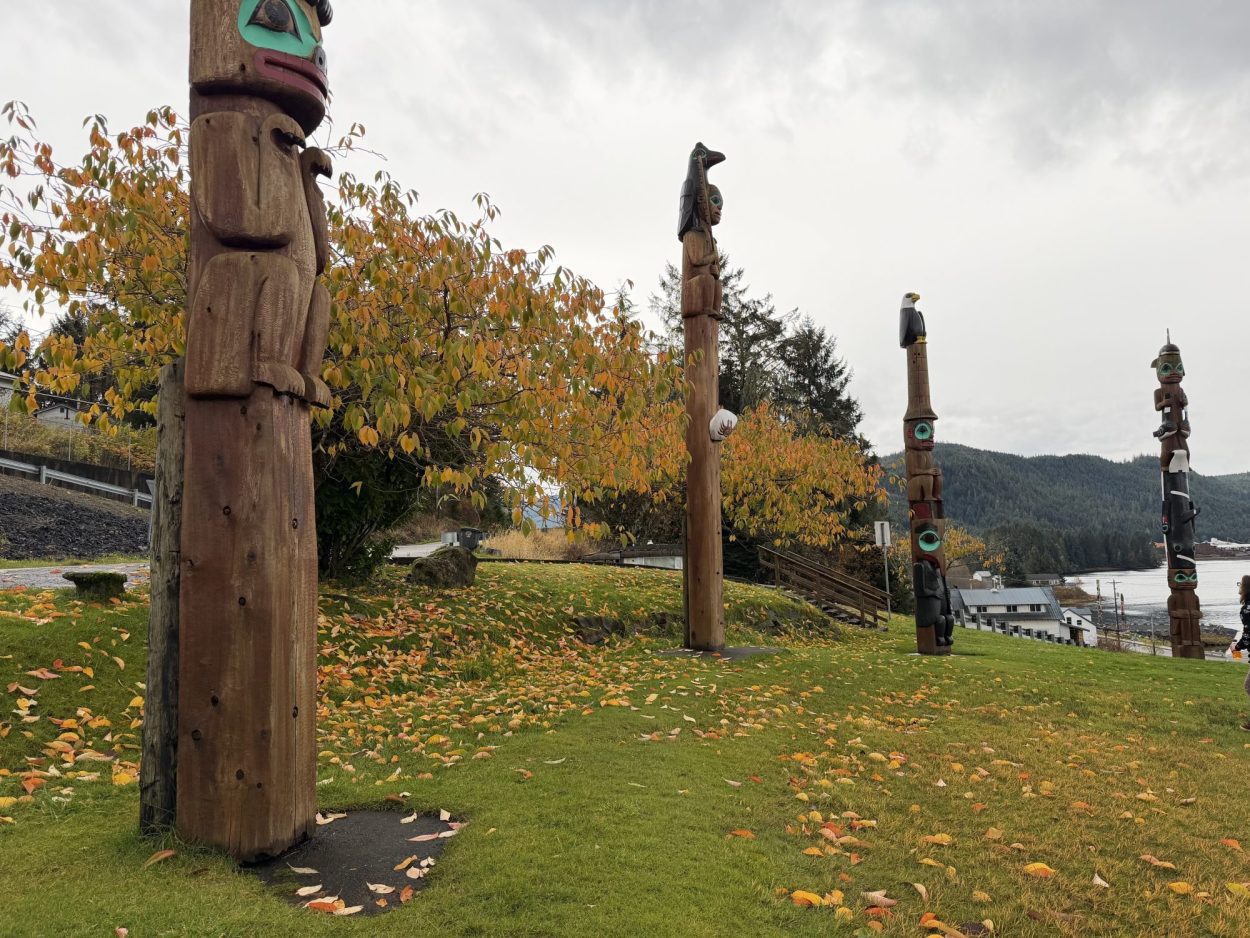
There’s a new social media trend of people dancing around Alaska Native totem poles to a Lil Jon song, replicating a scene from the 2009 movie “The Proposal.”
Ketchikan Indian Community, Central Council of the Tlingit & Haida Indian Tribes of Alaska, and Alaska Native Heritage Center sent out a joint press release last week condemning the behavior and calling on visitors to do better.
Emily Edenshaw, CEO of Ketchikan Indian Community, says the videos are more than just a harmful TikTok trend.
“I would very much equate the social media trend as the symptom of a root cause of lack of education, lack of awareness, lack of who and what a totem pole is and why we carve totem poles,” Edenshaw said.
She wants to offer solutions to the root cause, and says there needs to be a complete overhaul in the education system. Alaska history is Native history, and Edenshaw says the state’s education needs to reflect that. That includes the history of internment camps and Alaska Native boarding schools, which she says aren’t currently taught in schools in a meaningful way. She believes the erasure of Alaska Native existence in schools is, in part, what leads to disrespectful behaviors like these, and that people visiting Alaska have a responsibility to educate themselves.
“When you look at the time that it takes for a carver and his apprentice and the community to obtain the permission to harvest the log, to procure it, to carve it, to raise it, there’s so much more than what is being shared out in a 30 second video,” Edenshaw said. “I would encourage our listeners and our community to speak out when you see people distilling it down and turning beautiful, rich cultures and traditions into a mockery and into something as simple as a social media post.”
The press release was sent to cruise lines and tourism companies, asking them to publicly condemn the mockery of Native culture as well as actively educate visitors. She’d like to see Native languages on travel websites, land acknowledgements from pilots, and educational videos on cruise ships so that visitors understand Alaska is a Native place before they even arrive.
That responsibility to spread awareness, Edenshaw says, also falls on the state. She wants Alaska Native representation in travel marketing from entities like the Alaska Travel Industry Association. The press release was sent to state legislators and will be sent to Alaska’s congressional delegation.
Nicholas Galanin, a multidisciplinary artist and carver based in Sitka, says the social media trend is a form — and continuation — of colonization.
“Hollywood has a long history of stereotypes that misrepresent Indigenous people,” Galanin said. “A lot of that history is responsible for the intentional dehumanization of communities, linked directly to genocide and removal of our people, our children, from these lands.”
Galanin emphasized that there is no way to separate Alaska Native history from these totem poles — and that respect from visitors can go a long way.
He’s working on a totem pole for the Kootéeyaa Deiyí, or the Totem Pole Trail in Juneau right now. Sealaska Heritage Institute has spoken out about the disrespect to totems on that trail. In a recent Facebook post on Wednesday, they shared a photo of people climbing on a totem. They wrote, “Alaska Native people are not opposed to humor or having fun, however, the community has been working hard to move beyond 200 years of genocide, oppression, and very hurtful stereotypes of Indigenous culture.” In the post, Sealaska Heritage Institute asked the community of Juneau to help educate both guests and the visitor industry on the significance of the totem poles in an effort to prevent further desecration.