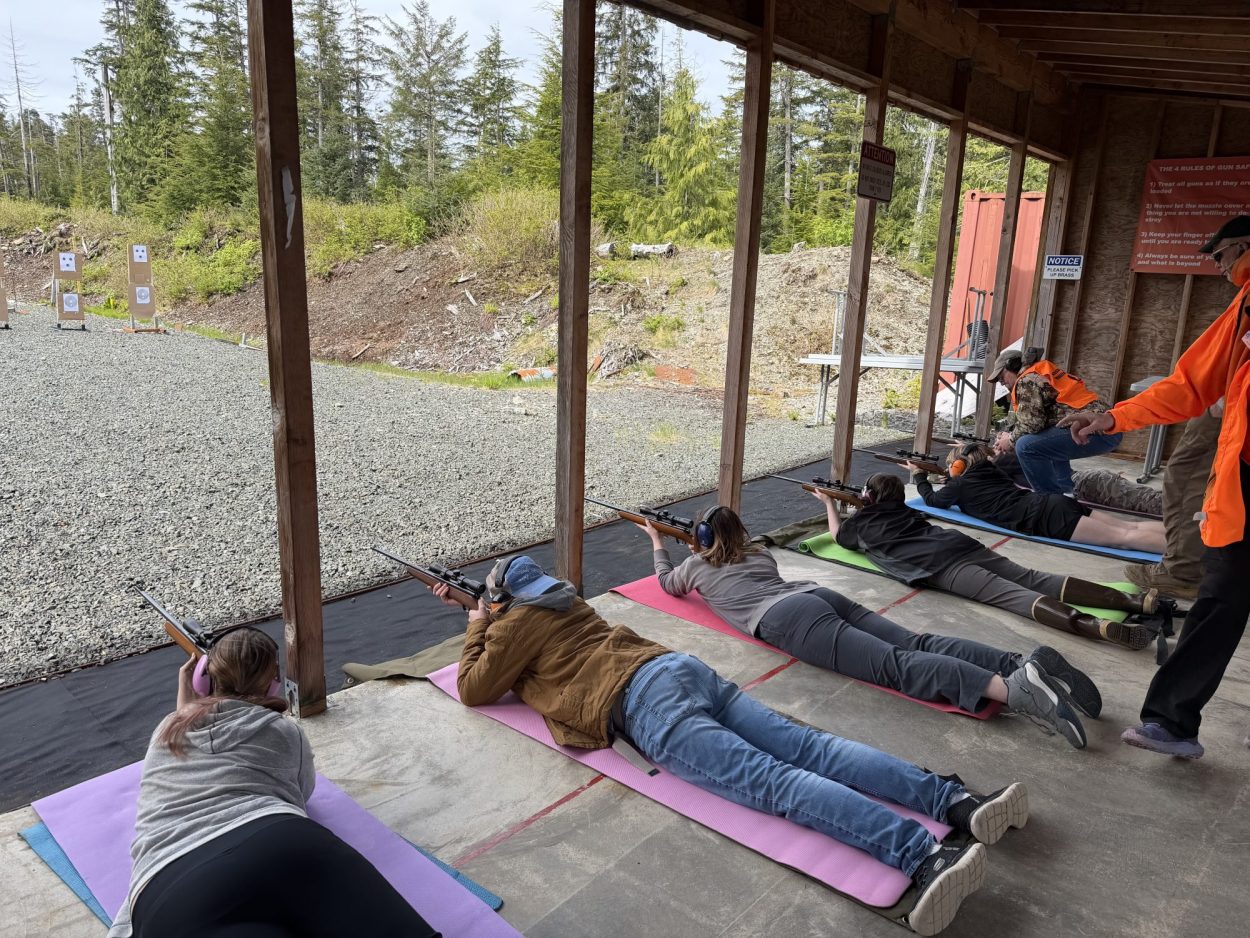
On a cloudy morning at the Prince of Wales Shooting Club last month, Emma Garrison, a ninth grader from Thorne Bay, was shaking a bit as she pointed her gun at the center of a target.
She and eight other students, armed with rifles and safety gear, lined up on yoga mats under a three sided shelter. Garrison had been taking the Hunter Education certification class all semester. She was finally putting her studying to the test.
“I was really nervous,” Garrison said. It was her second time ever shooting a gun. The first time was the day before, camping with her family.
There were over 30 students from the Southeast Island School District taking their Hunter Education field test.
This was the first year the district incorporated Hunter Education into the curriculum, with a goal to get every student from sixth to twelfth grades certified. The certification, which is through the state Department of Fish and Game, is required for most Alaskans to legally hunt. And for many people in small Prince of Wales Island communities, hunting is a key part of the lifestyle.
The Southeast Island School district is spread out, with around 150 students in seven remote schools across Prince of Wales and Baranof Islands. But all the students at the shooting club spent the last semester taking the course.
Ellen Hannan, a retired teacher and a volunteer with Fish and Game, has been teaching Hunter Education in Southeast for 25 years. When she asked how many students had ever shot a gun before, most of them raised their hands.
Hannan says that’s why the class is so important — she knows many of the students are around guns from a young age, and she wants them to be safe. The number one rule that they instill during the course: always treat guns as if they are loaded.
There were a handful of adult volunteers at the field test. Some of them were teachers with the district. Almost all of them had stories of preventable gun accidents. That’s part of why they teach safety before anything else.
Hannan helped the students hold and load their guns, shooting targets in different positions, like laying down, sitting and standing.
Down toward the clubhouse, students were taking a walk through the forest. It was part of the field test to identify cardboard animals and discern when, how and if it’s ethical to shoot them.
One of the students was Wyatt Farr, an eighth grader from Coffman Cove. He’s been hunting with his family for years.
“You get to enjoy the meat you processed, and I like it. Like deer meat spaghetti is good,” he said. “I just like being outdoors and actually doing things, instead of sitting there playing video games.”
Farr said he also likes how calm and quiet it is outdoors. The Hunter Education course also includes basic survival skills, wildlife conservation and respect for other hunters. That’s part of what he likes about it.
“So there’s not just like clueless people going out walking in the woods and getting hurt and stuff,” he said. “It’s also teaching the generations to come how to properly do things.”
Every teacher teaches the class a little differently. Melissa Dougherty, a teacher at Thorne Bay with a background in biology, designed the curriculum so it blends with broader outdoor education. She knows the outdoors are a big part of her students’ lives and she wants them to be aware of their surroundings.
Killing an animal is a serious thing, Dougherty said, and she wants her students to be thoughtful and observant when they’re out in nature.
“I think it’s really important to spend time thinking about how you fit into your environment and gaining an appreciation for the world around you,” she said.
Some of the class includes sitting outside and observing. That can be noticing deer droppings, or just taking note of different ecosystems.
“We’re learning how to just quiet ourselves down and really look and see what’s there, and observe, and then ask questions and take notes,” Dougherty said. “Because observations should always lead to questions. Questions should always lead to learning, and then that leads to more questions.”
At the end of the field test, students piled in buses and vans to go home. Everyone passed their field test and received their signed certificate.