(Sydney Dauphinais/KRBD)
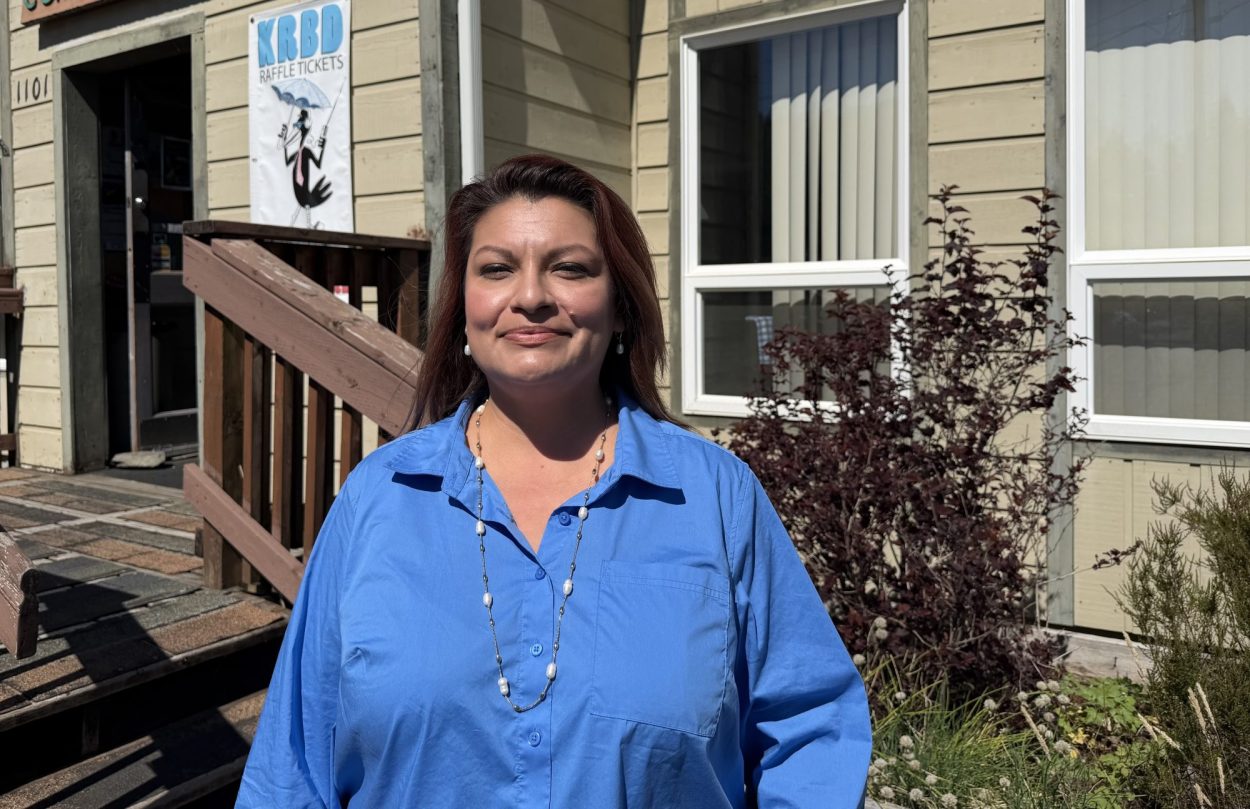
The Ketchikan Gateway Borough School District has a new superintendent. Kara Four Bear was hired earlier this year and started her role earlier this month.
Four Bear comes to Ketchikan at a time when the district is facing financial turmoil and millions of dollars of debt. School starts in a little over a month, and staff and students will soon adjust to school consolidations and decreased staffing.
KRBD’s Sydney Dauphinais spoke with Four Bear earlier this week about her plans for leading the district.
Sydney Dauphinais: Welcome in. I want to start off by having you introduce yourself, and can you tell us a little bit about your background?
Kara Four Bear: My name is Kara Four Bear, and I hail from the Dakotas of the Lower 48 or down south, as Ketchikan folks like to say. I’m a school administrator, of course. I started out as a kindergarten teacher in my early years, early childhood education as well, working with the FACE program, which is with three and four-year-old students, and I had some wonderful success with my teams in our elementary school in raising scores and helping our students to learn at the proficiency levels that they deserve to be learning at within our schools. So I thought, you know, I think I’d like to scale this up and make a difference in more kids’ lives, and so I decided then that I wanted to go into administration in education. I’ve worked my way up through assistant elementary school principal, middle school principal, and am now a superintendent, and have been for a few years now. So I do bring experience to Ketchikan, and most of my experience and success over my career has been with school turnaround models or school turnaround projects or initiatives. So by nature, I am drawn to schools with high areas of need for good purpose, and I am just motivated by having the opportunity to jump in and say, ‘Hey, let’s look at this a little differently. How can we build teams and move forward and make things better for our students and our schools and community?’
Dauphinais: I’m interested in hearing more about these school turnaround initiatives. Can you expand on that a little bit?
Four Bear: Sure. So, for instance, during my tenure as a middle school principal, I’d come into a middle school that had a huge number of at-risk students and the curriculum was very stagnant. It was kind of your basic ABCs and one, two, threes for that age level, and there was not a lot that was offered that was very inspiring or motivational or elevated. For instance, there’s a huge focus on discipline and [social emotional learning] because those were the needs for sure, but you have to motivate kids through education, and that just really wasn’t happening. And it wasn’t a matter of the staff not wanting that for the kids. It all really does go back to leadership and those accountability pieces, building systems with staff members, not for or against staff members, and really looking at the needs and the possibilities for student success. So we reinvented the wheel a little bit. We prioritized every teacher on board, every staff member within the building, including our paraprofessionals and our special education team members, and we formulated a core program that extended beyond English, mathematics, science, and social studies, and we included STEM education and social emotional education as part of our core curriculum. So every student got everything they needed tailored to their grade level and their need level as part of a multi-tiered systems of support framework. So it was very intricate, but very purposeful. Because we had everybody on board, they were a part of the design process for the system and the planning for it. It was easy for everyone to have a hand in pooling their strengths, like, ‘I can help out over here, I’m really great at that, this is my passion area, I’m a little weak over here, maybe you could pick up over there.’ It was really an all hands effort, and for the wonderful work that we did in supporting our students, we have become a less at-risk student population.
Through our work, we were able to be recognized as a team by the governor of North Dakota for building leadership. We won a state award for that, and we were invited to participate in the governor’s K-20W workforce initiative that included industry leaders from across the state, government leaders, education leaders, and were able to provide input on what that system of growth looks like for North Dakota. But we were able to bring an emphasis specifically for our student population, and we actually were invited to collaborate with as part of a delegation from North Dakota. We were the only K-12 school invited to visit ANSEP in Anchorage. They were hosting a really cool conference where they had selected participants to attend and they had received a National Science Foundation grant. Their purpose was to educate other institutions and organizations about the success and growth plan and development of their programs for students at risk and at need, and to build pathways for careers and areas of interest, and just even success in finishing high school if that was their goal, or to go into vocational school, or the workforce, for instance. It was an amazing experience.
So within North Dakota, we brought back that knowledge, and our middle school, in cooperation with Valley State City University in North Dakota and the North Dakota Department of Education, we had developed together a program for Native students and specifically in middle school grades to begin to attend these summer camps and build connections between the school, the college system, and it still exists now. It’s called INSTEM, and it’s really cool. So even though I’ve moved on in my career, it’s really great to know that that program still exists and those opportunities still exist for those students.
Dauphinais: That’s great. So as many people know, it’s been a tumultuous couple of years in the district, and there were just a lot of cuts made and unfortunate layoffs. Do you have any plans to ensure that staff are feeling supported in this time of transition?
Four Bear: Yeah, absolutely. That is the highest priority right now. Our staff members are home. Those that are still employed, those that aren’t, unfortunately, are home as well. Some have had to make the difficult decision to leave the community, unfortunately, and that’s never a win for any community or school system. So it’s a very trying time, but we have to focus on this coming school year that starts July 1. That’s kind of the beginning of the fiscal year, and those numbers don’t matter to the families at home necessarily. But I want the community to be assured that those that are still on the job year round are focusing on those topics. We have our administrative team who are still out until August, and so we’re eager and excited. Of course, we have wonderful ideas, and we’re brainstorming as a central office administrative team, and planning for areas within the system. But once we get our administrators back into the fold, and our teacher leadership back into the fold, and our teachers back into the fold, then we’ll have a more collective plan on what that looks like and get things rolling. We have to focus on our students, and to do that, we have to take care of our staff members. So that is our highest priority.
Dauphinais: At a recent borough assembly meeting, during your Board of Education report, you said that bringing stability to students is your highest priority. I thought that was really interesting and I was hoping you could expand on that a little bit.
Four Bear: Sure. So, of course, when communities go through difficult times, whether it be an issue with the school district, or, say, the pulp mill shuts down, just for instance. Huge things in the region, in the city, in the state — students feel those impacts regardless if they’re directly affected or not. Because we’re adults, we talk. Students watch the news. They’ve got devices. They’re not oblivious to the world around them, and so the purpose of bringing stability to students within the school system is ensuring that they can show up without feeling apprehensive about coming to the building despite us as adults having apprehensions. Because when changes happen, it’s not easy for anybody at any given point in time. But we have to remain steadfast and work through those changes and be the stability that the kids need. That really starts with us as adults, and that’s really that portion of us coming together and having that plan to make sure that our staff members are supported. So when our kids come in, it should be super seamless. Yes, there’ll be a few more students in the classroom. Some of them will be in new buildings. Some staff members will be in new buildings. But it really is a new year, and we have to approach it that way with some optimism.
We’ve got a plan in place for the fiscal issues. But with a focus being on the students, day one should be like any other day one for students and staff members alike.
Dauphinais: What do you think has been working really well in the district that you’ve seen?
Four Bear: Oh my goodness. So many things. I have to say, in my short time that I’ve been here so far, the community is just amazing. Outstanding. People on the street, even. The hellos, the waves, the nods, the courtesy. You see it in the community and it’s so very welcoming.
In relation to the school itself, the transition after the consolidation, it was really all hands on deck. Staff were in, community members were in, community partnerships and organizations were in to help with that school consolidation piece. Due to the fact that it had to be completed in such a short amount of time, then that leaves the administrative piece of planning for the next school year. So it really left a lot of leeway and a lot of time, which is what we need. We need time so that we can get ahead of anything that we might anticipate or not anticipate.
Dauphinais: And what is something that you see that isn’t working, or maybe the first thing that you would like to address?
Four Bear: Actually, that remains to be seen. I believe when somebody’s new coming into an organization and has a different perspective from being in it day to day, we can tend to just kind of melt into our system sometimes, and that’s not good or bad. That’s just human nature. But that fresh perspective coming in, I see opportunities for us to be more efficient in certain systems, and it’s just the way we get things done. Part of where we are, and why we are where we are, is because some of those systems weren’t administered well. That will change. We currently have a permanent human resources director. We now have a director of business and operations, and we have a superintendent. So I am 100% excited to have the full administrative team on board and ready to work. People are in their offices right now. Teachers are in their classrooms right now, on their own time even, and to see those things happening, it’s a true testament of the resolve and the purpose and dedication of the community members and our staff overall. It’s amazing. I really have no major complaints to say. There’s nothing we can’t work through. If we stumble across something, we’re going to make it better because that’s what we do.
Dauphinais: Do you have plans for how you’re going to approach community engagement, or maybe partnerships with community organizations?
Four Bear: I am a huge proponent of community partnerships. We can’t raise the child alone. You know, there’s the old adage: it takes a village to raise a child. It absolutely does.
We hear how much is piled onto the teacher’s plate — and this is historically true over hundreds of years — it was just to teach math and reading at the beginning, and then here’s science, and it just built and built over the years. And teachers today, we are super resourceful. We’re super knowledgeable. We have wonderful training, and we are professionals. We just really need to focus on not only extending our partnerships to the families, but how do we work with our community partners? Especially when we’re so fiscally limited these next few years, we have to be more persistent, and resilient, and resourceful, and so that is a high priority as well.
Coming up this year, we’re already meeting with several community leaders, part of organizations within and around Ketchikan, and getting on their radar, saying hello, learning about past projects that have happened, current projects, and then seeking out opportunities for us to build things so we can contribute to the success of our students. Specifically, right now, I think a high priority area will be that social emotional piece, and so I’ve got some great ideas, and so do our team members. It’s really just a matter of looking at the resources each entity has, and pooling together, and saying, ‘Let’s get this done,’ and finding creative ways to make things happen for our kids.
Dauphinais. Is there anything else that you would like to add that you think listeners should know?
Four Bear: I hope that our listeners understand that despite the current fiscal situation, we have a plan in place. Decisions were made by our assembly and our school board, and we’ve got a budget. And even though it did cost our community members and families some jobs, and everything else that entails when a loss is incurred to a family, that really sits at the heart of everything we do when we’re moving forward. It’s painful, but we have to recognize that we have to move forward at the same time. Know that everybody that is on board is still there. We’re there to move forward in a good way, in a positive way, and despite the mistakes of past administrations, this is not that administration. We’re currently very much open to transparency and working with the borough and getting things set right, things made right, things made just, because that’s what we owe our kids. That’s what we owe our taxpayers. You know, we have to do our jobs and we have to do our jobs well. And I’m thankful for the transparency piece. If anything, that’s a great motivator to want to do well for our school and community. But at the end of the day, we will need community support. You know, we are over that difficult transition. We’re moving forward. We’re climbing up the hill, and we’re really going to need the support of our community members, despite their thoughts on prior practices. We have the best of intentions. We have great experience, and we’re highly motivated. So, look for good things to be happening from us, and I hope everybody will be there to cheer us on.