The Ketchikan Indian Community submitted an emergency petition to the state’s Board of Fisheries in March, asking to reclassify European green crabs from a Class A to a Class B banned invasive species. This change would allow anybody to transport dead European green crabs for harvest or consumption. Currently, the invasive can only be possessed or transported for scientific or educational purposes by those with an Aquatic Resource Permit.
“This isn’t an issue that’s going anywhere, and it seems to be largely ignored throughout much of the state,” said Emily Halsell, a fisheries and wildlife biologist with the Ketchikan Indian Community. She’s leading a green crab monitoring and removal program, which officially kicked off last fall. The tribe has removed about 1,500 green crabs from Ketchikan beaches so far this year.
In its petition to the state, the tribe cites the species’ damaging impacts to the local ecosystem and economy. The adaptive critter can burrow and destroy eelgrass beds, which are nurseries for native species like Dungeness crabs and juvenile salmon. They can also compete with native crab species for the same resources. In its petition, the tribe said, “continued colonization of green crabs into Alaska’s marine habitats carries an inevitable and profound risk of disrupting local fisheries.”
Halsell said European green crabs are one of the top 100 invasive species in the world.
“So when these crabs come up and they tear up this critical marine habitat, there’s cascading population effects,” she said. “Not to mention just abiotic impacts on our coastline in terms of erosion.”
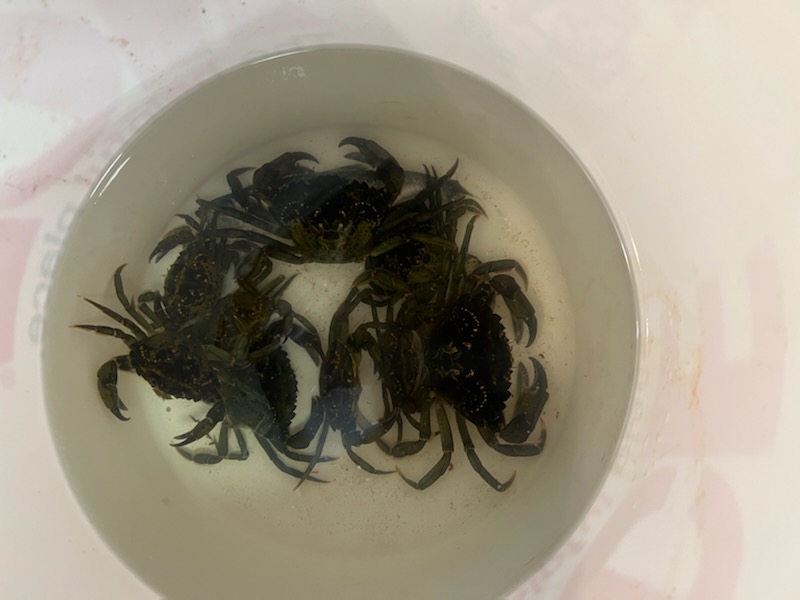
Despite the name, the species isn’t always green. It’s identified by three bumps between the eyes and five spines on either side. It was first detected in Alaska in 2022 on Annette Island, south of Ketchikan. They’ve since reached about 70 miles north on Etolin Island, south of Wrangell.
And the number of green crabs detected has increased. Last year, the Metlakatla Indian Community trapped over 40,000 of them on Annette Island, a large increase from the prior year, despite almost the same number of traps. The increase could be in part to the reproductive potential of female green crabs. Halsell said they can reproduce two or three times a year and can lay up to 180,000 eggs each time.
Other states on the West Coast have taken measures to protect the shellfish industry from the invasive crabs. Washington has earmarked state funds for green crab management efforts. And in Oregon, you can harvest 35 a day with a permit.
Halsell believes a change in how the crab is classified in Alaska, and opening a sport fishery for them, could help better manage their spread. She says right now, they can only be turned into compost by people who hold the Aquatic Resource Permit.
“Until we can come up with a more useful way to process these crabs and turn them into a natural resource, I just can’t imagine too many people being inclined to go through the process,” Halsell said. “So, I’m trying to lessen those restrictions to make it easier for the general public to trap and use crabs.”
Alaska’s Fish and Game Commissioner Doug Vincent-Lang, who denied the petition, said the state is determining how to best manage the invasive crab. They want to know more about the species’ distribution and how it impacts the environment before any changes are made. In the meantime, Vincent-Lang said the state is looking at other options.
“Before we get into a creation of a control program, we have a lot to learn just on how much impact there is,” Vincent-Lang said. “Whether there’s a cost benefit in trying to control the expansion, and if we control the expansion, how do we do that in a manner that doesn’t impact species that have commercial and economic value in the state?”
According to a letter from the commissioner’s office, the department, “does not believe there is food value in European green crabs due to their diminutive size.” The letter also states a lack of evidence that the invasive has contributed to changes in eelgrass habitat or caused changes in fishery populations.
Despite denying the request, Vincent-Lang said he is concerned about the invasive species in Alaska. He also applauds the tribe for submitting the emergency petition. But he said Fish and Game needs more time to discuss a potential green crab fishery with locals.
“I’m not opposed to the concept,” Vincent-Lang said. “I just think it needs to be fleshed out a little bit more, and I think it needs to be, you know, what does a fishery look like? What are the gear types that would be allowed, and what would happen with incidental harvests?”
The commissioner’s letter said Fish and Game emergencies are “rarely found to exist.” Regulations for Southeast Alaska won’t be discussed by the region’s Board of Fisheries until they meet again in 2028.
Halsell, with the Ketchikan Indian Community, believes green crab management efforts need to be addressed sooner than that. Although she understands the state’s concerns, she says green crabs are not going away, and they’re making their way north.
“So I’m trying to really impress upon people that this is something that concerns all of us, and we should all be on board with trying to keep them from absolutely decimating our environment,” Halsell said. “We’re Alaskans, and we love our coasts, and we love our natural resources, and this is something that’s going to affect all of us.”
Halsell believes Alaska’s invasive species department is understaffed and underfunded, and said more needs to be done on the state level to manage European green crabs. Currently, the state helps with trapping programs and works with other states to research the issue. Halsell said some states on the East Coast have opened sport fisheries and seafood industries for European green crabs.
Halsell hopes to petition Alaska’s governor to declare a state of emergency for European green crabs. She said that could bring more state money to manage the invasive species.
Hunter Morrison is a Report for America corps member for KRBD. Your donation to match our RFA grant helps keep him writing stories like this one. Please consider making a tax-deductible contribution.