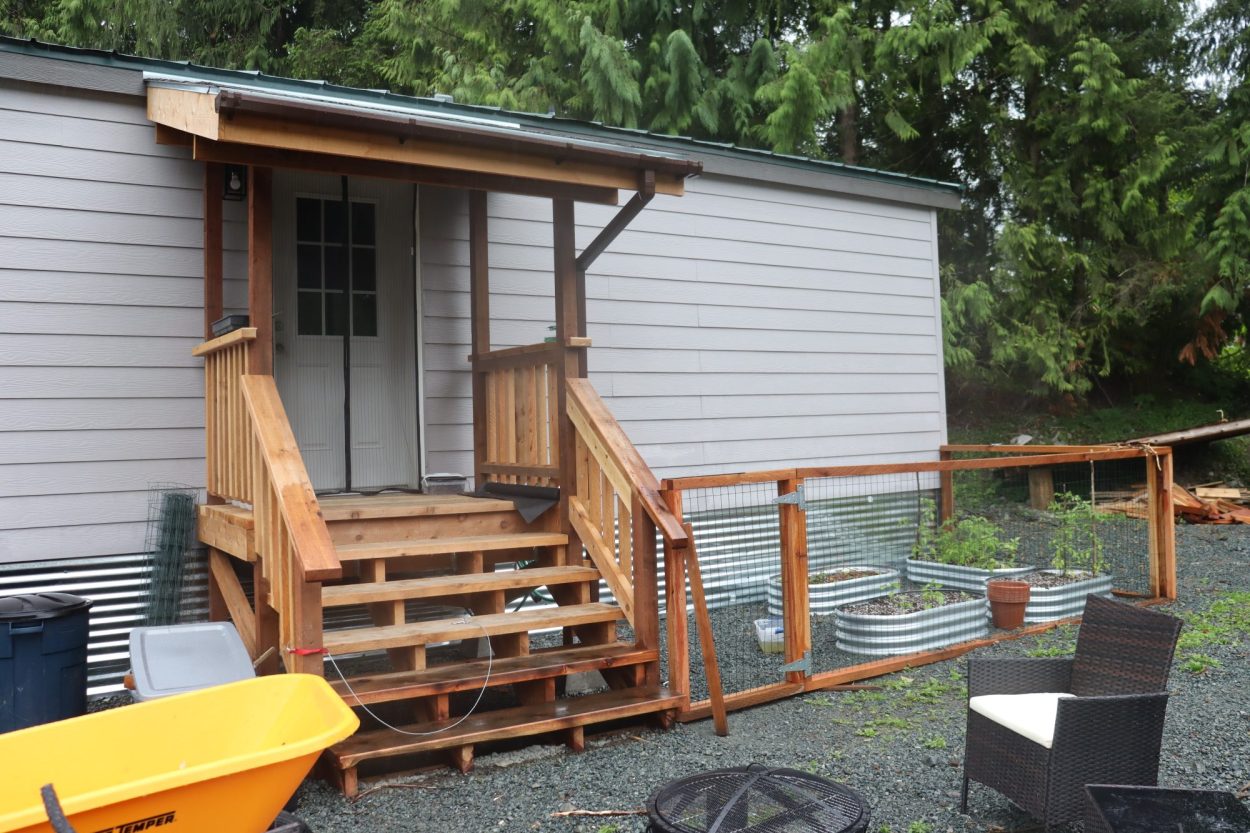
It was a rainy evening in Thorne Bay, on the eastern side of Prince of Wales Island. Rod Morrison, superintendent of the Southeast Island School District, walked up to a house and pointed to a newly constructed wooden deck by the front door. The aroma of freshly cut lumber filled the air.
The deck, and nearby wheelchair ramp, is one of three that high school students recently built for the community’s teacher housing. They also constructed a food pantry, and a home deck in Naukati, a small town 40 miles northwest.
Morrison said the eight-week summer construction class is one way the district is trying to prepare its students for the workforce.
“You know, our students in Southeast Alaska, especially on the island, not all of them go to college, but they all go to the workforce,” Morrison said. “And it’s really important to us that the kids, when they leave our schools, can contribute and make a wage, and do what they’d like to do.”
According to the U.S. Bureau of Labor Statistics, the construction industry has seen steady growth since the pandemic. But training opportunities for the trade, especially for those under 18 years old, are few and far between on the large, isolated island.
It’s the first time the school district has had full-fledged career and technical education, or CTE, programming since they lost state funding for it almost a decade ago. They’re the recipient of two federal grants to fund teachers, materials, training opportunities and more.
The push is part of a collaborative effort with three other school districts on the island to increase student access to CTE programming. They’re also partnering with tribally led entities, Sealaska Heritage Institute and Generations Southeast, to make these courses happen.
Morrison said the construction class is the first step in building new career pathways for students on the island.
“The idea is that Alaska’s workforce comes from the Lower 48,” Morrison said. “We want to help supply Alaska workforce with Alaskans.”
The new construction class provided high school students with real-world building experience. Students also learned basics, like rise and run, while constructing staircases and decks.
Students even got paid an hourly wage.
“I think it’s good for the kids to have something constructive to do during the summer,” said course instructor Daniel Nelson. “A lot of times on these small islands, the island doesn’t have a lot to offer for teenagers.”
Nelson is an experienced construction worker and will soon be teaching several CTE classes on the island.
“I think it benefits them with a 9-5 job, understanding what it takes to show up every morning, to be diligent, to work hard, and to understand what a job is going to look like after high school,” Nelson said.
Nelson, who was pretty hands off when students were building, said he wants them to walk away from the class knowing how to build a deck of their own. He said even if students don’t pursue a career in construction, the skills they learn is something they can add to their toolbelt.
Many of the roughly half dozen students who enrolled in the construction course took a woodshop class last school year, where they learned how to use power tools. Others have prior experience in construction work and wanted to build upon those skills.
But Tristan Dolan, a sophomore at Thorne Bay School, said he had no construction experience and wanted to learn something new.
“I think my favorite thing about this class was just learning the overall idea of how it would go on a construction site, or like a part of it, and just seeing the overall idea,” Dolan said.
Morrison, the superintendent, said the new course provides a different medium to learn math. He said that’s beneficial to students who might otherwise be unmotivated in a traditional classroom setting. That, he said, can also build confidence.
“You know, in my opinion, a lot of young people struggle with confidence,” Morrison said. “I think when you build something and you see it come together, there’s a sense of pride that happens with that.”
Morrison said the district plans to ramp up the island’s CTE courses in the coming school year. The district is going to offer an electrical program where students can get their apprenticeship card with the International Brotherhood of Electrical Workers. They also plan to offer courses in welding, scuba diving and other trades.
Hunter Morrison is a Report for America corps member for KRBD. Your donation to match our RFA grant helps keep him writing stories like this one. Please consider making a tax-deductible contribution.