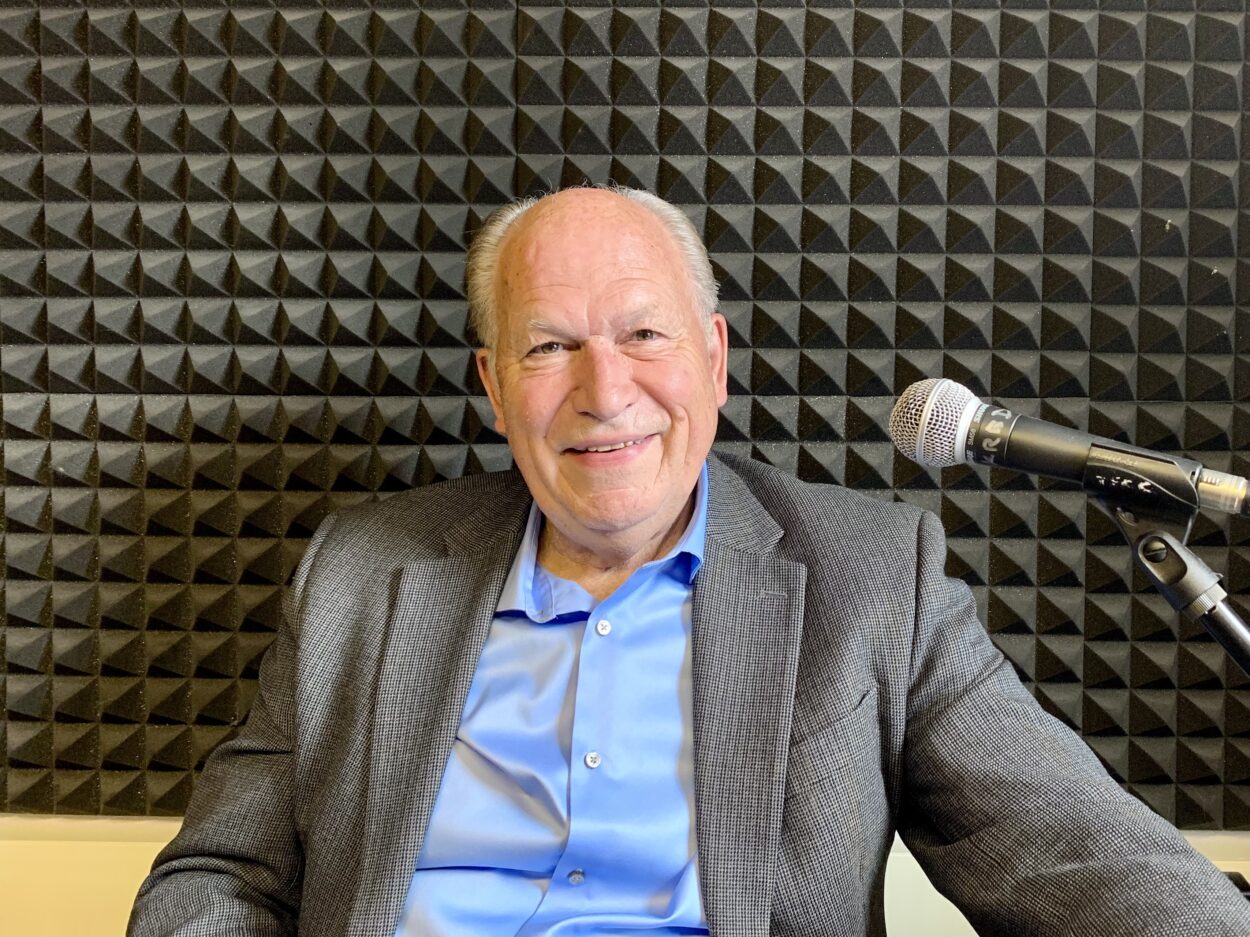
Voting is happening now for Alaska’s primary election. Bill Walker is one of the many candidates on the ballot, running as Independent with running mate Randy Hoffbeck.
Walker, who served one term as governor from 2014 to 2018, is running again. During his most recent trip to Ketchikan, KRBD’s Sydney Dauphinais spoke with Walker about his plans and priorities.
Editor’s note: this transcription has been lightly edited for length and clarity.
Sydney Dauphinais: To start off, why are you running for governor?
Bill Walker: I’m running because, as a lifelong Alaskan, and I formerly served as governor, I see the fiscal situation that Alaska is in as a crisis. I am running with my lieutenant governor candidate, and Randy Hoffbeck was my commissioner of revenue, so we are running with solutions to resolve the fiscal situation that we’re in. Certainly there’s other issues that bring us to the table, but the fiscal situation is very critical. The affordability of living in Alaska is there. I’ve been very involved in the gas line for a long time. That’s a big issue, but really, it’s our financial underpinning we need for the state to grow like it should.
Dauphinais: So you said that you have ideas for fiscal solutions. Can you speak a little bit about that?
Walker: One thing I love about this campaign, especially with Randy, is that we’re about solutions and not slogans. So when we say a fiscal plan, we’ll give you lots of detail about what we’re talking about on the fiscal plan. You know, I say that Alaska is not broke; it’s broken, and we need to fix Alaska so we don’t become broke.
So one of the things that people talk about is broad-based revenue and taxes and all that, and I say no, no, not until we get our revenues from resources fixed. You know, 10 years ago there was a Senate Bill 21 that passed by, I believe, by one vote, and there was a repeal effort in 2014, the year I was elected governor, and I was very much in support of repealing Senate Bill 21. I thought it was going to be a disaster. 90,000 Alaskans said repeal it. 99,000 said keep it. So it stayed, and it’s been 10 years, and we have lost money every year. We’ve been underwater ever since, and sometimes some years to the tune of a billion dollars. In my case, it was $4 billion. I was the governor when it first came into effect, and we lost half our revenue that year, so it’s been a disaster. So we want to go from that Senate Bill 21 legislation to a gross tax on our resources. In other words, rather than having all the deductions, all the audits, all the litigation, all the secret settlements, just take it off the top. Pretty much every other state in the nation just does a gross for that reason. They don’t want to mess with all the downstream deductions and this and all the other things we do. So we want 13%. That’s not the highest in the nation, but it’s not the lowest in the nation either. Gas right now is 13% already. The only gross we use in the state of Alaska, quite honestly, is on fisheries. That’s the only gross we use. Everything else is on a net.
I love mining. I’m a big resource development guy, but in 2024, according to testimony before the legislature by the Department of Revenue, we extracted the value is about $4 billion of resources from Alaska, our share was a negative number. We actually lost money that year. So, you know, we’re the only state in the nation that does on a net, on a gross. We’re talking you know two or 3% We’re not talking a big number on that, but we don’t want to hurt any industry at all. But my goodness, I don’t, I don’t think getting a negative number on a $4 billion extraction is really what we should be doing. So it’s a matter of getting our revenues from resources right, and then deciding what we do after that.
You know, we’ve identified just those couple things as about a billion and a half dollars of additional revenue, we need to grow the pie, but Alaskans have already given twice. They’ve given us a lower dividend, and the percentage of market value has caused the permanent fund corpus, the body of it, to grow not as fast as we’d like it to, because we’re using part of that to fund government services. So, Alaskans are paid twice, and I’m not against a broad-based tax down the road, perhaps an income tax, but not until after we get our revenues and resources right.
Dauphinais: So, how would you say that these priorities and this campaign more broadly differs from your previous ones?
Walker: In previous ones, we talked and we’re talking in concepts, and now we’re talking in specifics. This is a very different kind of campaign, and I’ve enjoyed this more than any campaign I’ve ever been in because we don’t have lots of contributors. We don’t run around trying to raise money and win the money raising contests. We are focused solely on solutions. Sometimes, when you have tons of endorsements or certain things that you kind of can’t do, because who’s endorsed you, you know, it has certain sort of expectations, and not directly, but I think there are those expectations, and we don’t have that. We’re free agents. We can say and do whatever we think is best interest of Alaska without hesitation. I sometimes refer to it as what I call the political stutter. That’s when you get asked a hard question. You have to remember who your donors are, who your supporters are, and have to be careful how you answer. We don’t. We just answer very quickly, and every answer is what we believe is the best interest of Alaska. I was born in the territory. I’ve seen the ups and downs over the years, and I know what works and what doesn’t work.
Dauphinais: We’ve talked a lot about the financial crisis that the state is in. What other priorities do you have?
Walker: Well, certainly education is. A big frustration I have is that our our turnover rate with educators is is very high because we don’t have a pension plan, we don’t have a retirement plan, and every year you sort of wait almost like the sort of Democratic who’s who’s not going to be here in the school system next year because of the cuts that have to be made, because there’s less and less and less funding. We need to get away from that. We need to get back to educators being valued at what they do. The most important jobs in Alaska are the educators, as far as I’m concerned. So, you know, I read a book when I was governor, it was titled “The Smartest Kids in the World and Why.” And my takeaway from that is that the highest numbers on graduation were places where the educators were honored, they were respected. You know, you go to a mall and there was special parking places for educators. It was not always monetarily rewarded, but they were held up in highest esteem. We don’t do that here in Alaska anymore. We used to, and we need to do that again.
Dauphinais: How would you plan to do that?
Walker: With proper funding. Again, it all sort of stems from the fiscal plan. If you don’t have a fiscal plan, we’ve been living off of borrowed money for the last 13 years, and we’re now down to about $3 billion in savings. What happens when that’s gone? So that’s the concern we have: is that we have to have the foundation. I’m a carpenter by DNA, and if you know if you don’t have a proper foundation, the rest of it is just noise. You’ve got the fiscal plan that is the foundation for the future of this state. I watch the marine highway system, you know, over the over the decades, used to be the rising star in the state of Alaska was the Alaska Marine Highway System. Now it’s on a decline, and it has been for quite some time because money hasn’t been put back into it. Again, we get back to the fiscal plan.
Dauphinais: Yeah, in Southeast, the Alaska Marine Highway System is very important. Do you plan on reviving that? If so, how?
Walker: You know, I’ve thought about this a lot. I would have done it, if I’d had a second term to do this, I think it’s time that we pull Alaska Marine Highway System out of the Department of Transportation. I think it needs to stand on its own. I think it needs to grow on its own. We have 237 airports in Alaska, which we own. The next highest state is Oregon with five, so it kind of puts it in perspective. So we have 237 airports. We’ve got 1000 miles of highways to maintain. The marine highway system needs to be on its own, be separate, and I know that when it was combined, it was for efficiency purposes. And I love efficiency, don’t get me wrong, but I think it kind of got lost into a bigger system, and it’s critically important not just to Southeast, but to all of Alaska, you know, to not have a connection into into Prince Rupert, that changed a lot of things in Southeast and in Alaska in general, so it’s time that it be it be separated and let it grow and become what it used to be quite honestly and I think it’s been held back not intentionally but I think it’s been held back because it’s big it’s part of a to me almost a stepchild in in this process, and not really the attention that should have received.
Dauphinais: So, when you were governor previously, you said if you had another term, that’s something that you would have liked to address. What are other things that maybe went unaddressed previously that, given the chance, you would like to address going forward?
Walker: Well, the rest of the fiscal plan. You know, when we were $4 billion in the hole, I called together several 100 Alaskans to the University of Alaska Fairbanks for a three-day summit on our fiscal situation. We all stayed in the dorms because it was cheaper. It was summer. We were available, and we came up with a fiscal plan. We took that and went out and had 500 town hall meetings around the state. And Randy Hoffbeck, my lieutenant governor candidate, was the captain of all that. And we then presented the fiscal plan, listened to what we heard, modified it, took it to Juneau, and presented it to the legislature. We got some of it through, not all of it through. We want to finish the fiscal plan, and that’s what we would have done the second term is finish the fiscal plan, so that we aren’t in the situation that we’re underwater financially, and that we’re underfunding education, underfunding every facet of governmental services you can name. So, really, it’s about finishing the job, and I think with our experience, having served once, having been there, we can hit the ground running on the fiscal plan and get that through, and get Alaska back on track financially.
Dauphinais: So it really sounds like getting the fiscal plan put in place is what would happen before anything else, like a day one priority.
Walker: Absolutely, it has to be. It has to be up front because everything else flows from that. I mean, if you don’t have the financial wherewithal to fix things, it’s hard to fix things without funding. As an example, our deferred maintenance, you know, it was 1.4 billion a few years ago. I haven’t seen any numbers since then, but I mean, deferred maintenance doesn’t get better with time. It gets worse with time. Deferred maintenance doesn’t have a real constituency. You don’t have ribbon cutting and golden shovels and handshakes and pictures that are on deferred maintenance. But it’s got to get done. But I want to do it in such a way that it’s done on bite sizes, so that in the local communities, the local contractors have the first opportunity to do that work, rather than bringing in a large outfit from Seattle or Portland or LA to do the whole thing. I want to make sure this is done so there’s a double benefit from that in the economy, the local community contractors, as well as just getting it done.
Dauphinais: What’s something that you are particularly proud of from your previous term as governor?
Walker: You know, I sort of went against the grain and accepted Medicaid expansion on my signature. I let the legislature have their opportunity to do it. They wouldn’t take it to the floor to vote. I gave them a special session. They wouldn’t, so I signed it myself, knowing I was going to get sued, also knowing I was going to win, and so I think the last number I heard was 70,000 more Alaskans have health care coverage because of that signature. So I was pleased with that. I was pleased that we created the governor’s Tribal Advisory Council, and to have a relationship with the tribes in Alaska that have never really had much access to administration, and so we brought them to the table. The 17 and let them select who they wanted at the table. We dealt with energy, we dealt with housing, we dealt with subsistence fishing, we dealt with all the issues that you know, and I think that was very productive to have that relationship with them. You know, I created a climate change action committee, which came out with a report about the impacts on Alaska from climate change and what and what some of the solutions are. I’m a big believer of ‘don’t just bring me the problem.’ You know, bring me your idea on the solution as well, and I learned that Governor [Wally] Hickel had that philosophy in his hotel, so that’s what they did. So we were aggressive in that regard, and we had a cabinet that I honestly didn’t know and didn’t keep score of what their political persuasion was. I didn’t care, I just wanted the best, and they were selected based not on who they knew, but what they knew. And when I interviewed them, certainly their resume was important. But I looked for passion. If they had the passion, that’s who I hired. I wanted people in those positions that had a real passion for what they’re going to do, and not just that they were qualified. So passion took precedence over anything else.
Dauphinais: When did you file to run?
Walker: You know, we filed on kind of the last day.
Dauphinais: That’s what I thought. Why?
Walker: It was intentional. We waited, we waited and we watched and we read to see who is going to talk about the fiscal, who’s going to talk about the hard stuff? And we didn’t hear much. We heard a lot of talking about build this, build that. You know, some people are coming out and saying, you know, vote for me. I’ll give you a full dividend. And no one is talking about the fiscal situation. And so we just said, are we going to really stand by and and let this go through and and not bring this topic out because we’re talking about it, others having to talk about it, and so so that’s why I mean it was it was we’re trying to be respectful the system and let it sort of you know time for somebody new this that new other thing but but we didn’t hear anybody talk about the fiscal and because that’s really our our specialty if you will. And I’m a resource development person. We have some ideas about that that I’m happy to discuss on resource development, how we can do it better, and how we can do it more aggressively, but certainly very responsibly. So, it was on the last day, but we’d been looking at it for some time and talking about kind of waiting for somebody to come out and carry this message. We didn’t see it.
Dauphinais: That does give you a limited time for campaigning. What is a message that you are hoping to get across in these next couple, you know, basically weeks?
Walker: So our message really is about solutions, and we really, you know, I think we say solutions, not slogans, because really, as an example, you know, a good politician would run from the hard stuff. We run to it, the Permanent Fund Dividend, as an example. You know, I reduced it in 2015 because we had a $4 billion hole in our budget, and we reduced the budget by a billion dollars. And before we did anything on the dividend, if we had continued to pay full dividends, the dividend program would not be in existence today, because it would have over overdrawn it, and now it wouldn’t be there. It just wouldn’t be there. There wouldn’t be a dividend today. So, I made that difficult decision. So we decided, all right, let’s start with the dividend. Let’s start with that. I mean, you’d think I would run from it, but nope. We run to it. So we’ve come up with a concept on the dividend. It’s a dividend from resources. In other words, all the resource revenue we received on taxation from oil, from gas, from mining, from timber, from fish, all goes into a pool, and 50% of that goes to the dividend, with a guaranteed floor of $1,000.
In other words, on the low years of oil prices, like when I was governor, it would be a you know a minimum of $1,000 dividend. But when oil goes to $100 or $110, like it is now, well, the dividend goes up because the revenues go up. So we would use the earnings from the dividend from the permanent fund on the steady-eddy kind of education forward funding, education, public services, public safety, public health, and then the volatile part over on the dividend part with the floor. So when oil goes to $100, you know fuel in Alaska goes to about $6, $7, $8, depending upon where you live, sometimes the highest $15, the dividend will go up that year because there’ll be more revenue from the resources that year. So, we think that’s better. We pulled that, and 67% of Alaskans said, “I like that idea. The revenues from resources create an alignment, and I think that’s important in Alaska. We have an alignment on that. So, that’s one of the things that we have spent time talking about on a permitting side to do resource development in Alaska, whether it’s mining or oil and gas, whatever. It takes 10 years to get a permit. In other states, it’s a matter of months, and the reason is that it’s just a long process in Alaska. So we are the owner of the resource. We’re an owner state. We’re owners of the land, other than of course a lot of federal land in Alaska, but we should be doing the permitting ourselves. We should begin the permitting process ourselves. So when someone comes in to lease a piece of property for development, they can go to work rather than waiting 10 years. The problem is with the 10 years, you only have a few companies out there that are large enough to wait that long to endure that risk. The biggest risk is not if you’re going to find something. Are you going to get the permit? So we should permit some of these things, and so that we don’t have to wait 10 years.
The other issue that brought me back into the race is the gas line. I’ve been working on the gas line for a long, long time, and we’ve been very close a number of times, very close. But then we have an election like we did in 2018, new governor, new plan, or other other political decisions that have caused it to not be built. We need it now. It used to be something that was sort of nice to have. We absolutely need it now, and you know it’s the largest stranded conventional gas in North America up on the North Slope. We re-inject more gas every day on the North Slope than they consume in California, Oregon, Washington combined. Largest 9.2 billion cubic feet a day. So we need to get that gas to market. We need to get it to Alaskans. And having worked on that before, I’m ready to pick it up where we left off. And you know whatever hand we’re dealt, we’ll play it. You know if this Glenfarne Group is the one, that’s great. We’ll help them every way we can. If they step away, we’ll find out if it’s economic. You know what I do differently than what’s being done now is on the gas line. I would make it much more transparent. I think Alaskans need to know sort of what the deal is, and so. So I would be much more transparent with a gas line.
Dauphinais: What does that transparency process look like? Look like. What does that mean to you?
Walker: That means making the contracts, if negotiated, public. That means if someone comes and says, ‘I need this concession,’ Alaskans should know what they’re going to get out of it. If you’re going to give something, you want to know what you’re going to get back, and so you don’t know that without seeing the contracts. There’s no reason not to make that available.
Dauphinais: Where can listeners learn more about you?
Walker: walkerhoffbeck.com is our is our website and everything we talk about we put on there and post that on there. We had a webinar recently, sort of a town hall meeting, if you will, and so that’s posted on there as well. So go take a look, and we hope that you recognize that our goals are absolutely not a political career or looking for a job. We’re looking to fix Alaska, and we believe we have the the background and the intestinal fortitude to do what’s best for Alaska.