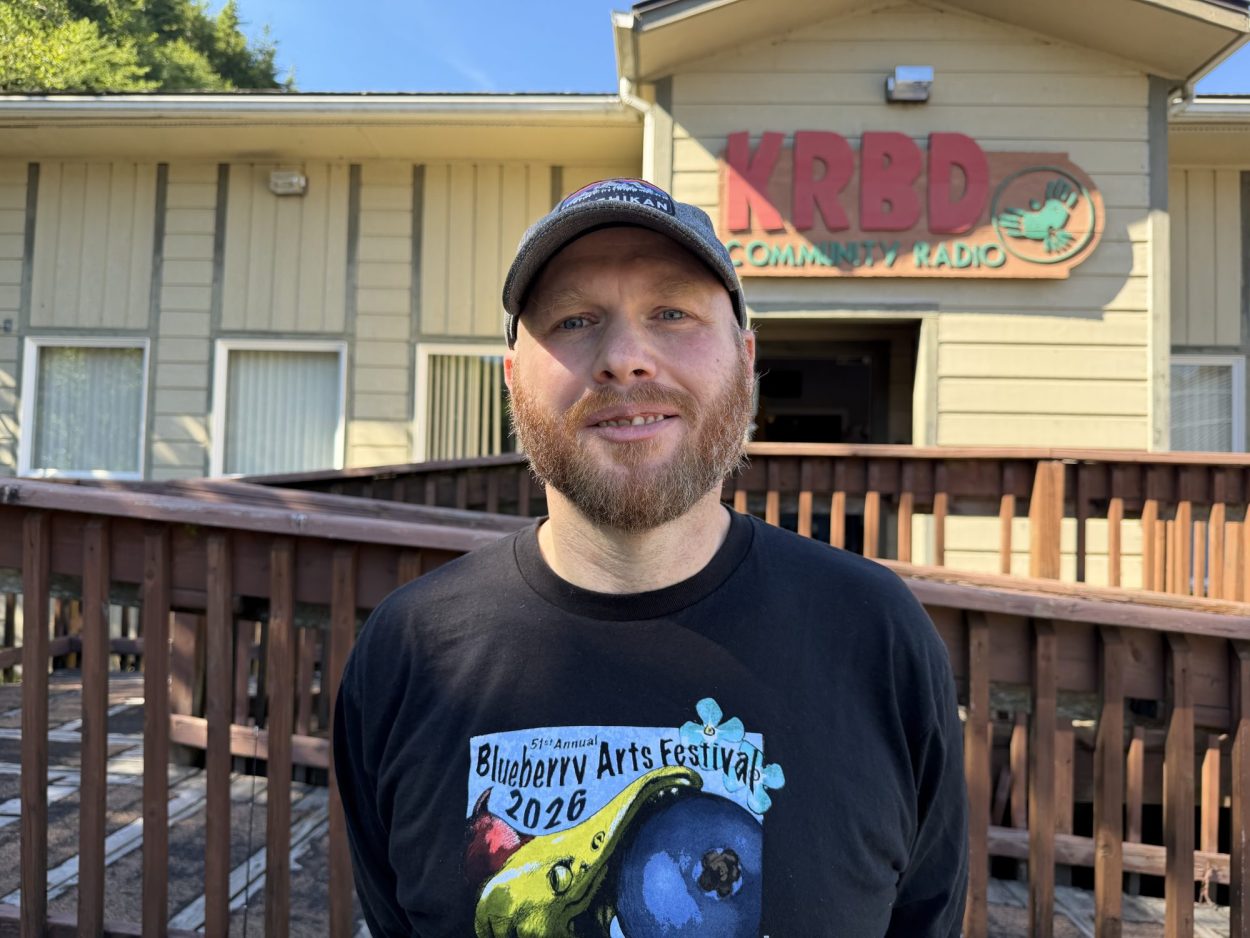
Name: Tommy Haugum
Age: 42
Occupation: Clinical Supervisor
Where are you from? How long have you lived in Ketchikan?
I was born and raised in San Diego. I moved to Ketchikan 2 years ago.
What is your community involvement, past and present?
I have always been active in the communities I have lived in, especially when it comes to the arts. Here in Ketchikan, I have been a very active member and performer for First City Players. I was involved in a regular show for about a year at Creek Street Cabaret. I attend and perform regularly at the town open mics. I have performed at Story Slam and had poetry shared on KRBD’s “One Poem a day”. I am also a member of the Ketchikan Arts and Humanities Council and had a table at the Blueberry Festival this year. Lastly, I engaged in the hummingbird festival this year and had a couple art pieces displayed in support of the festival.
Have you previously run for public office? When and what office?
This is my first time running for public office.
Why are you running for city council?
I hope to be one of the voices of change for the community. In my time in the community, I have had a lot of conversations with local residents who have expressed a desire to see change within local government. After a lot of consideration and strong encouragement from community members, I decided to run for one of the open City Council positions. I think it is important for voters to know that change in local government will require multiple people working together to achieve similar goals. I hope to be one of the voices for that change, and I am hopeful there will be other like-minded candidates voted in with me that will also be voices for change.
What are your top priorities if elected?
My top priorities if elected are ensuring a balanced budget, engaging in discussion and policy to improve the impact of tourism on the community, engaging in discussion and policy to improve our fishing and maritime community, working on government transparency, and working on policies to improve the quality of life for our year-round residents.
What is your stance on the ballot proposition asking for the transfer of library powers?
I support the goal of providing stable, effective library service for everyone in the Ketchikan Gateway Borough, and I’m not opposed in principle to transferring areawide library powers to the Borough. However, I have concerns about this particular proposition because it appears to ask voters to approve a major change before the Borough has provided enough detail about how it would work.
Before taking on areawide authority, voters deserve clear answers about the future of the existing library building, its employees, services, collection, governance, and funding. They should also know whether the Borough intends to operate the current library, negotiate a new agreement with the City, or pursue a separate facility—and what each option would cost.
As a City Council candidate, I would support working cooperatively with the Borough to develop a responsible long-term plan. But I do not believe the public should be asked to approve a transfer of authority first and receive the details later. I would prefer a transparent process, a clear implementation plan, and firm commitments to preserve reliable library access before moving forward with a change of this magnitude.
Do you think the city is doing an adequate job keeping up with infrastructure and community needs that come with increasing tourism? If not, what steps should be taken to address it?
No, the city is not doing an adequate job keeping pace with the infrastructure demands and community impacts created by peak tourism. While visitor volume has grown, our core municipal systems—including water, sewer, streets, downtown sidewalks, harbor access, and emergency response—are stretched thin every summer. Year-round residents feel that strain daily through traffic gridlock, blocked waterfronts, and overcrowded public corridors, while deferred maintenance on city facilities continues to mount.
To fix this, the city must take four concrete steps:
- Conduct a True Infrastructure Capacity Audit: We must realistically evaluate what our water, wastewater, road networks, and emergency services can sustain on peak ship days, and tie all future waterfront and downtown planning to those hard limits rather than hoping our aging systems won’t fail.
- Make Tourism Pay for Its Own Footprint: We cannot allow visitor-related costs to deplete general fund dollars meant for basic resident services. Commercial Passenger Vessel (CPV) funds and municipal passenger fees must be aggressively and legally deployed to shore up shared utilities, maintain docks, expand public restrooms, and fund summer emergency services overtime.
- Deploy Hands-On Crowd and Traffic Management: We need immediate, seasonal traffic controls: moving large private motorcoach staging out of the downtown Front and Water Street bottlenecks to designated outer transit hubs, and deploying seasonal crossing guards alongside foot or bike patrols to keep intersections clear and safe for residents and emergency vehicles.
- Demand Collaborative, Proactive Planning with Industry: The City Council must sit at the table with cruise lines and tour operators as an equal partner to stagger arrival schedules, coordinate onshore movement, and establish clear operational expectations well before ships arrive in May.
Ketchikan can welcome visitors, but our municipal infrastructure must work for the people who pay taxes, raise families, and maintain this island twelve months a year.
What are ways the city council can address the housing affordability crisis?
The City Council must approach housing not as a speculative debate, but as essential municipal infrastructure. When our young families, teachers, healthcare workers, police officers, and seasonal trades cannot afford to live here, the entire community suffers.
To address the affordability crisis practically and responsibly, the Council should take four targeted steps:
- Inventory and Release City-Owned Land for Workforce Housing:
The city owns underutilized upland parcels that sit idle. We should identify suitable parcels, extend basic water and sewer access to property boundaries using state and federal infrastructure grants, and offer them via competitive proposals to local builders and non-profit housing trusts with deed restrictions that prioritize attainable, year-round workforce housing over seasonal luxury rentals. - Modernize and Streamline Zoning and Permitting Codes:
Our building codes and setback rules must be updated to remove unnecessary red tape. We should permit accessory dwelling units (ADUs) by-right in residential zones, reduce excessive minimum off-street parking mandates where street layouts allow, and expedite the permitting process for infill development, multi-family conversions, and cottage-style clusters. - Protect Year-Round Long-Term Rentals:
The conversion of long-term residential housing into unmonitored short-term vacation rentals directly drains our year-round inventory. The City Council should implement an enforceable registration system for short-term rentals that protects traditional bed-and-breakfasts, ensures transient occupancy taxes are fully paid, and prevents residential neighborhoods from losing their long-term rental stock. - Partner with the Borough and Tribal Entities on Regional Infrastructure:
Housing does not stop at city limits. The city should actively partner with the Ketchikan Gateway Borough and the Ketchikan Indian Community (KIC) to pool capital grant resources, align utility extensions, and back regional housing authorities developing mixed-income, multi-family neighborhood developments.
By combining smarter land use, modern zoning, and targeted infrastructure extensions, the city can spur housing supply without burdening local taxpayers.
How do you think the city should continue to fund capital improvement projects?
The city must fund capital improvement projects with strict fiscal discipline so that essential replacements are not continually deferred, reserve funds are protected, and the financial burden does not fall unfairly on local residential taxpayers.
Four funding principles should guide the city’s capital program:
- Enforce an Enterprise “Growth Pays for Growth” Rule:
Capital projects driven by tourism volume—such as waterfront promenades, dock maintenance, pedestrian corridors, and port security—must be funded entirely through Commercial Passenger Vessel (CPV) funds, Port Enterprise revenues, and dedicated passenger fees, completely shielding local general fund tax dollars. - Aggressively Pursue State and Federal Grants:
With the city already tapping reserves to balance operating and capital demands, local dollars cannot shoulder major overhauls alone. We must aggressively capture matching grants from state revolving loan funds (such as ADEC clean drinking water programs) and federal programs like MARAD’s Port Infrastructure Development and bipartisan infrastructure funding for our water mains, bridges, and harbor systems. - Protect Enterprise Utility Self-Sufficiency (KPU):
Ketchikan Public Utilities projects—like critical water mains, electric grid reliability, and pump stations—must be supported by fair, predictable rate structures that reflect true asset depreciation rather than relying on unsustainable, multi-million-dollar draws from reserves. - Prioritize “Needs” Over “Wants” in the 5-Year CIP:
Every capital dollar must be targeted at core life-safety infrastructure—replacing decaying water distribution lines, stabilizing retaining walls, repairing failing bridges and trestles, and maintaining working harbor floats—while putting non-essential cosmetic enhancements and speculative studies on hold until our deferred maintenance backlog is solved.
Describe one piece of legislation you would like to bring forward as a council member, and explain how you think it should be funded.
I would bring forward the “Downtown Congestion Management and Pedestrian Safety Act” (working title). During peak summer port calls, Front and Water Streets face gridlock, making it difficult for year-round residents to access downtown pharmacies, post offices, and local businesses, while emergency vehicle response times are threatened. This legislation would establish an enforceable city-managed Downtown Mobility Plan: it caps tour bus curb-idling zones, mandates the relocation of large private motorcoach staging away from core pedestrian bottlenecks into designated outer transit hubs, and implements peak-hour traffic control officers dedicated exclusively to high-congestion intersections.
This program would be self-funding through two existing mechanisms: Municipal Passenger Fees (head tax), which are legally authorized to mitigate direct onshore impacts of cruise visitors, and a newly structured commercial tour vehicle staging permit fee. The tour operators utilizing city curb space and municipal staging lots during high-impact hours would pay an annual permitting fee scaled to vehicle size. This covers the cost of seasonal traffic management personnel and pedestrian safety signage, completely isolating the program from our property and local general sales tax rolls.