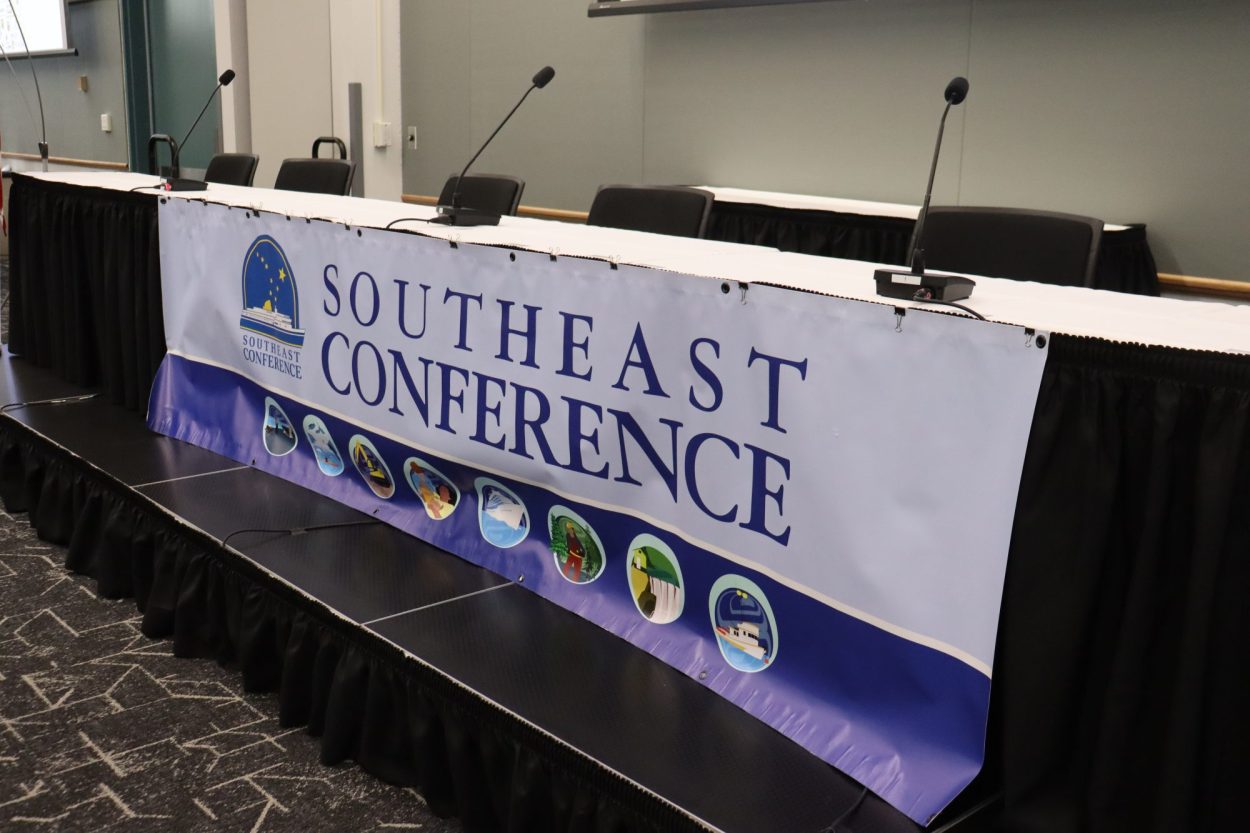
Southeast Conference’s annual economic summit kicked off Tuesday morning at the Ted Ferry Civic Center in Ketchikan. Industry heads, state employees and tribal entities are set to discuss Southeast Alaska issues ranging from housing, to fishing, to timber during the three-day conference.
Following a welcome address, representatives from Southeast Conference, the Alaska Municipal League and the Central Council of Tlingit and Haida Indian Tribes of Alaska discussed the state of the region. All highlighted the importance of working collaboratively to advance the region’s needs.
“I think we’re a very resilient region,” said Tlingit & Haida President Richard Peterson on Tuesday. “I think we’re in better shape because of our partnerships, and as we continue to work together, we will get through whatever hard times we’re facing.”
Peterson talked about the need for tribal consultation when regional decisions are made. He also spoke about Alaska’s upcoming gubernatorial election and the importance of voting. The conference hosted a gubernatorial forum with four candidates on Tuesday.
Nils Andreassen from the Alaska Municipal League, which services municipalities around the state, also talked about the resiliency of Southeast Alaska. But he said despite the strengths of the region, there also needs to be a more concerted effort to address affordability, livability and sustainability. He said that will require hard conversations.
“There is a lot of work to do to make sure that this is a region where people want to be and can afford to stay, and ultimately will be here for generations to come,” Andreassen said.
Speakers also spotlighted challenges the region faces. Southeast Conference Board President and Juneau City Manager Katie Koester said one of the biggest challenges for Southeast Alaska is natural disasters. She said partnering with state and tribal entities can help mitigate disasters, like Juneau’s annual glacial outburst flooding.
Koester said another regional challenge is aging infrastructure, which she said will require a lot of state investment. But, she said the region’s number one challenge is its aging population.
“This issue of aging demographics and slowly losing our population, just is, you know, death by a thousand cuts,” Koester said. “It’s something that needs to be the number one issue that we address as a region because we don’t have a future if we don’t have our children.”
She said shifting populations affect everything from schools to housing to job opportunities.
Panelists also talked about what they hope to get out of Alaska’s next governor. They mentioned increased investment in state government, more focus on island communities, and a governor who isn’t going to sue Alaskans over tribal sovereignty.
Southeast Conference will run through Thursday in Ketchikan.
Hunter Morrison is a Report for America corps member for KRBD. Your donation to match our RFA grant helps keep him writing stories like this one. Please consider making a tax-deductible contribution.