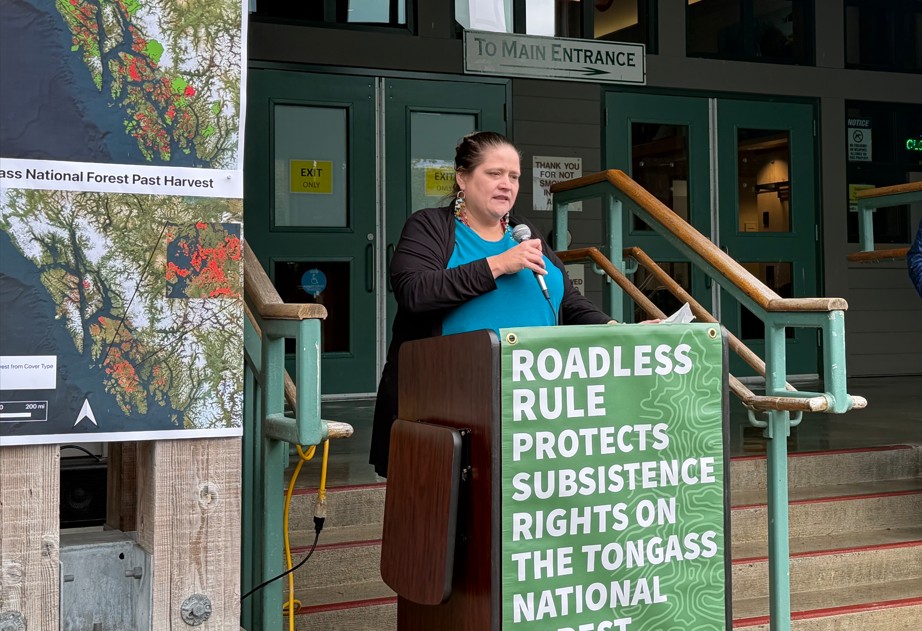
The United States Forest Service is holding subsistence hearings in Alaska after announcing the intent to rescind the 2001 Roadless Rule, a key environmental conservation law that protects much of the Tongass National Forest. If repealed, it’s expected to affect subsistence for people living both in the Tongass and in the Chugach National Forest. The United States Department of Agriculture — the Forest Service’s parent department — must hold a hearing if proposed actions are expected to impact subsistence living in the affected regions; a requirement of the Alaska Natural Interest Lands Conservation Act, or ANILCA. There are three in-person hearings for the repeal of the Roadless Rule.
At the Southeast Alaska Discovery Center Tuesday night, some tribal leaders said they worry these hearings are just the federal government following protocol and checking boxes, rather than including input in final decision making.
“We’re here making these comments again in continued good faith,” said Richard Peterson, president of the Central Council of the Tlingit & Haida Indian Tribes of Alaska, addressing Forest Service representatives at the hearing.
Peterson said he wants a positive relationship between governments and needs respect going forward.
“But I want to ask you a question: What worth is this good faith when you already took public comments, and 90% of them are against removing the Roadless? What is it really going to take?” he asked.
But Peterson said he knows the answer to his own question. It involves litigation.
“We’re gonna sue the hell out of you,” he said. “I promise you that.”
Peterson, among others, said the subsistence hearing was not a substitute for meaningful government-to-government consultation. Multiple tribal leaders, including Peterson, called for more engagement than the limited public comment provided.
Acting Forest Supervisor Janelle Crocker said at the start of the hearing she would limit public comment to two minutes to ensure everyone had time to speak. No one was cut off and most people spoke for more than two minutes. Crocker said she had no issue going over the two hours set for the hearing. But initially, at least six audience members pushed back on the time limit, saying it was too short to get vital messaging across.
The Tongass covers most of Southeast Alaska, but until last week, there were only two in-person subsistence hearings scheduled – the one in Ketchikan, and one in Anchorage. The Forest Service added an additional hearing in Craig, on Prince of Wales Island, for later this month. That’s scheduled to happen after the public comment period is over.
Gloria Burns, president of the Ketchikan Indian Community, said they requested tribal consultation twice over the Roadless Rule and have not yet received it. She said they’re not alone either — dozens of tribes have requested government consultation, and less than half of those requests were granted.
“No bad idea dies in the federal government,” Burns said. “And this is the most terrible idea there is.”
She asked what had changed since 2023, when previously repealed protections were restored for the Tongass, saying, at the time, the federal government seemed to value the sanctity of the forest.
“Nothing has changed but a president,” Burns said.
The feds have gone back and forth on the Roadless Rule for around a decade, and at some points have exempted the Tongass from protections. In recent years, the protections have swung in-step with changing administrations. The Trump administration announced its intent to rescind the law in early 2025, setting off a lengthy series of procedural actions required before any changes go into effect. Right now, the law protects nine million acres of the Tongass — nearly half of the largest national forest in the country.
Burns said the U.S. Department of Agriculture is shortchanging every process that is meant to protect the land — including the accuracy of the required analysis on subsistence use. The analysis the Forest Service used to evaluate potential impacts on subsistence is from before Ketchikan was designated as rural last year. That designation opened up substantially more remote land near Ketchikan for federally permitted subsistence use, including Prince of Wales Island.
Ketchikan residents have always been able to harvest under state guidelines. But they were restricted from participating in federally managed subsistence harvests since 1992, when the Federal Subsistence Management Program was first put in place.
That means until recently, people from Ketchikan couldn’t subsistence hunt or fish anywhere near their homes.
Ginger McCormick, a resident of of Saxman, said because of that, the land is in a different state than it was when it was last analyzed.
“We’ve only been in it for a year, and you’re already asking us why we need it,” McCormick said. “We’ve needed this. We’ve needed it, and as a matter of fact, the stewardship should no longer be there. If anything’s out there and it’s open land, trust land, everything, return it to the tribes like every other state, so they can run it appropriately, and we don’t have to have these inappropriate conversations.”
Repealing the Roadless Rule won’t just impact subsistence via increased logging, Burns said; it’s the trickle down effects of mining projects and road construction that will ultimately impact the salmon runs and the health of the land.
The USDA has said increased road construction will help with wildfire management. The decision also aligns with a broader push to stimulate logging and natural resource extraction in Alaska. Researchers have pushed back on the validity of wildfire risk in Southeast Alaska.
“When the rest of the United States has extracted everything they can extract, there is no place that the people of Ketchikan want to go,” Burns said. “We will live and die and starve here when you have killed our forest.”
Written testimony on the plan to rescind the rule is accepted until October 6. More information can be found on the Forest Service website. The next in-person subsistence hearing is at the Loussac Library in Anchorage on Thursday, Oct.1, at 5 p.m. Another hearing is scheduled at the Craig Tribal Association Hall on Monday, Oct. 26, at 5 p.m.