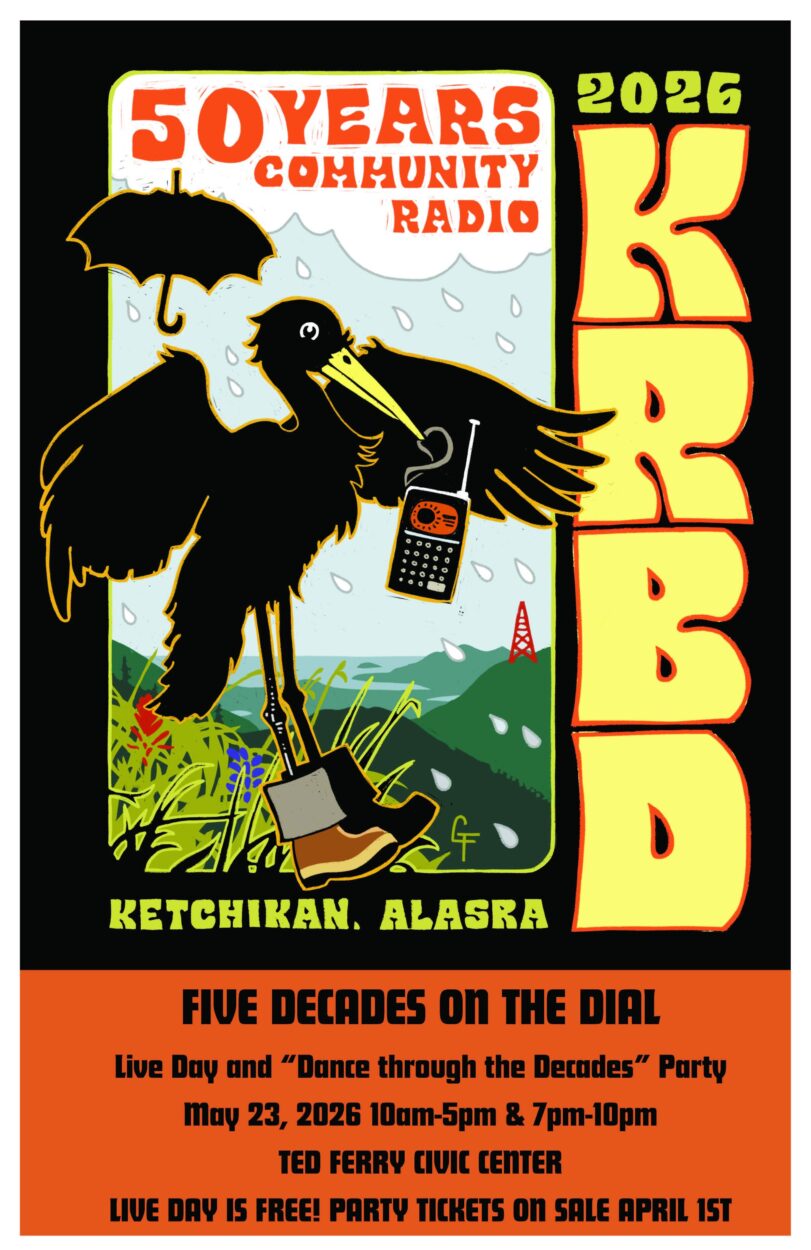
Join us in a walk through KRBD’s history!
Each week, Dave Kiffer is taking to the airwaves to share the story of 50 years of community radio in Southern Southeast Alaska. Miss the moment on the radio? You’ll find the radio spots and their transcriptions right here as they are aired.
And be sure to Save the Date for our Live Day & our 50 Year Dance Through the Decades Party and Costume Contest on May 23, 2026 at the Ted Ferry Civic Center! See you there!
KRBD History Moment #1
Early in 1974, a group of “radio aficionados” began meeting in a classroom at Ketchikan High School. Its goal was to form a public radio station in Ketchikan.
Ketchikan had had a radio station for nearly 50 years. But in the words of the early KRBD promoter Dave Donovan the new group wanted “variety.”
A core group formed a board of directors. Its early members were Virginia Klepser, Richard Yospin, Keith Stump, Tom Shackle, Tom Jacobson and Donovan. Jacobson was the only one with a Federal Communications Commission license.
Originally, the group wanted to name the station KBRD but that name was taken so it shifted to KRBD. It also considered an AM station because it would be easier to broadcast around the mountains. But it was decided to stick with FM, because it had a higher quality sound.
By December of 1974, it was time to hold a public meeting to spread the word about a new station in Ketchikan.
KRBD History Moment #2
On December 10, 1974, 50 people turned out for a public meeting to talk about KRBD.
The attendees were told that the station board had applied for both a station permit and the station construction permit from the federal government and hoped to go on the air around August 1, 1975. The KRBD board reported it had also applied to both the state and the federal government for funding for a transmitter and other equipment.
Of course, the timeline proved to be optimistic. Although the FCC approved the station permit fairly quickly, it was way behind on approving 10-watt education construction licenses. That second permit would not come through until nearly 11 months later.
By December of 1975, the fledgling station had found a space, in the bottom of the Marine View, and begun construction, which was mostly funded with a $32,000 federal grant.
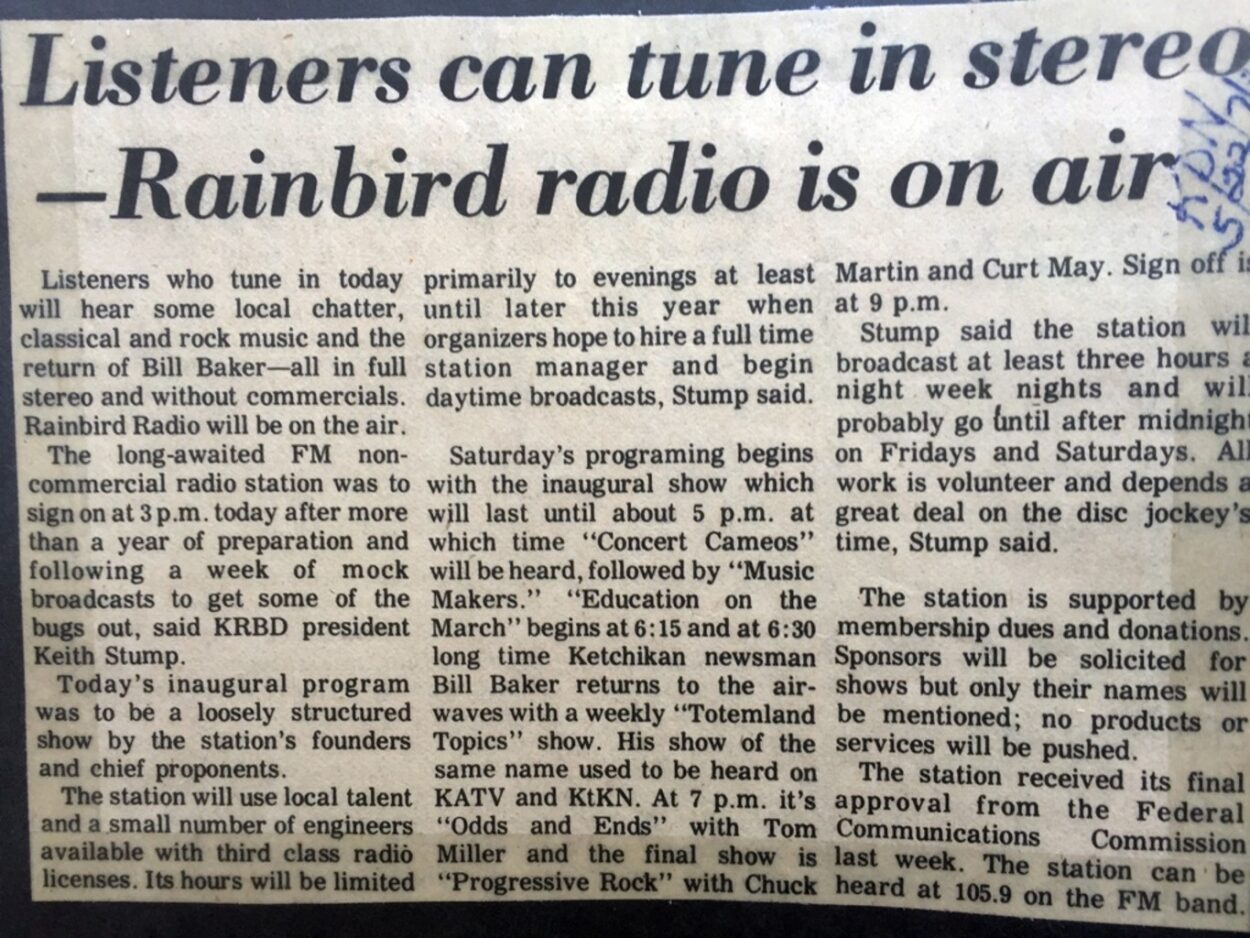
By April, it had begun doing test broadcasts. And in May of 1976, KRBD was ready to go on the air. For KRBD, I’m Dave Kiffer
KRBD History Moment #3
When KRBD went on the air on May 22, 1976, The schedule called for broadcasting from 6 pm to 9 pm. Keeping with the theme of “variety” there were rock, country, folk, and jazz shows. There was a cooking show, a religious program, a foreign language show, a Native history show, and legendary Ketchikan newsman Bill Baker brought his “Totemland Topics” to the KRBD airwaves.
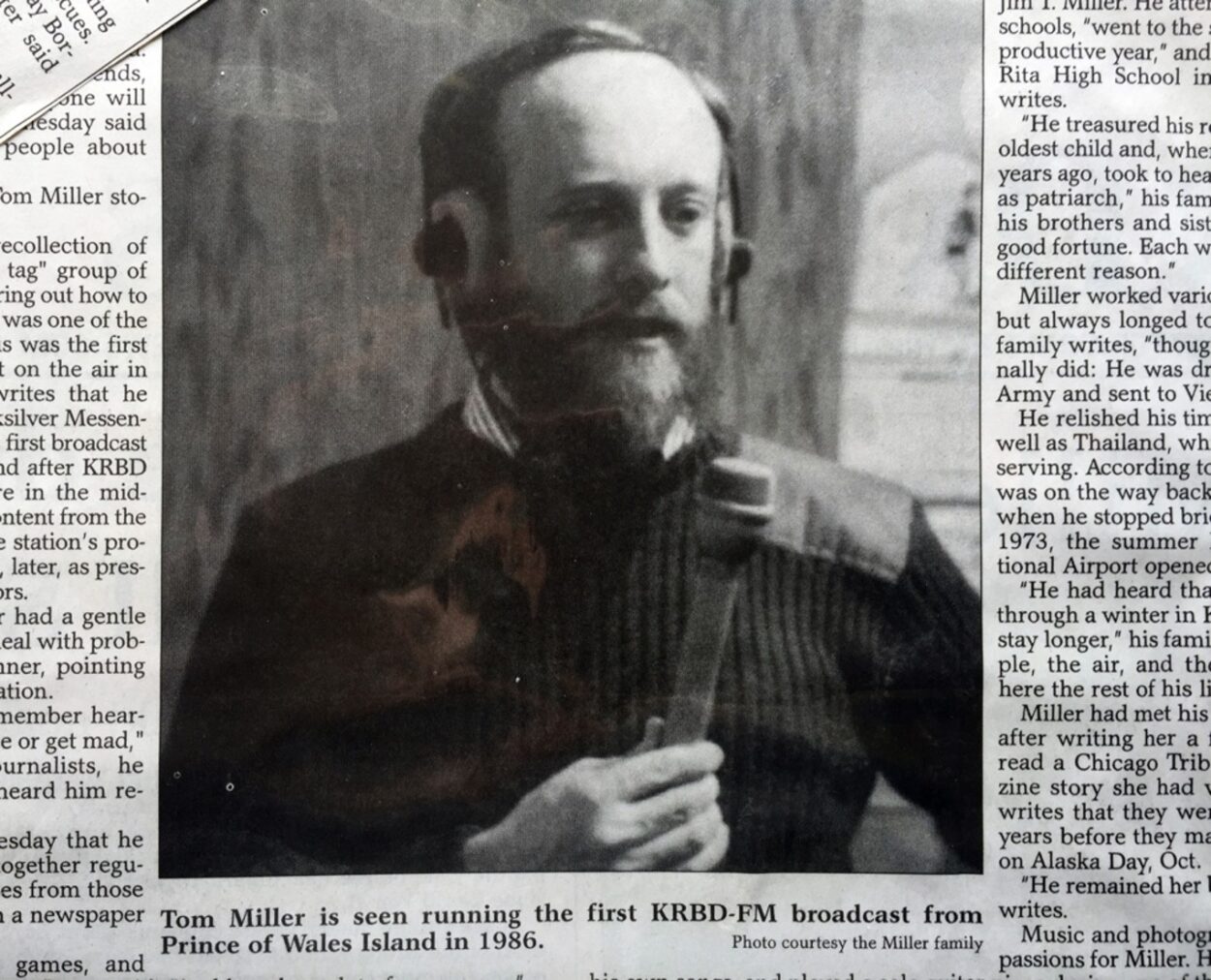
Tom Miller was the first “daily director” to go on the air. Other early KRBD DJs were Ed Blake, Jim Lutz, Jim Case, Bill Green, Richard Yospin, Claude Ostyn, Mary Jo Turek, Roy McPherson, Al Colyer, and Keith Stump. There were also high school students with shows including Bruce McKibbon, Lane Johnson, Curt May, Chuck Murphy and Dave Kiffer.
All the DJs had to pass FCC Third Class License tests to be allowed on the air, some also went ahead and passed the FCC First Class tests as well.
For KRBD, I’m Dave Kiffer
KRBD History Moment #4
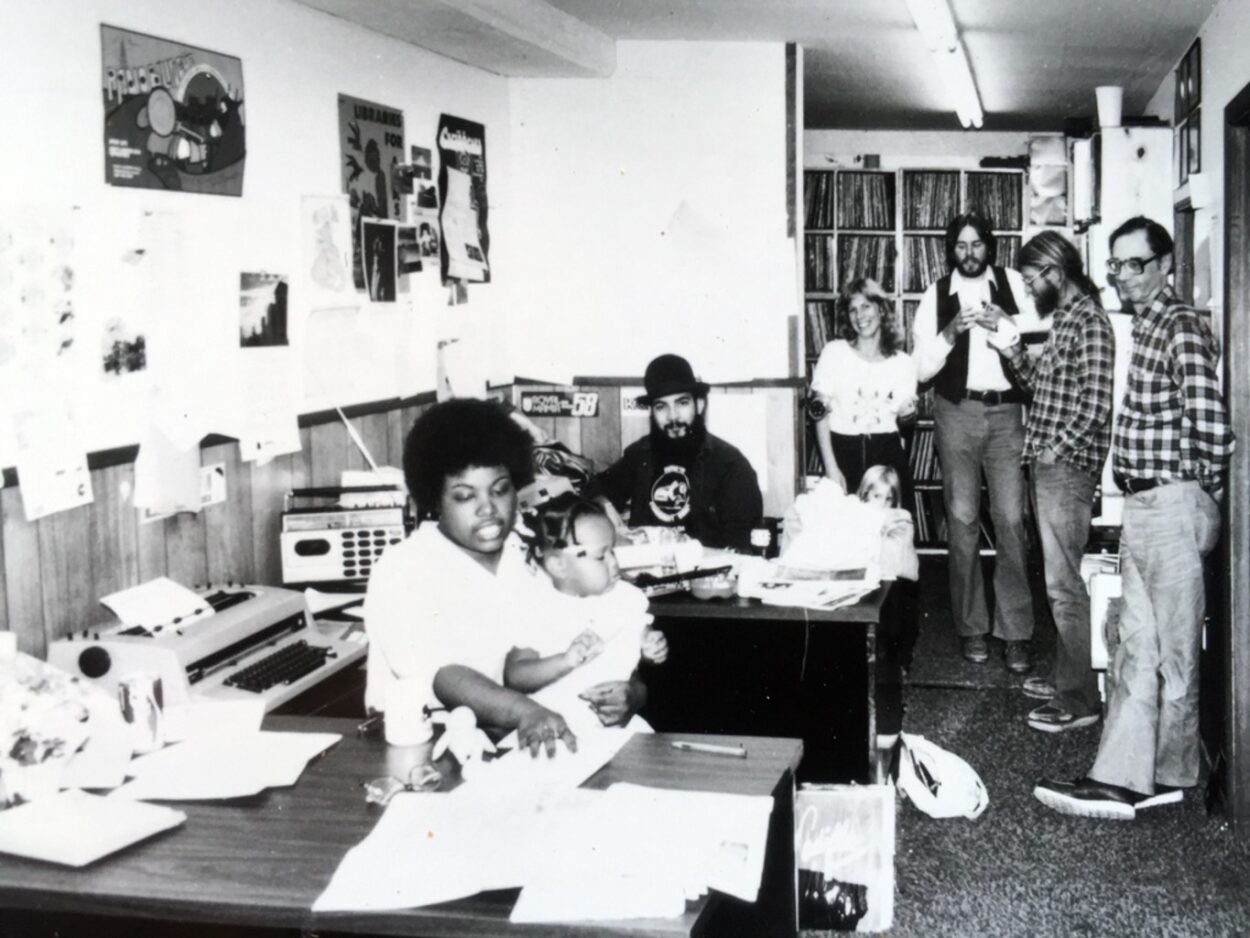
The first KRBD studio was in a 100-square foot space in the basement of the Marine View Building.
It had three rooms: An entryway, the studio, and a bathroom. The station’s 100 LP donated music collection was stored in the bathtub.
There are many stories about wild parties in the studio but there was barely room for two people at a time. In those days, KRBD was almost always a singular deejay sitting in a dark room spinning records and wondering if anyone outside was even picking up the tiny 10- watt signal from the rooftop transmitter which had been installed by Teddy Walters and Dave Henderson.
Sometimes, when the station was on the air, toasters and other appliances in nearby houses would buzz. Reportedly the signal could carry until it ran into mountains or went straight when the shoreline turned. People reported picking it up in Metlakatla and eastern Prince of Wales. But not regularly.
For KRBD, I’m Dave Kiffer
KRBD History Moment #5
A month after KRBD came on the air in May of 1976, it received a surprise visit from a Federal Communications Commission inspector. Not surprisingly, for a station run by volunteers, it fell short in a few areas. Although the inspector did not order the station off the air, the KRBD board decided it needed to make some changes.
Using money it had fundraised in the past year, KRBD hired two part-time employees. Phil Allred was hired as a technical director and Ed Blake was hired as a program director to make sure the station record keeping was up to snuff.
The board also cast about for its first full-time employee, a station manager. By fall, Bob Kern – who had been at KTKN previously – was hired. He would be the first of several KTKN employees to eventually make their way to KRBD including Jackie Erickson, Will Seltzer, Marty West, and Gregg Poppen, giving the young station a much need boost of professionalism to go along with the enthusiasm of the volunteer programmers.
For KRBD, I’m Dave Kiffer
KRBD History Moment #6
After a few months on the air, KRBD has outgrown its tiny space in the basement of the Marine View. The bathroom was now doing double-duty as a record library and an office. When a larger space on the 11th floor became available, the station moved upstairs. The space was large enough for a studio, multiple offices, and had a view that overlooked the Ketchikan waterfront.
More money was coming in from both the state government, courtesy of Ketchikan Representative Terry Gardiner, and the federal government, courtesy of Senator Ted Stevens. Stevens made it his goal to build a robust public broadcasting system in Alaska and KRBD benefited from his enthusiasm.
The biggest benefit was in 1978, when federal and state money paid for a new transmitter that boosted KRBD’s wattage from 10 watts to 3,500 watts, with another boost to 7,000 watts soon to come.
For KRBD, I’m Dave Kiffer
KRBD History Moment #7
By 1980, KRBD had grown significantly from its humble beginnings in 1976. It had eight staff members including a general manager, program director, office manager, music director, engineer, development director and two news persons. The volunteer rolls topped 30 with most having weekly shows.
It had also begun sponsoring community events such as a women’s history talk at Revilla High School, and local concerts from outside performers such as Tex Williams, Banish Misfortune, and Susan Shewan.
In addition to increased funding from federal and state sources, it started to hold local fundraising events, including a 24 hour live music marathon in which new pledgers were called “muggers” in honor of the new station mugs that were given away. The station in the Marine View was a hive of activity with KRBD’s morning and noon talk shows drawing large audiences.
For KRBD, I’m Dave Kiffer
KRBD History Moment #8
In late 1980, KRBD made another move. According to station manager Bruce Theriault, the station had outgrown its Marine View digs.
A new location was found in a building near Creek Street owned by the Turek family. KRBD would take up an entire floor at 716 Totem Way allowing twice as much space as before. The biggest change would be that KRBD would have production space for an additional studio, allowing it to produce more live events. Now on the schedule was KRBD’s first “live day” an eight-hour celebration of music, poetry, radio drama, and public interest programming. More than 70 people took part in the event.
KRBD continued to sponsor local concerts featuring such acts as Rambling Jack Elliot, Silly Wizard and Utah Phillips. It worked with the Alaska Humanites Forum to bring nationally known poets, Robert Creely and Richard Brautigan to Ketchikan. KRBD also began broadcasting regional high school girls basketball games.
For KRBD, I’m Dave Kiffer
KRBD History Moment #9
One of the most prominent bits of programming from KRBD’s early years was “live day” in which literally dozens of people would take to the airwaves to celebrate yet another KRBD birthday.
A good example was in 1982 when the live day schedule began at 7 am and ended 17 hours later. There was music, poetry reading, short plays, Native history, foreign language readings, a news show discussing an upcoming KPU bond issue, mother and child story time, yodeling, more poetry, and a concert from the Sons of Norway Hall featuring the touring folk-jazz-troubador band Banish Misfortune.
A veritable who’s who of locals took to the airwaves to help KRBD celebrate including Phyllis Almquist, Walt Matel, Kathy Stanton, Judith Anglin, Kate Martini, Kris Kuhns, Judy Jenkinson, Mary Jo Turek, Darrel Thomas, Ed Fisher, Paul Pirkl, Richard Yospin, Dave Kiffer, Peggy Giddings. Steve Shaefer, Ken Burton, Tom Miller, Dave Goodale, and Eric Hummel.
Although it was supposed to stop at 2 am, the live show continued on, making it a true 24 party for KRBD’s 6th birthday.
For KRBD, I’m Dave Kiffer
KRBD History Moment #10
In many ways, the heart of KRBD over the years has been its news programming. Early on, it was decided that providing another news and information source for Southern Southeast Alaska was crucial to KRBD’s mission. Over the years, staff has offered local break ins for national programming such as Morning Edition and All Things Considered. There have been local news shows in the morning, at noon, and in the evening.
There have also been talk shows and live local election coverage, as well as special programming geared toward important local, statewide, and national issues.
Perhaps most importantly for the community has been KRBD emergency coverage of things like weather and tsunami alerts. But even the fact that KRBD provides daily weather updates has been crucial to those who make their living on the local waters.
One of the more popular “information” offerings that KRBD has provided over the decades has been “Muskeg Messages.” The messages, which are part of the daily community calendars, allow members of KRBD’s far-flung audience to contact each other at times when more traditional avenues are not available.
For KRBD, I’m Dave Kiffer