About a mile down a gravel road in Saxman, south of Ketchikan, Ginger McCormick walked up to a tall, beige water tank. Height marks with dates and times were penciled into the side.
McCormick, who stands about five feet tall, pointed to one of them.
“You could see here, that’s probably as tall as me,” she said. “So we’re sitting right there on January 23, ‘25.”
The scribblings mark how much water remained in the village’s holding tank after their filtration system malfunctioned a few winters ago. At one point, it got down to three feet — which might be enough to last the village for a couple of days.
McCormick is the village’s clerk, but she’s taken an interest in water infrastructure. She said a water employee wrote the dates on the tank so they would never forget how low the water got.
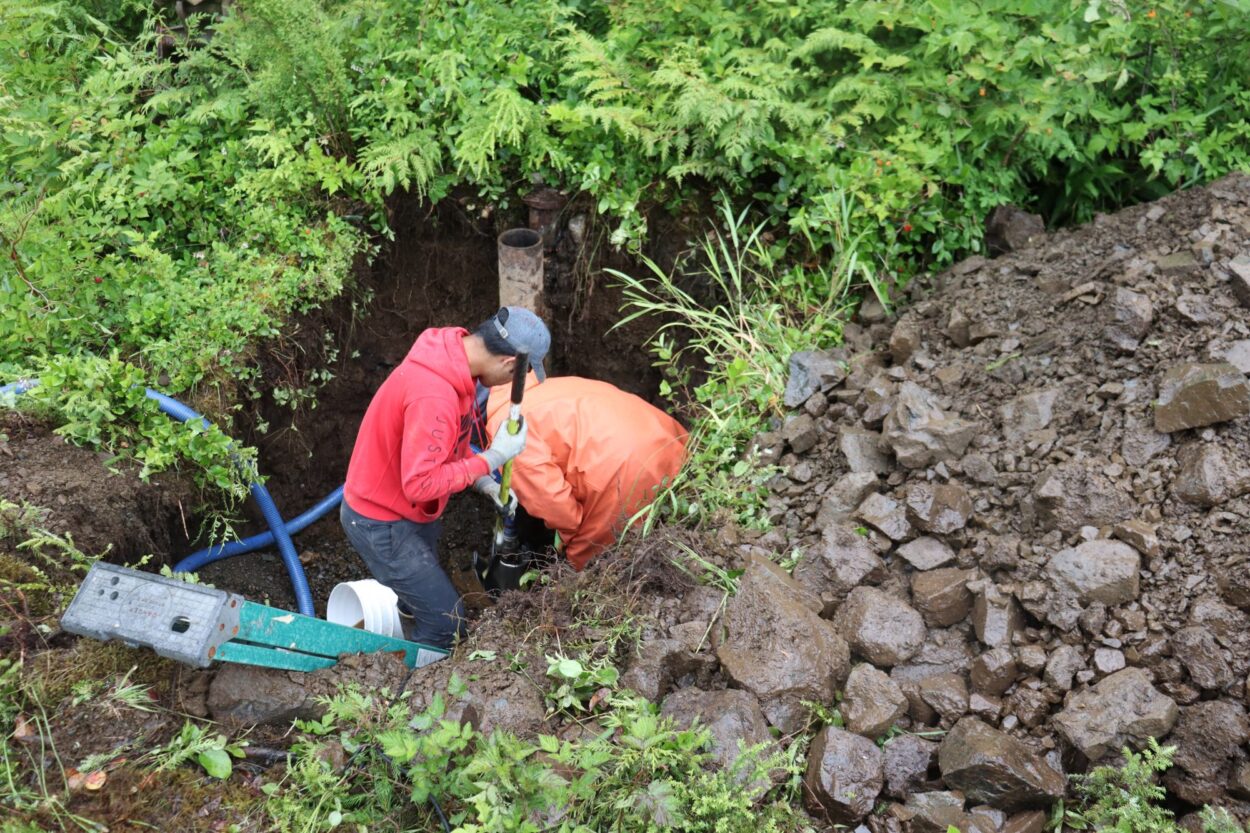
The filtration system isn’t even the main problem. The village’s water lines are plagued with frequent breaks.
“These are the pipes of our grandfathers. These are the pipes of previous mayors, previous city administrators, that maybe had too much going on. I’m not sure, but today, this administration’s fixing it,” McCormick said.
Fixing them is Saxman’s highest priority for capital improvements, but it won’t be cheap. It will cost the village of about 400 people millions of dollars.
Building without long-term planning
Most of Saxman’s water system is much older than the filtration system that malfunctioned. Many of the village’s water mains date to the late 1960s or early 1970s. Water lines in other southern Southeast Alaska communities are about the same age, and many of them are also failing.
Ori Miller, an engineer with Northern Utility Services in Anchorage, says a lot of those projects were funded by the Indian Health Service.
“The federal government poured a lot of dollars into the idea of bringing modern conveniences to all these rural Alaskan communities,” Miller said.
The former state employee helped write the American Society of Civil Engineer’s latest Alaska Infrastructure Report Card — which gave Alaska’s drinking water infrastructure a D+.
Miller said the original intent of these projects was for cities and villages to cover operation and maintenance costs after the lines went in. But he said that — for most of the country, as well as Alaska — there wasn’t really a long-term plan.
“We are basically facing 40 to 50 years worth of backlog of deferred maintenance that these communities have built up because this infrastructure was foisted upon them without really thoughtfully assessing whether or not they had the means to operate and maintain it,” Miller said.
A lack of resources and manpower
The report card says most urban utilities in Alaska are well funded, partly because they have more rate payers. But Miller said rural communities in Alaska often lack the resources they need to keep up.
The state’s Department of Environmental Conservation offers financial and technical assistance for drinking water infrastructure and improvements. The department also administers a fund that provides low-rate loans for water projects.
But the department doesn’t cover operations and maintenance expenses, and the needs of aging rural water systems outweigh the support that’s available.
Miller said small communities can’t shoulder the costs themselves.
“You only got a couple hundred people to spread out that cost over, and so that’s a big hit for everybody to share the load on,” Miller said.
Manpower is a problem, too. Rural water operators often have other responsibilities, like road maintenance and garbage collection. And hiring is a challenge for rural communities.
All of that takes a toll on water systems. The report card says a lack of skilled operators has caused village water systems to deteriorate faster. They sometimes need complete overhauls years ahead of their design life.
And the report card points to another problem. It says investment in water systems has disproportionately favored building new infrastructure over maintaining the old.
“When you do that, really all you do is kick the can down the road, and meanwhile dig yourself into a deeper debt hole while doing it,” Miller said. “It’s a national crisis.”
Miller said that’s nothing new. Nationwide, investing in new infrastructure has beaten out maintenance for nearly 100 years.

Back at the water holding tank in Saxman, Ginger McCormick pointed to some handwritten dates that mark a time when the village’s water supply got very low.
“You could tell for almost a good, solid two-three weeks, we’re sitting at about three to five feet.”
The community went through a nearly month-long boil notice.
McCormick said the village hopes to replace all of its aging water lines in the next five to ten years. In the meantime, keeping the water running will take a group effort from the village’s staff.
This is the second installment in a three-part series. You can read the first story in this series by clicking here.
Funding for this series was made possible by the Alaska Center for Excellence in Journalism.
Hunter Morrison is a Report for America corps member for KRBD. Your donation to match our RFA grant helps keep him writing stories like this one. Please consider making a tax-deductible contribution.